According to Lincoln Center's new LCT3 project at its slogan, it takes "New Audiences for New Artists." It also takes new critics, hence the establishment of Theater Talk's New Theater Corps in 2005, a way for up-and-coming theater writers and eager new theatergoers to get exposure to the ever-growing theater scene in New York City. Writers for the New Theater Corps are given the opportunity to immerse themselves in the off-off and off-Broadway theater scene, learning and giving back high-quality reviews at the same time. Driven by a passion and love of the arts, the New Theater Corps aims to identify, support, and grow the arts community, one show and one person at a time.

Saturday, September 30, 2006

'nami

While everybody worries about the violent disasters of the world, Chad Beckim has put his finger on the pulse of an urban catastrophe. In 'nami, he explores ghetto life and working-class insanity (literally) and, aided by a talented cast and a gifted director, puts on an entertaining show, too.
---------------------------------------------------------------------------

Reviewed by Aaron Riccio

Why is Chad Beckim going back to school for an MFA in '07? He's already co-founder and co-artistic director of the intriguing theater company Partial Comfort Productions, and his new show with them, 'nami, is a substantive showcase of urban life and social struggles. Beckim's material is intellectual, but written with the authentic voices of the working class: 'nami is more immediate and dramatic than some of the stuffy, sterile scripts that other companies put out. While not yet an epic writer, Beckim is on his way towards becoming a modern Odett (or an urban Shepard), and director John Gould Rubin shows a masterful vision (and love) of theater.

Heather Wolensky's set features a battle-scarred sofa, grimy windows, once-white curtains, and a lonely hanging ceiling fan. It looks and feels like a prison, and that's how it's used. For Lil (Eva Kaminsky), a mentally imbalanced woman who celebrates her fifteen-year anniversary by sleeping on the floor in her wedding dress, it's where she waits for her husband, Harry (Mark Rosenthal), to tell her what to do. For Roachie (Alfredo Narciso), it's a place he's always itching to leave, and for his girl, Keesha (Quincy Tyler Bernstine), it's a place to crash between double-shifts at a local McDonald's. It's the type of place where failing to pay the rent might make the local drug-dealing pimp cum slum lord, Donovan (Michael Gladis), force you to harbor a four-year-old girl while he tries to sell her into sexual slavery. It's a deus ex machina that comes early in the play and goes explored, but it gives us a reason to watch these lively characters, and Beckim doesn't leave a dull moment. If anything, there's almost too much action in the second act, but that's hardly a complaint, just a gasp for breath. (Violent, too, thanks to Qui Nguyen, the fight choreographer.)

Though there are two apartments, director John Gould Rubin uses the same set for both, which emphasizes the equally dismal circumstances of both couples. He also chooses to stage the transitions, too, using choreography to move the characters in and out of each other's scenes up until a climactic moment where two scenes take place simultaneously, yet separately. Good as Beckim is, he owes much to Rubin for tightening up the logic of the play. Eva Kaminsky deserves some respect too: her role as the often-hysteric (yet believable) housewife occasionally lapses out of character, but she keeps it in check. (About the abortion-they-don't-talk-about, she suddenly screams: "Strap me bare like some abandoned mine shaft.") The rest of the cast is excellent, particularly Quincy Tyler Bernstine, but their dialogue is more consistent.

'nami doesn't have an agenda, or a message to portray, and because of that, the work is entirely character based. People rise, and people fall, and watching our struggles through their struggles is a part of how great theater can pull us up from our lowest lows.

Tuesday, September 26, 2006

Songs of the Dragons Flying to Heaven

A show that's cracked up on purpose, Songs of the Dragons Flying to Heaven is an identity crisis in crisis, one of the few "wrecks" worth seeing. It needs polish and an emotional hook, but for now, it's enough to watch an artist (un)tie things together.
-----------------------------------------------------------------------------

Reviewed by Aaron Riccio

Songs of the Dragons Flying to Heaven is a show born of confusion: a Korean-American narrator (Becky Yamamoto) is trying to come to terms with her culture, and winds up losing herself even more in a messy, experimental play. Given that the disconnect is purposeful and that Young Jean Lee succeeds in confusing the message and both discomforting and cracking up the audience, this is one of the few "wrecks" worth seeing. However, while hybrid theater is different from, say, a hybrid car, this show could've used a light tune-up: exploring artistic possibilities is nice, but improving on them is nice, too. The comedy works, but Yamamoto's dramatic confession isn't believable, nor is the final scene's test-tube emotion (i.e., emotion generated by the circumstance rather than the character).

So okay, the characters--a sardonic Korean-American, a trio of giggly Koreans, and two deadpan White people--become tools of the director's expression rather than living beings. That's not a terrible thing. But the show is so focused on disconnecting things--a task which the myriad forms of theater helps to accomplish--that at times it makes the text monotonous. Young Jean Lee tries to escape into her dozens of scenes (and her violent cultural satire), but the shallow emotion makes the work unpolished: more performance than performance art.

The other place that Lee's direction lags behind in is the use of space. The audience enters through a narrow corridor of traditional Chinese mythological paintings, illuminated by the subtle glow of green, white, red, and pink paper lanterns. We turn a corner and walk over a carpet of pebbles, only to find traditional seating on the other side. Eric Dyer's design is fantastic--his set looks like a modernist's dojo, all bare wood under the stark glare of several thin bars of light--but all that beautiful space, onstage and off, is wasted. The play addresses much of its commentary to the audience--particularly the non-minorities--and the message would be more confrontational if the audience weren't so insulated.

Unable to refrain from explaining the show's message, at one point Lee has a hyper-modern version of the classic Greek chorus appear. Dressed in silk robes, they interrupt the middle of a scene between the two White outsiders to pronounce--in unison--that they don't know what the show's about, and that they don't know what the two White people are in it. After some exposition, the Korean actors leave, and the White actors, as if nothing has happened, start their scene over again, a lengthy-one act that begins like David Ives' start-stop-and-repeat piece, "Sure Thing," and ends like some of John Patrick Shanley's early, relationship-scarred work (think "Women of Manhattan"). When the two finally agree to get psychological help, Songs of the Dragons Flying to Heaven ends--on a note totally unrelated to the show (though that assumes there is a "show").

Sure, there's missing emotion and a lack of polish, but this ending is a brilliant way to (un)tie things together, and for whatever else Songs of the Dragons Flying to Heaven might be (or try not to be), it's an entertaining piece.

---------------------------------------------------------
HERE Arts Center (145 Avenue of the Americas)
Tickets (212-868-4444): $18.00
Performances: Thursday-Sunday @ 8:30

Monday, September 25, 2006

FRINGE 2006 (Encore): Perfect Harmony

Here's a case for all things cute, cheesy, and cheery. Perfect Harmony is a show of eccentric characters with more eccentric problems, united in the quest for one shining moment of perfection (the a capella high-school National title). Ridiculous as that sounds, it's more ridiculous in performance, which makes this the most delightfully low-budget (semi-)musical since 25th Annual Putnam County Spelling Bee.
--------------------------------------------------------------------------------

Reviewed by Aaron Riccio

At last, a show that recognizes a capella for what it is: "a cult of pressure and perfection." Just as The 25th Annual Putnam County Spelling Bee took a cute, musical approach to a somewhat geeky field, Perfect Harmony has arrived to make high school a capella cool again. Or at least something that you can laugh with, not at. (Full disclosure: I was a high school a capella-ist.) The fact that this was a workshopped play means that it plays for the laughs, and riddles the characters with superficial problems that make them both easy to identify and full of easy humor. What's surprising are how good so many of those jokes are, and how the confessional monologues actually work their way into the show. What's more, beneath the cheesy songs (actually the weakest part of the show) and riotous humor, there's an actual plot that explores friendship, competition, and whether or not art has any place in music anymore. This is not a perfect play (much as that'd help my tagline) but it's close: a PG-rated, feel-good, semi-musical blast.

The story follows the misadventures of two rival groups as they approach the Nationals: the unbeaten men, The Acafellas, and the ditzy yet talented women, The Ladies in Red. Scenes cross back and forth from each group's side of the stage, and toward the end of the play, the groups begin to collide. Half of the ten-person cast also double as "members of the greater community" who advance the plot while providing even more comic relief. This not only keeps the audience on its toes but also displays the range of actors like David Barlow and Marina Squerciati, and keeps the show moving at a lively pace.

A rundown of all the terrific jokes (there's one about genealogy that involves a certain Phillip Fellowes the Fourth the First) or all the brilliant characters (like J.B., a quarterback turned a capellageek and his sister, Valerie, who can't stand being looked at) would take far too long. That would be an injustice to the show, a zippy in-and-out affair that doesn't squander a second. Director Andrew Grosso (who created the show with The Essentials) knows enough about a capella to keep it moving and though the stagecraft is still a bit bare bones, there are enough tricks (like Simon Depardieu's appearance from the audience) to remind us that he's trying.

During the show, Lassiter A. Jayson III, the polo-wearing, pitchpipe-playing perfectionist of the group makes the argument that "good art makes people uncomfortable." I agree, but after seeing Perfect Harmony, I'd add that the best art is that which makes uncomfortable people smile.

Sunday, September 24, 2006

FRINGE 2006 (Encore): Billy the Mime

When the highbrow art of mime meets the lowbrow art of shock comedy, you'll cringe and you'll titter. But that's all Billy the Mime brings to the table, and it's a threadbare meal.

----------------------------------------------------------------------------------
Reviewed by Aaron Riccio

Pantomime is the closest thing to a universal language. At the essence of this art, the human body can bring out, through exaggeration, the invisible truths of the spirit. At its most commercial, which is what Billy the Mime strives for, it can bring out, through exaggeration, the societal flaws of a culture. In a series of five-minute-long acts, Billy (the Mime) covers the current (“A Day Called 9/11”), the historical (“World War II”), and the obscure (“A Night in San Francisco: 1979”). Most of these are recognizable, even to a 22-year-old anti-culturist like me.

You can’t call Billy’s material tasteless, though it prides itself on the same shock value as South Park (it’s no surprise that both appeared in the crass documentary The Aristocrats). It’s as hard not to laugh at the parodies of Anne Frank or a priest and altar boy as it is not to be offended by them. Cringe or not, it’s an innovative adaptation of high-profile issues.

Social mores simply can’t hide from a good mime. In “A Romance,” Billy the Mime uses his two hands as puppets that first fight, then start to seduce each other, then—after applying a latex glove—start to fuck. Granted, it’s not very subtle, but neither is our culture, and that’s his material. Besides, the baser the subject matter, the more obvious it is to the audience, which is why bulimia is so recognizable (even if Karen Carpenter is not). “The Abortion,” in which Billy plays the patient, doctor, and fetus, manages to say so much more on the subject than the millions of words op-ed writers have expended on the subject.

Content aside, the mime isn't pure: music accompanies each scene and a few use props, but desperate times call for desperate measures and Billy uses the innocence of clowning to make the public writhe uncomfortably, even as they laugh. One can’t look away (without missing the act), and with nothing but subtext, the mind is forced to draw its own conclusions. This does lead to a lot of downtime between numbers, and a lot of repetition within them. For a seventy-minute show, a great deal of it rests on the physical control of Billy, something that, due to the political content, we don’t actually see all that much of.

In the end, Billy the Mime is an entertaining diversion, but it’s lacking a substantive force to affect the audience. And maybe that’s all clowning is—but pantomime is one of the oldest arts out there, and it ought to do more than make us occasionally giggle.

Thursday, September 21, 2006

FRINGE 2006 (Encore): Broken Hands

Reviewed by Aaron Riccio

Broken Hands is a fantastic drama that uses boxing as a jumping-off point to explore family ties. Skipping theatrically between past and present, the show pulls no punches as it builds in intensity to a painfully good climax.

Photo Courtesy/Neilson Barnard

Shrouded in a darkness, a man with bandages around his hands stands on a bridge, peering off into the dark and unforgiving waters of the Thames. His brother, a well-groomed shyster, climbs up to join him, holding onto a gun as if for dear life. He appears out of the shadows like a ghost, and fades back into them like a ghost, which is for the best, for he is a ghost, and the man on the bridge, a boxer, is haunted. Moby Pomerance's striking drama, Broken Hands, is haunting, too: Cory Grant and Eric Miller have such a profound and nuanced relationship that we hate to see anything bad happen to it. And though Pomerance puts the end of the play at the beginning, he handles the theatrical jumps between past and present so effortlessly that one forgets, at times, where it's all going. The credit doesn't belong to anyone in particular: the actors make us forget that we're watching a play, the smooth writing helps the actors forget that they're acting, and Marc Weitz's smooth direction helps everybody forget that there's a world outside the theater. Jay Ryan also deserves credit for his elegant palette of lighting (and his efficiently simple one-piece set): after all, the play only won the Fringe awards for Best Actor (Grant) and Outstanding Playwriting (which it shares with The Catharsis of Pathos), and everybody involved in this show deserves a round of applause.

Broken Hands uses metaphor, action, great storytelling, and clear dialogue (with spot-on British accents) to relate the story of two brothers torn apart by Mick's inability to communicate (he's retarded) and George's inability to stop dreaming. Neither plays to a stereotype: Mick is childish, but he's also a boxer and is hence far from powerless and George, if anything, is more like the Tennessee Williams archetype of a man lost to his own inevitable machinations. Both are equal parts charm and menace, though the latter always comes as a surprise (which speaks well of the play's construction).

Performed without intermission, the show slowly builds to a powerful and cinematic climax, the moment at which Mick's past can no longer protect him from the present. To use the oh-so-applicable pun, this final scene pulls no punches, and the effect can't help but hit you like a ton of bricks. Here is a man who has suffered so much adversity, who works so hard just to communicate, only to be denied the thing he loves by a man who cares nothing so un-valuable as family. These brothers, betrayed by the world and each other, manage to calm each other from opposite ends of the bridge that is the set, and they reach out across it, but their love does know a boundary--death, and that is a ghost that cannot be shaken free.

"Fizz" is the Real Thing - or close to it

Review by Elizabeth Devlin

A crazy, entertaining romp through culture and commercialism, “Fizz” tells the story of a Cuban chemist turned Coca-Cola CEO, rocketed to Cola stardom by creating Diet Coke, and becoming a national target after he introduces New Coke.

The Cola wars are presented in delightful parody, with Pepsi execs portrayed and uber trendy underworlders and Coca-Cola merchandise treated as American artifacts. The outraged reaction to New Coke is not far off the mark: from angry letters to picket signs, one reading “Our children will never know refreshment!”, we are reminded how seriously this nation takes our soft drinks.
At its best (meaning the first act), the sharp dialogue and n-point acting draws you into this absurd setup, and makes you laugh while doing so.
The second act suffers from an odd sub-plot involving cocaine, a Rockette and cola formulas. The dream sequences take us away from the characters we actually care about. In the end however, all is as it should be: sugary-sweet with a touch of irony.
Inconsistent though the writing may be, Bryant Mason as Roberto is sincere, charming, and believable. Cheryl Lynn Bowers as his girlfriend Trixie, gets to show off her formidable comic talents. The rest of the ensemble cast plays multiple roles extremely well, and plays off one another in a rare, truly gratifying way. Even the most absurd moments become believable due to excellent acting and directing.
Fizz is definitely worth seeing, and will surely make you crave a Coca-Cola.

“Fizz” at the Ohio Theatre
Through September 30
Tuesday through Saturday at 8pm; Sunday at 7pm
No Performances 9/24; 9/26
General Admission $18
Tickets: www.ticketcentral.com / (212) 279-4200

Monday, September 18, 2006

FRINGE 2006 (Encore): The Deepest Play Ever: The Catharsis of Pathos

Everything you love about theater and more, The Deepest Play Ever is deep like a delicious slice of deep-dish pizza or a thick slab of pie, that is, it's good all the way down. A slick, swift comedy, the play mocks everything from Brecht to violence to zombies and back: and it's one wild, thrilling ride.

Reviewed by Aaron Riccio


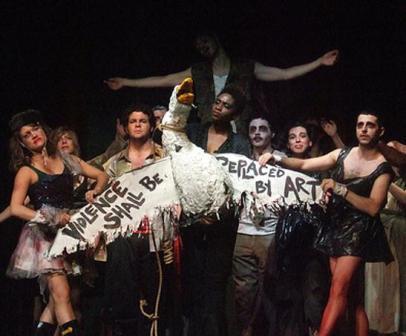
Ever see a high-brow fart joke before? Let The Deepest Play Ever: The Catharsis of Pathos, for which Geoffrey Decas won the 2006 Fringe award for Outstanding Playwriting, show you some dancing zombies rip people to shreds. Though one could easily imagine an entire play dedicated to musical numbers involving zombies and the post-post-apocalypse of World War V, Decas's script goes way beyond easy laughs: it parodies Mother Courage, for one, on Brecht's intellectual level. If anything, the cheap laughs are there to make sure there's something for everyone: the play is so overwhelmingly full of meaning that if you blink, you'll miss something.

The satire operates as ironic allegory about the endless cycle of violence and warns against the destruction of art. Or the parody operates as a violent attack on the endless cycle of ironic allegory. Or something: just know that Mother LaMadre is pushing a cart from scene to scene, aided by Time as Narrator, abetted by her cadre of children (the retarded KitKat and beloved Golden Calf), and hindered by the villainous Dalvador Sali. Oh yeah, and Mephistopholis, Delilah, Persephone, et. al. show up too, for shits, giggles, and well, mostly giggles. Accents? We've got those too: the subtly Irish Swiss Cheese, the over-the-top French prostitute, Yvette La Guerre, not to mention the styled Britishcisms of most of the cast. The dramatic overtones, the hushed whispers for emphasis, every stylistic nuance of theater gets represented here.

The trick to The Deepest Play Ever isn't that Decas managed to cram so much into his script, or that Ryan Purcell managed to justify all of it in the direction, or even that Boo Killebrew made it look so pretty through the choreography. It's that it all works, on so many clever levels: an astonishing feat of what a dedicated theater group (CollaborationTown) can accomplish. A bunch of curtains get stretched across the wooden O (read: the stage) to transform the scenes, the delightfully glib performance of Phillip Taratula (as Time as Narrator) segues between them, the puppetry of Golden Child and Mephistopholis keep us on our toes, as do the dancing and singing ensemble and the accusatory multimedia ("Is your heart a dead acorn of filth, human? Well, is it?"). Fantastic, enjoyable theater: watch out for Decas and CollaborationTown.

Sunday, September 10, 2006

Iphigenia Crash Land Falls On the Neon Shell That Was Once Her Heart (A Rave Fable)

An dazzling but disaffecting multi-arts interpretation of Greek myth, Iphigenia Crash Land Falls... is the result of aesthetics overwhelming substance. It is a confusingly poetic show that, once in a while, surprises you with a moment of innovative beauty.

Reviewed by Aaron Riccio

Iphigenia Crash Land Falls on the Neon Shell That Was Once Her Heart (A Rave Fable) is, in case you can't figure it out yet, a hypermodern work. What's less obvious from the title is that it is a multimedia adaptation of the Greek myth of Iphigenia (pronounced IFFY-IN-YA). Don't worry, that's even less obvious in the presentation: a ragtag bunch of scenes, solidly yet ambiguously performed by the One Year Lease company, a group determined to find ways to revitalize the classics. But this is shock therapy, and this production is almost too extreme to be likeable. It's easy to admire James Hunting's stunning set: televisions lie among cinderblock ruins and characters descend down metallic platforms and cross a dust-covered floor till they rest against a corroded steel fence that leans, like an abandoned anachronism, against another wall. It's a lot harder to extract anything from the text, drowned in metaphor and performance as they are. The word that best comes to mind is "abandon," both as in "the glory of reckless abandon" and as in "abandon all hope, ye who enter here."

Personally, I can't hate a play with lines like "lick the scabs off those valentine lips" or "shake loose that bad-luck piñata that rains down on me." Caridad Svich's words are exquisite. Her play is not. The presence of the media (those scattered TVs come with a news anchor) is not a sustained enough, and segments with the Virtual MC, while striking, are just fever dreams in the night. The physical use of space, coming from the double direction of Ianthe Demos and Danny Bernardy, is excellent, and when the play focuses on a microcosm of emotion, as in the scenes between doomed Iphegenia and her lover, Achilles, the show becomes truly theatrical.

ICLFOTNSTWOHH(ARF) is an experience, but it's not provocative enough. It is dispassionate and reserved. In the original, Agammemnon sacrifices his daughter, Iphigenia, to appease the gods. The parallel here is that now her father, Adolfo, is a dictator general, murdering her for political gains. It's a powerful point, but the show seems more interested in painting a pretty picture than a poignant one, and whatever pop there was to this show, the result is more than a little flat.

------------------------------------------------------------------------------
Walkerspace (46 Walker Street)
Tickets (212-352-3101): $15.00
Performances (to 9/16): Tuesday-Saturday @ 8:00 & Saturday @ 3:00

Friday, September 08, 2006

FRINGE 2006 (Encore): The Infliction of Cruelty

Reviewed by Aaron Riccio

Pinter meets Cruel Intentions. In a good way. The kind of way that makes you really like a bunch of people, and then really hate them. And then fall in love with them all over again. Remember when shows were about characters? See The Infliction of Cruelty.


The Infliction of Cruelty is a smart play about secrets, big secrets. It's a glossy, sleek affair for the first act, filled with the kind of quote-lobbing games you'd expect of Tom Stoppard. In the more mature and plot-driven second act, the characters finish the games and unleash the drama. Too elegant for the harsh honesty of Neil Labute, the play could be Pinter's take on Cruel Intentions. The erudite yet emotional writing (Andrew Unterberg and Sean McManus), the natural direction (Joel Froomkin), and the outstanding ensemble: what more does it take to get off-Broadway?

The only barrier The Infliction of Cruelty faces is that it's the quintessential highbrow play. The father's a famous composer, the mother's a famous psychiatrist, the children are extremely intelligent, handsome, and witty (and, of course, far too smart for their own good). They sit down and quote both Emily and Charles with ease, they go into the merits of free-associative therapy, and they might as well be George and Martha's children for our purposes. The deep secret that's reunited this "Pascal triangle" of siblings is that after fifteen years, they're finally ready to stop punishing their father for having an affair with his sister-in-law. Well, almost. The eldest (and brooding-est), Thomas, is having second thoughts, much to the chagrin of the well-rounded, charming Jonathan, and their sister, Prussia. As for Benjamin, the youngest: he doesn't know yet -- but his girlfriend Zoe just overheard the truth, so he's bound to find out about the infidelity and the horribly subtle punishment by Act II.

There's a lot of character development and exposition, but it's so damn clever that it just rolls into the silver-tongued pacing. And yes, while everybody's smart, they're not smug: Holter Graham, for instance, is one of the most likeable and natural actors I've seen. The whole cast's chemistry is superb: it's as easy to believe their familiarity as it is to enjoy it. Normally, I'd make a bad pun here that worked the title into my tag-line, but the play is verbal enough without me adding any wordplay. Go see The Infliction of Cruelty. It's a great play.

-----------------------------------------------------
The Hypothetical Theater @ The 14th Street Y
Tickets (212-279-4200): $18.00
9/10 @ 10:30; 9/12 @ 4:30 and 9:30
www.theinflictionofcruelty.com

Thursday, September 07, 2006

FRINGE 2006 (Encore): I Was Tom Cruise

Reviewed by Aaron Riccio

I Was Tom Cruise
doesn't feature classy writing, and it doesn't attempt a potent plot. Why should it? It has a Tom Cruise lookalike (and a Kate Holmes, Joaquin Phoenix, and Oliver Platt). That's vehicle enough, right? Alexander Poe's script and well-intentioned direction (with Joseph Varca) is just there for the ride. But the play itself is a slow ride without Jeff Berg (Tom) onstage, and even then it's still pretty turgid. It points out the shallowness but doesn't poke fun at it; that makes I Was Tom Cruise little better than the real thing.

Berg gets some mileage from the Twilight Zone-ish premise that Tom Cruise is just a sack of flesh inhabited by luckless saps (ala Face/Off): a means to polarize the Scientologist movement. Though he doesn't change outwardly, Berg presents some subtle differences (especially toward the end) between Tom, the "original" Cruise (cockily ethereal) and Frank, the "replacement" Cruise (insecure and lonely). Too bad every other character is scenery. Gideon Banner (Frank), acts like a one-dimensional Seth Myers (who is already one-dimensional), and Victoria Haynes (Frank's wife, Paula) just goes increasingly over the top. The rest of the large ensemble cast--for lack of anything better to do?--plays it even bigger: the show becomes a parody not just of pop culture, but itself.

Is it funny to watch people make fun of Tom Cruise? Sure. But when you pay money to watch people make fun of Tom Cruise, and you sit in a cramped seat for ninety minutes, and you leave the theater giggling a little, perhaps, but otherwise completely unaffected--who is the joke on?

FRINGE 2006 (Encore): Diving Normal

Reviewed by Aaron Riccio

Ashlin Halfnight's contribution to the 2006 Fringe Festival, Diving Normal, makes two things abundantly clear. First, that the playwright deserves his Fulbright Award. Second, that this playwright has just graduated Columbia's MFA Playwrighting program. Halfnight has an excellent command of character, and a distinctly theatrical sense--like Albee--of the heartwrenchingly compelling. However, he lacks an even temperament: some of his lines are playfully cheap and the narrative build suffers from uneven pacing and focus. Diving Normal is a pleasure to watch, but it has too much splash to be a perfect dive.

Though the play is ostensibly about the budding relationship between Fulton, a geekily hip writer, and his high-school crush Dana (a pill-popping, pain-addicted dream girl), the real story is about Fulton's neighbor, Gordon, a mildly retarded library technician. Calling this the world's "most unlikely love triangle" is a disservice to Halfnight's writing: the way he builds on the loneliness of each character makes the end result not just inevitable but understandable. He uses an abundance of ill-explained devices to get there, but the strength of his characters overwhelms the niggling, unresolved questions and the sudden, expository outbursts.

Diving Normal won the "Best Ensemble" award from the festival, but Jayd McCarty, who plays Gordon, is the soul that holds it together. It takes real skill to show awkwardness without becoming a one-dimensional version of it. (This is the trap Josh Heine, who plays Fulton, falls into when the script gives him a cheesy line, or the direction strips him of action.) Though Mary Catherine Burke's blocking does little to enhance the comedy, the mannerisms she has helped McCarty find do wonders whenever Gordon's onstage. It's unfortunate that the same backbone has not been provided to Eliza Baldi (Dana): her emotion is palpable, but it seems disconnected from the cast; more a product of Baldi's hard work than a natural moment.

But hey, we watch the perfect diver as much for the mistakes as for the flawless technique, and regardless of the edges, Diving Normal is a smooth, exciting show.

-------------------------------------------------------------------
Electric Pear Productions @ The 14th Street Y (344 East 14th Street)
9/7 @ 9:30; 9/8 @ 9:15, 9/10 @ 4:30, 9/12 @ 7:00, 9/21 @ 4:00, 9/24 @ 4:00
Tickets (212-279-4200): $18.00
www.divingnormal.com
www.fringenyc-encoreseries.com

Tuesday, September 05, 2006

Soul Searching by Maria Perez-Martinez

“It’s not about the destination, it’s the journey.”

At first glance, Soul Searching seems like a show not meant for the “modern woman”. With a story based around four women and their search for that perfect soul mate, it would seem that the only thing that matters in life is a man; finding a man, marrying a man and have children with that man. But as the play moves forward, we discover, along with the women that life is not all about the men, it is about the love – and the journey one has to travel in order to find that love.

Soul Searching is a unique and highly enjoyable experience which is not your average musical. Every single word spoken during the performance is not actually spoken, but sung. With a rock band in the middle of the stage the entire time, the musical element of this show cannot be missed. Also, the voices of this six-member cast all make for a fantastic musical experience meant for the generations both young and old.

The story is timeless – women searching for their perfect soul mate – but also new. As the methods we have of dating and finding love has changed. The show also demonstrates new ways of bringing love into your life – such as religion and friendship. Indeed, the bond between the four women is amazingly strong and endures so much, even whilst each woman faces her own life’s problems.

Soul Searching is a must-see, 21st generation musical…guaranteed to make you sing down the street as you leave, and give you renewed faith that love will find us all.

Soul Searching
August 30th-September 17th
Theater for the New City
155 First Avenue (b/w 9th & 10th Streets)
NYC

Sunday, August 27, 2006

FRINGE 2006: The Burning Cities Project

Reviewed by Aaron Riccio

The Dreamscape Theater has just landed on the "it" list for notable companies. Their contribution to the Fringe Festival is The Burning Cities Project, a dramatic ensemble piece conceived and assembled by Brad Raimondo. This is Play With a Mission: to define and understand tragedy. And not Hamlet-level tragedy: we're talking Holocausts and Hiroshimas, Dresdens and Pompeys (and, of course, 9/11).

Danielle Monica Long, Mark Lindberg, and Laura Moss find
themselves struck by the moment in The Burning Cities Project.

Director Jennifer McGrath has assembled a diverse cast to populate this fractured world, and she guides them expertly through spoken word, movement, fragments, modern dance, dark comedy, avant-garde, and a political rant. Between each piece, an actor speaks directly to the audience about the purpose of the show, as in The Laramie Project, and on the whole, it's a moving evening.

Interestingly enough, the more recent the tragedy, the worse the presentation: the Katrina piece, entitled "The Usual Conversation," is too jaded and off-key to be strike any nerves or funny bones, and the 9/11 scene "Everyday/That Day" winds up digressing from loneliness into melodrama. As affecting as Mark Lindberg's in-character confession of loneliness is, the scene doesn't fit the oeuvre of the piece, and makes the early moments of The Burning Cities Project a little unsteady.

Luckily, the rest of the evening is a phenomenal tour-de-force of young actors who know how to strike a chord with the audience. The horrific bombing of Dresden, a much ignored tragedy (unless you count Vonnegut's Slaughterhouse-Five), springs to tear-soaked life in the most relentless piece of the night, "Survivor's Words." On the other side, the way in which people dance around the topic of the Holocaust (or the more recent genocides in Sudan and Rwanda) finds a fitting satire in "The H-Word." Ricardo Perez Gonzalez plays the manic host of a Jeopardy-type game show where all the answers vilify the Jews. ("Q: Oprah calls them the future, Jews eat them; A: the children.") His relentless badgering of a conscientious contestant (Brad Raimondo) makes us feel bad, up until the "Final Solution" round reveals the contestant's own shortcomings: "What horrible tragedy resulted in the deaths of over 12,000,000 people?" "The Holocaust." "Wrong. The slave trade." "Well, yeah, but that's exaggerated."

This strong performance piece stands well in comparison to other cultural awareness plays like The Vagina Monologues. But even alone, The Burning Cities Project is a strong and passionate presentation of suffering and the human will to express (and thereby overcome) it.

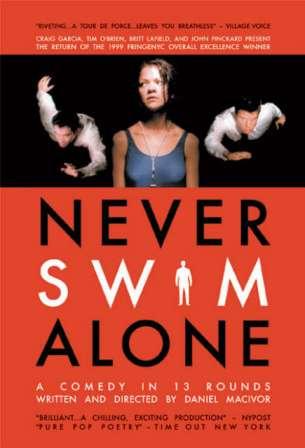
FRINGE 2006: Never Swim Alone

Reviewed by Aaron Riccio

Bravo, Daniel MacIvor, and I don’t mean the military letter that comes after Alpha and before Charlie. Never Swim Alone is a technically perfect, dazzlingly verbal, low-budget show that solidifies the Fringe as a showcase of pure talent. While not a theatrically daring piece—it has a cast of three, no set, and two props—but by investing all of its energies in a story, a particularly moving story, it has all the thrills you expect of the theater.

Arguing in a stylishly clipped tone, together or overlapping, two men (Douglas Dickerman and John Maria) walk into a room. As the story goes, one is the first man, and the other has a gun. A woman (Susan Louise O’Connor) clad in a blue bathing suit that complements the two men’s suits (black suit, silk tie, black shoes, black socks), referees from a stool as the two men compete. Why they compete is not as important as the fact that neither of these friends wants to lose, and all that matters is that they'll unleash the playful banter of David Ives's All in the Timing or the furious sarcasm of David Rabe's Hurlyburly in order to get it. This passionate dexterity is enough to sell the show alone, but MacIvor's got a secret buried in all the semiotic dissections of character that make up his thirteen "rounds." There are these two men, sure, but there is also a beach, a bay, and a point, and that point is both a far-off place and the dramatic hook.

Never Swim Alone is about one-upmanship, but it’s also about the costs of such fixation, and as the insults grow more personal, MacIvor paints a perfect satire of the American workaholic. More so, he does it all with a few lighting cues and a few exceptional actors. The rightfully confident John Maria, who has been with this show since the original ’99 Fringe production, is joined by newcomer Douglas Dickerman (though by the chemistry, you’d swear he’s been with this show forever). Their interplay, like Tom Stoppard’s warped Rosencrantz and Guildenstern, leaps off the stage with personality. (O’Connor is fantastic too, commanding when she speaks, but this is a showcase for the swaggering male stereotype.) This is a well-oiled play: there’s no reason this couldn’t run off-off-Broadway forever, perhaps in repertoire with the similiarly themed Israel Horovitz play, Line.

Bravo, Mr. MacIvor. Bravo. And encore.

Friday, August 25, 2006

FRINGE 2006: Absolute Flight

Review by Aaron Riccio

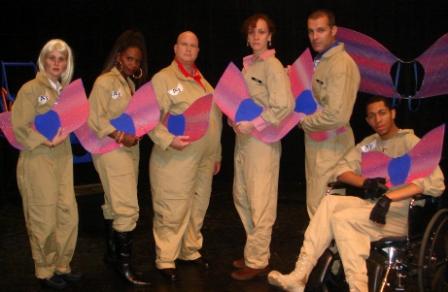
The cast is all winners, and I'm not just saying that: will Amy Landon, Marishka Phillips, Cameron Hughes, Effie Johnson, Garth T. Mark or Keith Eric Chappelle be the one to fly?
Photo/Sam Rosen

In a world that already has shows as hilariously full of self-loathing as Who Wants to Be a Superhero, do we really need parodies of reality TV like Absolute Flight? Sure, why not? "Reality" is a simple, painless device that brings disparate characters into close proximity, complete with pre-installed motivations--in this case, the right to be dropped from a plane while buckled into some wings, i.e., to fly. All the author needs is some playful banter and a twist or two and a play is born. To be sure, Barbara Blumenthal-Ehrlich has done more than adapt a genre, but for all the manic nuances, Absolute Flight seems a bit tethered by its own substance.

To apply the play's beautiful ending to itself, Absolute Flight takes awhile to get off the ground. It runs on a tarmac made of sound bites and groveling, and only ascends when we see that the actors have infused these characters with souls, too. The more depraved, the more likeable--and these are some very likeable characters. From Michael, the "war veteran and sex-crazed cripple," to Joshua, a man "who pretends he's an alien because he's too fat to be human," to Iris, a bright young thing who constantly chirrups "I could die at any moment" (with stage-four ovarian cancer, she just might). Yes, it's that kind of comedy.

The next bit's a little choppy as it heads through the turbulence of plot development. In this case, it's a little backstage intrigue before the Season Finale, and a dramatic buildup to finding out the "celebrity" contestant's tragic past; by the second act, we've Leveled Off, and we're ready to take a plunge of glory. Blumenthal-Ehrlich piles on so many neuroses at once that there's a constant cacophony of pathos, and the actors (led by Effie Johnson) sure love smearing themselves with that muck.

What can I say? It's entertaining to watch good actors dirty themselves with dark comedy. And it's shocking to find that all this "reality" has a point: the ending pulls Absolute Flight away from those who would simply dismiss the concept as lowbrow and puerile. Nothing's perfect, but for a show about reality, this one feels just right.

The Fringe: 24 is 10 the BEST of the 24 HOUR PLAYS

Review by Liza White

NOTE: In honor of the talents of the writers, actors, and directors who create respectable works of theatre in 24 hours and rehearse them in 9 hours, I plan to write this review in 10 minutes (not including the time it takes me to post this on our blog which may take me the rest of the afternoon - Start Time 12:01 PM).

Ten years ago a phenomenon hit the New York theatre scene when a group of friends challenged each other to write, rehearse, and perform 6 plays in 24 hours. It was intended to be a one night stand sort of event but here I sit in 2006 in awe of one of their productions. For 5 days during the NY Fringe Festival the producers of the 24 Hour Plays are presenting 25 of their and the audiences top pics.

I saw the Thursday night performance which included: “Karla Says” by Mac Rogers, “The Woman” by Michael John Graces, “Vikings!” By Greta Billinger, “Poor Bob” by Elizabeth Meriwether, and “A Weekend in Brazil” by Ted Travelstead and Julie Wright. I was impressed by the quality of the writing but more so by the subtle nuances and grace the actors brought to the scripts in only 9 hours of rehearsal. Most notable was Karla Mosley in “Karla Says” for her duality of character as a child entertainer turned unfaithful spouse. (It is now 12:14 PM) Another standout was “Poor Bob” about a hysterical girl on the crux of adulthood who still in love with fictional character Atreyu from the film “The Never Ending Story”. Her hysterics lead to a ball gag, a yahtzee game purchased on e bay, and an unobservant lover with a turkey hat. Meriwether’s crafty writing gives us an humorous take on childhood obsessions.

The night led to other enjoyable moments such as a Spanish speaking orgasm, a retarded boy named Jesus Christ who mistakenly kills his friend with a rubber ball, and Vikings giving each other bouquets of flowers and debating the manliness of this. The triumph of creating not only comprehensible works of theater in a day, but creating enjoyable worthwhile theater in such a short time is commendable and quite frankly as fun for the audience as it seems for the artists involved...perfect for the Fringe. (Time 12:37…I received a phone call, had to do some googling and run spell check. I'm just not cut out for the 10 minute review.)

The Best of the 24 Hour Plays is playing at the Lucille Lortel Theatre, 121 Christopher Street. Tuesday Aug 22 at 11, Wednesday Aug 23 at 6:15, Thursday Aug 24 at 6:15, Saturday Aug 26 at 8:45 and Sunday Aug 27 at 6. Check out www.24hourplays.com or www.fringenyc.org for more information.

Thursday, August 24, 2006

FRINGE 2006: Americana Absurdum

Reviewed by Aaron Riccio

God bless America, home of non-sequiturs and overzealous greed, and also, as we're reminded in Brian Parks' Americana Absurdum, rabid pursuits and hyperactive life. Parks' piece dials way past eleven, running on the fumes of an ever-elusive America. Split into two identically styled one-acts titled Vomit & Roses and Wolverine Dream, the evening is an explosive satire of America, as fast, furious, and inane as our culture.

Shone with a light from above, Paul Urcioli's direction uses clip lights to focus all the attention on whatever portion of the pitch-dark stage is currently under scrutiny. Of course, those vague, ominous shapes in the background, those performers holding down the lights, they're as much of the show as anything. It's all an effect, including the 100-meter-dash speed of the lines, meant to disorient and distract you, to suck you into a world of overwhelming superfluities, one that, as the show continues, looks more and more like a certain land that we love.

Sitting there, one becomes a half-baked theater potato. Verbal rapture, sure, but also mindless intellectual entertainment (oxymoron or not) that shifts between scenes so fast that only TV commercials draw comparisons, those zippy little spots that pause long enough to occasionally be funny. What distinguishes Parks from a commercial is that he isn't selling anything, he's lampooning it, and moreover, he isn't occasionally funny: he is consistently hilarious. (One wishes he were more sporadic; then we wouldn't feel so bad about missing a line here or there.)

When talking about Marquez, Ibsen, Dickinson, &c.--sometimes in the same breath--it's almost inevitable that at some point, mania takes over. That's the beautiful, irrepressible point. Parks jumps from issue to issue within his overarching "plots" not because he has ADD, but because the theme he's representing, America, has ADD. These satires have points--even beginnings, middles, and ends--but the deluge of scenic interjections and oral non-sequiturs make those inconsequential. Parks is shaping a mood, a mood that happens to be attached to a product, a product that happens, in this case, to be a fantastic play.

Excellently performed, every superlative phrase fits this counter-countercultural canon: nothing is ever simply "cracked" when it can be "cracked like a toddler's vertebrae." More is better, and examples (ala Family Guy) are everywhere: "Mummy could be sad about anything. Remember her suicide note?" If you're wondering just how over-the-top and speedy Americana Absurdum is, look no further than Greg Kotis (Pig Farm) . . . squared. One of the most absurdly entertaining pieces of the Fringe Festival, this returning favorite is still at the top of its game, and is a must-see staple for anybody, be they hip or hip-replaced, cool or cooling, smart or just into art.

------------------------------------------------------------------
The Lucille Lortel Theater (121 Christopher Street)
Thurs. AUGUST 24 @ 11, Fri. AUG 25 @ 6:30, Sat. AUG 26 @ 12

Monday, August 21, 2006

The Middle East, in Pieces

By Leila Buck, Kia Corthron, Israel Horovitz, Anne Nelson, Heather Raffo, Betty Shamieh and Beau Willimon
Produced by Back House Productions and Cherry Lane Theatre
Reviewed Thursday, August 17
By Nancy Vitale

About a month ago, playwright Beau Willimon extended his own kind of olive branch to Cherry Lane to counter the most recent war in the Middle East. He wanted to provide New York theatre artists an opportunity to channel their angst into a nearly two-hour staged reading of The Middle East, in Pieces, seven dramatic short plays that ranged from the satirical to the deeply personal. The company of talented writers, actors, directors and collaborators sought the human behind the inhumanity in the struggle, and what emerged overall was a human face, an Arab face that lusted and feared and lost.

Many of the emerging and established writers who participated avoided the pedantic, the melodramatic and the stereotypical. The two excerpts from Betty Shamieh and Heather Raffo, for example, convincingly captured the female Arab and explored the power of the women in Arab culture. Original pieces included Beau Williomon’s charming epistolary play, Dog River, in which lovers communicate via email as the hope that they will see each other again and the even more remote possibility of peace crumble around them. Kia Corthron’s Power Lunch delights and exasperates as Condi and Hillary flee their lunch date when their rhetoric fails them, and they are unable to adequately respond to their Lebanese waitress.

The highlight of the evening came from Israel Horovitz’s Beirut Rocks in which the writer populated his poignant and hilarious story with the most clichéd personalities on the world stage. Disguised as frightened American college students awaiting deliverance from a hotel in besieged Beirut, the characters threaten to destroy one another before whistling bombs outside their windows can do the job.

Enabled by a stellar cast of actors and directors who focused on communicating the intentions of the writers, the readings successfully expressed the importance of words amidst the seemingly irreconcilable conflicts raging in the Middle East. And happily, it was more entertaining than reading the op-ed page.

Sunday, August 20, 2006

FRINGE 2006: Only a Lad

Reviewed by Aaron Riccio


Eric Shelley, Jenny Weaver, Joey Calveri & Barret Hall are "On the Outside" in Andrew Loschert's Oingo Boingo musical, Only a Lad. Photo/Andrew Loschert


As the story (or at least the author's note) goes, writer Andrew Loschert, fresh out of grad school, got the idea for Only a Lad while listening to the Oingo Boingo Greatest Hits CD. His idea was sound (no pun intended): use the narrative-driven eccentricities of Danny Elfman's '80s rock band and make a musical out of it. The concept was in the right key too: a good-at-heart gangster who just happens to be different from the "cool cats" gets framed for murder and must find a way to save himself and reconcile his spirit. The thematic nature was there too: if we've learned nothing else from VH1, it's that America Loves the 80s. So what went wrong?

Many, many things, the first (and most important) being the technical design. The inability to hear the lyrics over the band and the inability to hear the band over the static crackle of feedback makes it difficult to gauge just who's to blame for the lackluster production. Loschert's written a decent frame for Elfman's excellent music, and though his efforts come across as a straight-up jukebox adaptation, his source material really is that good. Also, his performers have great voices, which is why it's more the shame that we can't hear Barrett Hall and Joey Calveri. These two really capture Oingo Boingo's spirit, both in look and feel, and even the numbers that don't fit the book (like "Little Girls") rock all the same because of that x-factor.

This cultural exploitation is nicely finessed by director Rob Seitleman. In my eyes, he has more than redeemed himself for his last project, Paradise Lost; he's taken an incomplete project and strung together a visually stimulating '80s homage. What the musical lacks, and I suspect Seitleman and his choreographic partner Jason Summers know this, are group numbers and big choruses -- both of which are difficult with Oingo Boingo's music and Loschert's script.

Speaking of which, if we strip away production gaffes, Loschert's own problems come back into focus, which is that he hasn't fleshed out his idea. The story is straight out of Grease or Cry Baby or any other movie about teen culture clashes, and while Oingo Boingo should be on Broadway, this isn't the vehicle for them. Not yet, at least. Slap some more meat on these bones and figure out a way to work "Nasty Habits" into the show, and Only a Lad may one day find its way onto the Great White Way. Here's hoping.

--------------------------------------------
Harry De Jur Playhouse (466 Grand Street)
WED, AUG 23 @ 9:15; THURS, AUG 24 @ 9:30

Saturday, August 19, 2006

FRINGE 2006: Letter Purloined

Review by Aaron Riccio

The intricate elegance of Letter Purloined deserves a review written in twenty-six lines which can be read in any order. It should be a metacritical review, one that constantly refers to the structure of the piece itself, using wonderfully oblique metaphors like golf. It should also serve as a form of psychotherapy, drawing on the sex dreams of Freud, the language of Derrida, and the works of both Edgar Allen Poe and Shakespeare. Of course, this would require a lot of work on my part -- and a near-genius capacity for post-modernism. For this reason, I prefer to just highly recommend David Isaccson's Letter Purloined and to extol the talent of Theater Oobleck, the group that performs it, sans director.

The plot applies the mash-up philosophy of albums like "The Gray Album" and runs two concurrent beats: Poe's detective story about a stolen letter and Shakespeare's classic tragedy of a certain Moor (and we don't mean a dock). In this version, a sinister minister named Ogai frames General Cassio by stealing a letter sent from him to King Navodar's wife, Queen Diri. It's best if you're familiar with the conceit: the show is performed in a random order every night, and figuring out the twists and deviations is great fun for the bohemian surveyor. The one annoyance is that Cassio speaks as if he's a Casio keyboard. Get it? The joke doesn't stretch for the two-plus hours of the show, even though Colm O'Reilly is a good imitator; thankfully, characters and transitions clarify his subtext often enough for story to still work.

There's so much other stuff to praise though: Isaccson (who also plays the insecure, soft-spoken king) manages to make difficult literary theory not only comprehensible but funny, and just wait until you see how he incorporates psychoanalysis into Queen Diri's manic and overwhelming personality. The actors also deliver this purposely convoluted story with full bravura and intonations of significance.

Aside from being a novelty, a show that can boast of cramming Kofi Annan and Lacan into the same breath, Letter Purloined is also a rich, deep metadrama. It's intellectual, it's not very sexual, and it's not full of over-the-top action: it is the anti-Fringe Fringe show. It's also a must-see, and I certainly hope this play finds producers willing to take it to the next level.