
What if your only hate and your only love were the same person? Theatre Breaking Through Barriers toys with Shakespearean convention using just four actors to cover all the parts in “Romeo and Juliet.”
BY ELLEN WERNECKE
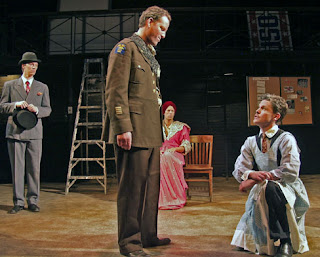
By the time Romeo meets Juliet in Theatre Breaking Through Barriers’ production, in seemingly the same way a million Romeos have met a million Juliets, they’ve already met before. Rather, the characters haven’t met before, but because TBTB’s production covers 41 roles in “Romeo and Juliet” using just four actors, they have met as Lady Capulet and Paris, and Romeo’s best lady is also his best friend Mercutio. It’s a novelty and a gimmick, but it bears out long enough to highlight some good performances and many entertaining ones.
The ensemble uses costumes and accents to set their characters apart from each other, populating the streets of Verona with cowboys, hipsters, b-boys and an old lady in a wheelchair with a pistol. (A decent Bill Murray and an eerily good Christopher Walken also turn up.) The Capulets are a genteel Southern family whose lives revolve around their belle (Emily Young), who they have matched to a nerdy suitor (Young as well). But all bets are off when she meets Romeo, played by Gregg Mozgala with an attractive fluidity to his emotional journey. All actors in the troupe -- besides Young and Mozgala, Nicholas Viselli plays Lord Capulet among others and George Ashiotis, the Friar among others -- are to be lauded for their versatility on stage, but Mozgala seems willing to give himself over to madness more so than others who perform the role. He climbs up towards Juliet with a palpable yearning, not content to stand below her balcony.
The consequence of this is that Mozgala’s other roles fade into the texture of the show, as do Young’s when she isn’t Juliet and Viselli’s overall. Ashiotis, on the other hand, balances two roles (the Friar and the Nurse) so deftly that it took the audience several minutes to realize when they held a conversation behind the column why neither of them were making an appearance downstage -- a rare moment of levity in the play’s back half.
In his program note, director Ike Schambelan explains that Shakespeare’s troupe contained as few as four actors in its early years, so it’s possible that the first performances of “Romeo and Juliet” were done under such a cast constraint (although in their fat years they had as many as nine actors for the repertory). It’s a clever constraint, but is it completely worth it other than as historical artifact? For its new insights into the classic work, and the puzzling out of the many roles included, it’s worth a second glance.
---
Now through April 6
At the Kirk Theatre, 410 West 42nd Street
For more information visit TBTB.org
Showing posts with label Shakespeare. Show all posts
Showing posts with label Shakespeare. Show all posts
Sunday, March 30, 2008


Wednesday, January 24, 2007
The Taming of the Shrew
Like most of Shakespeare’s comedies, “The Taming of the Shrew” relies on the pairings of so-wrong-they’re-right couples and a web of mistaken identity. The Roundtable Ensemble ups the confusion, but also the laughs in its small-cast, 90-minute version of "The Taming of the Shrew,” now playing at the American Theatre of Actors.
(Chosen as one of The New Theater Corps'
FIVE FAVORITES for 2/2/07)
Reviewed by Ellen Wernecke
The actors putting on this “Shrew” are variety players in a USO show who pass the time backstage playing cards and annoying each other with their warm-ups until a drunk (Arthur Aulisi) stumbles in. They throw him in a robe, start calling him “Lord” and plant him in the front row of the audience for the duration – or at least until he makes his own stage debut in the final act. Complicit in the duplicity, the audience is roped along into the show, with six actors tackling 23 parts (with the help of identifying props and accents).
Roundtable Ensemble presents The Taming of the Shrew
American Theater of Actors, Chernuchin Theatre (314 West 54th Street)
Tickets (212-696-6699): $18/ $15 students (via Theatermania)
Performances: Wed, Fri, Sun @ 8pm; Sat @ 3pm
For more information, visit the Roundtable's Website.

Left to right: JONATHAN KELLS PHILLIPS, TOM BUTLER, ARTHUR AULISI (in pink dress in background), and PAUL WHITTHORNE in The Roundtable Ensemble production of "The Taming of the Shrew," directed by Andrew Grosso. Photo credit: JIM BALDASSARE
(Chosen as one of The New Theater Corps'
FIVE FAVORITES for 2/2/07)
Reviewed by Ellen Wernecke
The actors putting on this “Shrew” are variety players in a USO show who pass the time backstage playing cards and annoying each other with their warm-ups until a drunk (Arthur Aulisi) stumbles in. They throw him in a robe, start calling him “Lord” and plant him in the front row of the audience for the duration – or at least until he makes his own stage debut in the final act. Complicit in the duplicity, the audience is roped along into the show, with six actors tackling 23 parts (with the help of identifying props and accents).
It makes sense that for the play-within-a-play to work, there has to be some doubling. And the double casting sets up some interesting juxtapositions: If the same actor (in this case Alex Smith) plays Bianca’s father Baptista and her eventually successful suitor, Lucentio, then her eventual choice of him is both natural – after all, it’s a type she knows and of which he must approve – and slightly alarming, in its confirmation of Baptista’s power over her. (She couldn’t have made it work with the suitor Gremio, whose part actress Autumn Dornfeld takes with a pair of thick glasses and an old man’s affect.)
But the most surprising change about the Roundtable’s adaptation is the male player who takes the role of Katarina – or is forced into it, having assigned all the other parts. Once we’ve gotten over actor Paul Whitthorne’s mustache and his player’s disdain for the role, it presents us with a series of questions about the shrew’s own nature. Having seen her state, why does Petruchio (the swaggering Tom Butler) continue to pursue her? Is “shrewish” just a synonym for “too much like a man?” (Whitthorne drapes himself with a blue checked apron but makes no pretense of raising his voice to play her, foregrounding the difference.)
And it changes the titular taming: With a man in Katarina’s shoes, the struggle between her and Petruchio takes on an erotic subtext which was present in the original play when all the parts were played by men, but which our modern castings have allowed us to forget. Instead of being physically overpowered by him, the implication is that she chooses to submit. There is no pretense at unending love here: Katarina’s final speech to her fellow wives seems like a performance, rather than a lecture, and is thus easier to swallow.
In the interest of time, much of Bianca’s own courting is cut out, though B. Brian Argotsinger as Tranio, Lucentio's loyal servant who disguises himself as a suitor, stands out. But the play ends on an unresolved chord, despite the double wedding; we’re left pondering Butler’s rendition of “You Belong To Me” and wondering how much truth there is in it for Baptista’s daughters.
Roundtable Ensemble presents The Taming of the Shrew
American Theater of Actors, Chernuchin Theatre (314 West 54th Street)
Tickets (212-696-6699): $18/ $15 students (via Theatermania)
Performances: Wed, Fri, Sun @ 8pm; Sat @ 3pm
For more information, visit the Roundtable's Website.
Subscribe to:
Posts (Atom)


