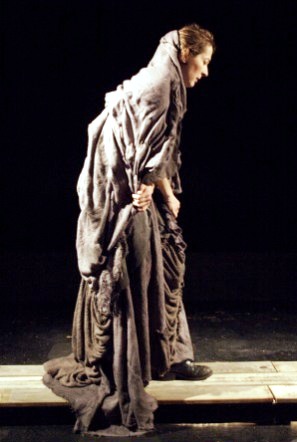
According to Lincoln Center's new LCT3 project at its slogan, it takes "New Audiences for New Artists." It also takes new critics, hence the establishment of Theater Talk's New Theater Corps in 2005, a way for up-and-coming theater writers and eager new theatergoers to get exposure to the ever-growing theater scene in New York City. Writers for the New Theater Corps are given the opportunity to immerse themselves in the off-off and off-Broadway theater scene, learning and giving back high-quality reviews at the same time. Driven by a passion and love of the arts, the New Theater Corps aims to identify, support, and grow the arts community, one show and one person at a time.

Saturday, January 13, 2007

Macbeth: A Walking Shadow

An essential Shakespearian production, boiled down to its essence (and pared down to seventy-five minutes), this adaptation of Macbeth keeps the Bard's language, but heightens the haunting with a lot of clever direction from Andrew Frank and some excellent acting from the cast (led by Ato Essandoh).


Reviewed by Aaron Riccio

Soldiers turn into witches, dead men creep around, and Macbeth is trapped onstage, caught in a series of flashbacks e'en as he fights that epic battle with Macduff: this isn't your parents' Shakespeare. It's better. That's not knocking the elongated prose of the bard, but Andrew Frank and Doug Silver's new adaptation of Macbeth (here subtitled "A Walking Shadow"), has managed to emphasize the magnificent language by cutting out the majority of it. The scenes glide smoothly from one key moment to the next, whirling around a horrified Macbeth (the excellent Ato Essandoh), and showing, more than ever, how a heroic man becomes a despot. Politically resonant, emotionally relevant, and theatrically elegant, this new production of Macbeth needs to be seen. And at seventy-five minutes and only $18.00, you can even see it again and again.

Director Andrew Frank uses the intimate space of Manhattan Theater Source to mount an epic production, and succeeds, placing all the action on a narrow slab of stage between two rows of the audience. The action, long and narrow across that black strip, makes every scene into a fierce showdown, none stronger than the pivotal moment when the tempestuous Lady Macbeth (Celia Schaefer) convinces her husband to murder the fair King Duncan (Chuck Bunting). Schaefer's compelling performance is quiet at first, not manic, which gives her opportunity to build to a murderous pitch by her climactic "spot" speech. Better still, because Macbeth is condemned to remain on stage, seeing all that has led him to his bitter end, we can watch Essandoh's marvelous reaction to moments he would never actually witness in a more orthodox Shakespearean production.

But this is far from the Essandoh and Schaefer show, fabulous as both are. The cast is engaging and outstandingly clear, so much so that almost every line becomes quotable. Everything is so focused, so intense, that we cannot look away. And why would we want to? From Malcom's mournful anger (Michael Baldwin) to Banquo's loyal demeanor (Len Childers), there are plenty of nuanced performances to enjoy. James Edward Becton, cast in a melange of small roles (witch, soldier, and doctor), was the most captivating performer of the night, a man truly living his part.

T'would be a shame to miss this excellent production, nay, an unforgivable sin. I hope Frank and Silver will consider cutting some other Shakespearean plays: what they've created here is not only a flattering adaptation, but a short and sweet Macbeth that is as perfect for schools as it is for even the most grown-up, jaded audience.

---------------------------------------------------------------
Manhattan Theater Source (177 MacDougal Street)
Tickets (212-352-3101): $18.00
Performances: Wednesday-Saturday @ 8:00

Thursday, January 11, 2007

Israel Horovitz's New Shorts

Israel Horovitz is still hard at work, spinning nine new short yarns that look at character first, but with a nice flourish of comedy, a slice of sarcasm, and a slab of drama. They're not all perfect, but they're a well-rounded offering of a hard-working playwright's contributions to his field, and well worth seeing.


Reviewed by Aaron Riccio

Take the metaphor of "The Race" (one of the nine new playlets in Israel Horovitz's New Shorts) as a means of expressing this evening of theater. Nine actors, each running for their own reason (well, okay, one is just standing there) but united for a common cause. One's a twelve-year-old girl, exuberant but unpolished (like "Audition Play"), and one's a two-time champion, trying to outrun her own age. The pieces don't mesh together, nor should they: as is, they show the wry, comic sensibilities of their writer, Mr. Horovitz, and his range. "Affection in Time" could be Beckett, "Inconsolable" is stylized poetry, and "The Hotel Play" is classic Horovitz. Save for the wholly uneven "The Fat Guy Gets The Girl" and "The Bridal Dance," both of which try to hard to have a punchline, this is a theatrical anthology of one playwright's love of characters. Best of all, because the shows are swift, there's no room for exposition, and the plays are as distilled (though not as refined) as Line. There's a certain sort of thrill in seeing nine plays run by in one evening, each jockeying for your attention.

The cast is filled out by members of the Barefoot Theater Company and some other talented actors (like Lynn Cohen); the direction is deftly handled both by the writer and by Michael LoPorto. There's a potpourri of elements to each scene, but what's interesting is Horovitz flexing his comic impulses, even while burdened with the tragic. "Cat Lady" is the best of the pack, for while it is filled with double-takes and bad puns, the monologist is a person first, lonely and depressed. "The Hotel Play," which gets laughs from awkward misinterpretations, is ultimately about the same thing: two people, this time, each lost, but perhaps able to connect if they can let go of their masks.

The most relevant play, however, is the political piece, "Beirut Rocks," which begins as a conversation between two American students who meet during the evacuation of their overseas overseas school. These moments juxtapose the Israeli bombing of Lebanon, just outside, with the live feed Benjy (Christopher Whalen) is getting of Tiger Woods, a world away. It's the reverse of their normally sheltered American life, and what's more, their illusions are being shelled by US weapons. Before long, two more evacuees join them, including an Arab-American who, in living up to the antisemitic stereotype, surprises us with her fiery denouement.

That Horovitz, after so many plays, can still seem fresh, young, and fierce is not surprising. But it is refreshingly satisfying to see, much like this collection of short plays.

-------------------------------------
Kirk Theater (410 West 42nd)
Tickets (212-279-4200): $18.00
Performances: Wednesday - Saturday @ 8:00/Sunday @ 3:00

Macbeth

Finally, a traditional production of The Scottish Play that manages to feel surprisingly young, spry and good as new. If only poor Banquo could say the same.


. . . . . . . . . . . . . . . . . . . . . . . . . . . . . . . . . . . . . . . .
Reviewed by Cait Weiss

Macbeth. There. I’ve said it. Aloud. So once every last one of you theater-lovers has finished walking in circles and spitting in doorways so ghosts do not haunt your opening nights and unwrap noisy otherworldly candies through your recognition and reversal monologues, perhaps we can just sit down like normal well-adjusted adults and talk about The Scottish Play.

Done?

Wonderful, because the New York Actor’s Ensemble’s current production of Macbeth is worth talking about. There are no gimmicks in this show, no single-gender casting, WWII updating or disco interludes – this here is pure Shakespeare. Very little text was cut, yet somehow the play whizzes by, action-packed, seamless, and vastly entertaining. Of course, there are bumps along the way, but, on the whole, NYAE’s Macbeth was what our professors always told us Shakespeare should be -- riveting, gross, raunchy, insightful and very entertaining.

Of course, our anti-hero Macbeth (played by the excellently on point David M. Mead) does the same thing he always does (next time, just ignore the Weird Sisters!), but Mead brings a approachable just-your-average-guy quality to the role. This is a Macbeth who snuggles up in his new royal robe when no one else is watching – the snuggle lasts only a simple split second, but it subtly expresses both the satisfaction he must be feeling and the intense insecurity. This Macbeth is understandable and relatable – two very welcome attributes in any Shakespearean production. Mead encourages our compassion through these small human gestures, yet isn’t afraid to make us recoil; whether blood-stained and searching for that sticking point or ranting over the now-you-see-him-now-you-don’t Banquo, Mead’s Macbeth somehow holds strong as the center of this play’s success, even as the character himself unravels into tragedy.

Kenneth Cavett, taking on the role of Banquo, also presents a stunningly complex and sympathetic character, though, granted, it is much easier to be Mr. Popular when you’re discovering the murderer instead of wielding the gory blade yourself. Still, Cavett’s Banquo is the early pulse behind the show, stirring the demons in Macbeth long before Banquo suspects there is anything to fear, jumping around with childish excitement at the Weirds’ mere mention of “king.” Together, Cavett and Mead keep the production moving, leaving the audience rapt up in the action, of course, but far more impressively, in the language as well.

The same cannot, unfortunately, be said of Lady Macbeth, played by the chiseled-featured Susan Angelo. Lady Macbeth is indeed the pinnacle of the complicated female, so one can’t blame Angelo too much. However, why is it that almost all actors playing Lady Macbeth play her with the mannerisms and facial expressions of a drag queen taking the stage after five too many daiquiris? It’s the Blanche DuBois Dilemma – when an actress starts crazy in Act One, where’ll she go for Act Five? Sure, she can always make the jump from crazy to crazier, but with Lady Macbeth, that’s just spitting in one enormous blood-red ocean.

On the topic of enormity, the stage is, well, not. And while the size of the performance space shouldn’t make or break an otherwise rewarding production, when the play is Macbeth and the first scene involves a bevy of men stage-fighting in multi-colored plaid skirts, size does matter when the kingdom in contention is roughly the size of a New York City kitchen. Furthermore, when the show’s set is a miniature version of Stonehenge, it’s only natural for This is Spinal Tap to pop into my mind. And, call me as crazy as Lady Macbeth, but when I go out for a little high culture, the last thing I want on my mind is a trio of dancing midgets.

Overall, though, Macbeth is an exciting production, entirely worth both your time and your superstitious spits (just not on the teeny tiny stage, please; you might flood Stonehenge).

. . . . . . . . . . . . . . . . . . . . . . . . . . . . . . . . . . . . . . . .

The WorkShop Theater (312 W 36th Street, 4th Floor)
Tickets (212-695-4173 x5 or www.macbeth2007.com): $18 general, $10 students and seniors
Performances: January 5th through January 21st, Wednesdays through Fridays at 8pm, Saturdays at 1pm and 8pm, and Sundays at 4pm.

Tuesday, January 09, 2007

Linnea

A stripper, complete with a heart of gold and two dueling suitors, brings Dostoevsky’s The Idiot into 1990s East Village street life – but what else is new?


. . . . . . . . . . . . . . . . . . . . . . . . . . . . . . . . . . . . . . . .
Reviewed by Cait Weiss

There are a couple of ways to pass English Lit your senior year of high school – you can 1. read the books and take a plethora of margin notes in your extra-special lucky ballpoint pen; 2. check out sparknotes.com and hope that the poor starving college grad who penned the synopsis wasn’t feeling maliciously inaccurate that night; or 3. frequent that certain type of Off-Broadway show that gets its theatrical rocks off by mirroring the classics in an entirely self-conscious and clearly underlined way. If you choose number 3, well grab your Kipling sac and head for The Storm Theater’s world premier production of Linnea.

Now, before I sound too snooty, keep in mind that I am a big literature fan. True, I find those turn of the century Russians mighty depressing – but any play that adds to my knowledge of novels is okay by me. And, in that sense, Linnea certainly fits the bill. After surviving a full semester struggling through Dostoevsky’s Crime and Punishment, I would never (never!) willingly pick up The Idiot on a whim. Linnea however, absolves me of my aversion to this fruit of epileptic genius – the show tells a modern-day version of the classic Dostoevsky story – and how!

Danny, played by a nearly Pollyanna-esque Joshua Vasquez, serves as a 20th century Myshkin, exemplifying kindness, analytical reason and compassion, while Cody, played by a charismatically hulking (if such a thing is possible) Jamil Mena, updates the role of Rogozhin, who in turn personifies all that is hyper-sexual, brutishly lusty and a enjoyable on a Friday night after a pint or two at Mars Bar.

Danny and Cody first meet in a pub, and the two hit it off disconcertingly well – if this is Alphabet City in 1993, I don’t see what Jonathan Larson (let alone NYC’s immense homeless population) was getting all worked up about. This Big Apple is so friendly it forces me to query why anyone would ever want to riot in Tompkins Park. In the disconcertingly rose-tinted eyes of Linnea playwright John Regis, these rabble-rousers should have all just shared a drink, a childhood story, and good joke instead of throwing stones and storming the police force. Who knows; in Regis's pinkeyed perspective maybe a simple tea party with doilies would have sufficed…

Regardless of the eerily sociable nature of the East Village residents (even a homeless man jokes around for spare change and – get this – seems just as happy when no coin is forthcoming), the play darkens into a story of betrayal and competition as Cody and Danny fall in love with the same woman, a stripper named Linnea (played by the limber and lovely Benita Robledo).

I feel I should mention that Linnea is performed in a church located right off Broadway. I say this now because only in a house of God would a stripper (albeit one with a heart of gold, of course) fall in love with a customer (or better yet, even, with two!). Awesome.

However, as sweet as a stripper love story can be, Linnea quickly sours -- while the acting is servicable and the production elements (lighting, staging, and sets) are impressibly effective, the play itself is as devoid of subtext and spark as a Times Square hooker circa 1993. It takes a lot for me to say this, but, despite his allusions to granduer, John Regis doesn't begin to measure up to the man behind The Idiot. Regis bites off more than he can chew and, in this play it seems, speaks with his mouth full. It's too bad he had to make such bald allusions to a work of genius. While I may not love my Dostoevsky, I respect him, and flaws that may be forgivable in an original production become unforgettable in a play that insists on underlying its laughably lofty aspirations.

Still, if you prefer your Dostoevsky distilled and modernized, Linnea will surely do the trick, and will do so with far less complicated character names. Linnea is also worth seeing for its high production value – the lighting in this show is beautiful and its visuals really impress upon the audience just how gritty this nice little city used to be, even if the dialogue doesn’t quite drive that same point home.

I recommend Linnea as a nice addition to the sub-genre of New York plays that deal with the good old days of extremely intimidating East Village street life (see also: Larson’s Rent and Jose Rivera’s stunningly apocalyptic Marisol). And if you’ve got those mid-terms looming and for some odd reason you’ve mistakenly assumed pre-Revolution Russian Lit would be an easy A, well, Linnea’s got a heart of gold for you too!

. . . . . . . . . . . . . . . . . . . . . . . . . . . . . . . . . . . . . . . .

The Storm Theater (St. Mary’s, 145 W 46th Street)
Tickets (www.stormtheater.com): $18.00
Performances: January 11th through February 3rd, Thursdays through Fridays at 7:30pm and Saturdays at 2pm and 7:30pm.

The Germans in Paris

You can do a lot with a set consisting of only three doors and whatever else is brought on stage, but no matter how delightful the scenery, if the characters start to seem like entertaining props, there's a problem. The Germans in Paris is a smooth show with likable actors, but the script is too stiff to flow: it looks and sounds good, but keeps tripping up the narrative.

Reviewed by Aaron Riccio

Jonathan Leaf's play, The Germans in Paris, has two duels, three revolutionaries, and an adulterous love affair. For all that, it comes across more as a comedy than a serious play, and on top of that, as more of an intelligent play than a rip-roarer. The lines are clever, but often come across as dry or artificial, and the plot's distracted narrative never picks up enough speed for a climax or a denouement. There is much to admire in Leaf's play, for the performances are still sincere and full-bodied and their costumes are as rich as the play wishes to be, but his vision of 1840's France is strikingly out of focus.

First off, the story revolves around Heinrich Heine, who may be a poet in real life, but is here portrayed as a smug, pinched, and pared aristocrat (even though he is written as a womanizing socialite). Jon Krupp is engaging in the role, but far from poetic in his language or carriage. Rather, he makes Heine sullen and untouchable: when he gets into a duel with the bellicose Solomon Strauss he seems almost apathetic; after being shot, he laughs and fires his own gun into the air. It's the way we would expect the more lively character, Karl Marx, to act; instead, Marx comes off as an arrogant, self-serving man, filled so much with revolutionary fervor that he scarcely knows how to care for his own family, let alone fight his own duels. Leaf's script makes the likable Ross Beschler portray Marx as a villain and the reserved Krupp's Heine into a hero, and The Germans in Paris, like its title, works best as a fine display of paradox.

What Leaf has done, and what I fear director James Milton only emphasizes, is to wrap this paradox not in a riddle or an enigma, but in the cloying, bumbling presence of Richard Wagner, a role hammed up by Brian Wallace. Wagner has little to offer the play in terms of ideas -- the character is an egotist, and spends most of his time talking about his struggles trying to publish music. Alone, Wagner's pitiable existence might make for an enjoyable farce, coupled with two other characters screaming for attention, his plight means little and, in fact, gets little attention from the writer or director. The only plot followed through on is that of Heine's affair with Mme. Morisot (a charming Angelica Torn); even his marriage to Mathilde (Kathryn Elisabeth Lawson) comes across as no more than dramatic effect.

It takes Tom Stoppard nine hours and three plays to tell the story of his Russian intellectuals in The Coast of Utopia, and while we can all aspire to do better than that, two hours is perhaps not enough time to do anything of great weight or import in The Germans in Paris.

-----------------------------------
The ArcLight Theater (152 W 71st Street)
Tickets (212-352-3101): $18.00
Performances: Wednesday - Saturday @ 8:00

Monday, January 08, 2007

The Rapture Project

Puppets fighting for the political and religious future of Earth -- the stakes couldn't be any larger, the platform couldn't be any smaller. It's hard to see the message through all the chaos and the humor (intentional and otherwise), which makes The Rapture Project somewhat of a mess, but you can't say it's not an enjoyable, wacky mess.


Reviewed by Aaron Riccio

I dare you to tell me that watching puppets fight isn't the funniest thing you've ever seen (puppets do). Great Small Works's The Rapture Project goes one further than mere puppet action, though, when Susan Sontag gets the s#!t beat out of her by the devil. I'd say that it's just one of those plays, and chalk it up as a hip urban experience, but The Rapture Project tries too hard to also be a political play about Islamic fundamentalists and Christian zealots, not to mention a series of unsubtle vignettes on American corruption and global culture shock. Plots run as rampant as puppet strings, and there is little attempt made to blend things together. If anything, the ever-changing musical styles of the interludes just make things more divisive.

Now, chaos can be fun, as with a mass puppet melee set to excited shrieks of "Armageddon." And there are scenes of ephemeral beauty, as when a security-guard puppet flies off-stage, only for the roof's curtain to pull away to reveal him being transported through a black-and-white wonderland by four naked puppeteer "gods" as the rest of the cast hums a crescendoing series of notes. But the show is erratic and, like a jigsaw with missing pieces, starts to become more of an annoyance than an amusement. Luckily, the performance isn't much more than an hour, and it ends on a good-enough note that the work isn't soured by the rougher patches.

The concept, to revive the old Italian tradition of Orlando Furioso plays that brought Christian and Muslim violence to a head, is a good one, and very relevant today. But it's going to take more than the promising presence and premise of the female punk-rock militant Islamist, Rebeah, to break through to any audiences. The work needs to be developed, and the cuts between scenes need to do more than play with ethnic beats and post-hip spoken word to draw things together. At one point, pigeons fall from the sky, but we've only got blind faith (and a narrator) telling us that it's a sign of the apocalypse and the ensuing Rapture. The biblical flowchart surrounding the "stage" doesn't help much either -- it's Greek (or Latin) to me.

It's not that there's too much noise--the troupe's musical segments are polished blends of saxophone, tambourine, oboe, drum, and accordion--it's that there's no blending of those elements in the show itself. There's just a bunch of individual pieces that caterwaul their way to a decidedly unresolved finale. There are plenty of sight gags to make the play palatable, and there are those rare, truly enjoyable moments of total cohesion, but you won't leave the theater full of ideas, just with the image of puppets swinging their futile arms at one another.

-------------------------------------------------
HERE Arts Center (145 Avenue of the Americas)
Tickets (212-352-3101): $20.00
Thurs.-Sat. @ 7:00 | Sat. @ 10:30p.m. | Sun. @ 2:00

The Rapture Project

The Rapture Project places the tangled debate between Fundamentalism and Tolerance in the hands of black-and-white-clad puppeteers, creating a fascinating and morally-nuanced play that leads us to read between the proscenium arches and wonder just who is pulling our strings after all.


. . . . . . . . . . . . . . . . . . . . . . . . . . . . . . . . . . . . . . . .
Reviewed by Cait Weiss


“Rapture”, a Latin word, literally means “to be caught up or snatched away.” What better way to set the stage for a play about the End-Times and all thereafter than the use of puppetry? Bound as puppets are in their own strings, they only look alive when they are hovering hesitantly over seemingly solid ground. Furthermore, for the tangled dilemma that is Fundamentalism versus Tolerance, nothing beats an old-fashioned puppet show in metaphorical relevance or good clean fun.

Great Small Works, the Obie and Jim Henson Award winning collective of artists, was largely responsible for the revitalization of toy theater in New York City, bringing paper cut-outs, puppets and tiny proscenium arches to the city’s downtown and outer-borough theater scene. Now, at the HERE Arts Center this month, Great Small Works picks up the marionettes once again, and, with The Rapture Project, they have indeed got the world on a string.

The Rapture Project is an impressive undertaking, inspired by 19th century Sicilian puppet theater, 1920’s apocalyptic artwork, and the 1960’s hallucinations of San Francisco theater designer Jilala. The production combines music, puppets and live performances as a sort of 21st century anti-Revival.

Clearly made with a blue-state bent, The Rapture Project begins with a musical number, and the performers (GSW members John Bell, Trudi Cohen, Stephen Kaplin, Jenny Romaine, joined by Shane Baker, Andrea Lomanto and Jessica Lorence as actors/puppeteers and Jessica Lurie on sax) sing out a litany of their spiritual and all-too-secular grievances – one piece of the big complaining pie: “Locusts falling from the sky / Promotion went to the other guy.”

Soon the puppet show begins, and we are transported to a world “when times are scary and nothing seems just” where “you need answers, something you can trust.” In other, less metrical words, we are transported to a world of Fundamentalism, into its deepest ring, the ring of the Born-Again Christian and his God-driven quest to covert the heathen Muslims.

The Rapture Project presents a humorously tongue-in-cheek examination on the perversion of faith, satirically naming both Peace in the Middle East and decent dental care sacrilegious goals of the Anti-Christ. However, the play’s true intelligence and entertainment isn’t so much what is said (as by now most New Yorkers know the case against Bush and the Religious Right as well as Pinocchio knows the inside of a whale) but in who is speaking; out of the mouths of puppets and puppeteers hast The Rapture Project ordained strength against its enemies.

In a play so anti-Bush, it’s odd that most of The Rapture Project still works in binaries of Good and Evil. Yes, GSW’s Evil is not Bush’s Evil, but it is an Evil nonetheless – an Evil of intolerance, greed and violence. Perhaps moral ambivalence isn’t the best fit for toy theater, a genre most often used today by children acting out fairytales with paper dolls and brightly-hued pipecleaners – still, The Rapture Project persecutes the American Religious Right with the same fervor and delight Bush employs in his verbal attacks against Middle Eastern Muslims. The Creator’s hand alone transforms this show from a witty exercise in hypocrisy into a deeply thought provoking, morally nuanced and wholly fascinating production. No, that’s not God’s hand, but the hand of the Puppeteer.

The slight intrusion of a human arm in the upper corner of the proscenium arch; a puppeteer’s acknowledgment to the audience that two strings have tangled together; the finally removal of the stage’s top border, revealing the shoulders, arms and faces of the puppeteers themselves – all The Rapture Project’s self-conscious staging choices pull the attention off the literal and onto the bigger picture (not coincidentally, the most persuasive argument against Literal Christianity isn’t in any of the scripted, but in these staging choices and how they affect the tone of the show). Yes, the action of the play suggests the moral that “Fundamentalism = Evil, No Questions Asked,” but with the puppeteers visibly manipulating the puppets below, a second, far more interesting moral surfaces – the moral that simply binary systems (and all the stereotypes that arise from them) need to be deeply questioned as long as someone else is pulling the strings.

The Rapture Project sets out to cleave the universe into just another set of Right and Wrong – however, in the end, the show completely fails at that goal (thank God), and instead of a black and white morality tale, we are given an equivocal, debatable and dialogue-encouraging reflection of all our own political and social paradoxes, no strings attached.


. . . . . . . . . . . . . . . . . . . . . . . . . . . . . . . . . . . . . . . .


HERE Arts Center (145 6th Avenue between Spring and Broome Streets)
Tickets (212-352-3101 or www.here.org): $20
Performances: January 4th through 21st, Thursday and Friday at 7pm, Saturday at 7pm and 10:30pm, and Sunday at 2pm.


Sunday, January 07, 2007

The Country Wife

The Country Wife is anything but rustic: this revitalized production is crammed with sex, schemes, swords, and stupid people. Nothing's confusing, nor is it dull -- this is top-notch physical and wittical comedy, with high Off-Off-Broadway production values to back up and emphasize every over-the-top situation.


Clockwise from UL: Janna Kefalas, Richard Haratine, Laura LeBleu,
Kristin Price, and Linda Jones. Photo Courtesy: Sergio Reynoso


Reviewed by Aaron Riccio

Restoration comedy is a moniker that might chase away some audiences, conjuring up images of Shakespearian prose and dainty outfits rather than bawdy plots and hilarious farce. So let's call a fop a fop and cut to the chase of this excellent production by the HoNkBarK! Theater company: The Country Wife is a sex comedy, complete with bold double entendre, like a scene in which the supposed eunuch Horner (just faking it so that men will trust him with their wives) pounds Lady Fidget's “china” while her husband, the aged Sir Jasper Fidget, and Old Lady Squeamish laugh unknowingly to themselves.

Whether it's the outstanding cast, the fantastic portrait-gallery set, or their delightfully colored velvet robes, stockings, and beribboned shoes (and that's just the men!), this 1675 play hasn't aged a day, and actually has the added humor of watching a historical sexcapade from our modern perspective. John Ficarra, who keeps the pace brisk for this three-hour show, has worked in plenty of physical comedy too, playing with the tropes of caricature in the oblivious Sparkish (a fantastic Brian Linden) and the signature repetitions of the (rightfully) jealous Mr. Pinchwife and his innocent country wife, Mrs. Margery Pinchwife.

The play steals from Moliere, but more in the traditional homage of the time than a plagiarist's intent, and I'd love to see the exceedingly talented Ray Rodriguez and Kristin Price go on to star in A School for Wives. That's a specific example, but the whole cast knows how to keep classical theater alive: their lines are more baroque than our modern argot, but their actions are direct and to the point. Take for example one of the three plots: Harcourt (Steve Kuhel) finds that the best way to seduce Sparkish's wife-to-be, Alithea, is to let the fool help him. Alithea's misplaced honesty to her fiancee forces Harcourt to be as quick with his tongue as he is on his feet, and there's not a twisted line of logic from his mouth that can't be followed by the audience.

The bottom line is that The Country Wife is filled with men of wit and women of fancy, and as the show builds to a satisfying collision of plotlines, you can't help being giddy with the delight of being swept off your feet. Not many Off-Off-Broadway productions feature such high production values, casting standards, and entertaining scripts: I advise you to rush to the country before it's too late.

-------------------------------------------
McGinn/Cazale Theater (2162 Broadway)
Tickets (212-352-3101): $17.00
Thursday - Saturday @ 8:00 Sunday @ 6:00

Saturday, December 23, 2006

A Crazy Sound

The strongest moments of “A Crazy Sound” lie in exploring the unconventional sounds of an insane asylum, those that cannot be contained or expressed in the light of day. Yet the play quickly devolves into a traditional theatrical form, stunting Dario D’Ambrosi’s promising premise and opening scene.

Reviewed by Jessica Freeman-Slade

The inmates of “A Crazy Sound” (from left to right: Meredith Summers, Celeste Moratti, Lucy Alibar, Emma Lynn Worth, Kat Yew, Sheila Dabney.)
Credit: Jonathan Slaff.


Like all good experimental theatre, Dario D’Ambrosi’s “A Crazy Sound” begins in the near-dark. The bareness of the LaMama warehouse annex provides the perfect setting for six women curled beneath white hospital sheets, as a nun recites the Hail Mary up and down the corridor. The sleeping bodies soon pick up the recitation, and the audience is drawn into the possibility that finding this sound beautiful and incomprehensible insinuates that we are the ones made “crazy” by staying to listen to this sound. The opening five-minute sequence, modeled on D’Ambrosi’s observations from a stint in a psychiatric hospital in Milan, embraces all the possibilities of the term “experimental” and truly hooks the audience.

Yet when the lights come up, you are saddened by their return. The women’s vocalizations of their experiences turn trite when they are forced into the realm of regularly paced exposition, from the most benign (Lucy Alibar, exacting hilarious vengeance on a cheating husband) to the most grotesque (Celeste Moratti, counting and muttering as she limps around the hospital floor.) Songs from the inmates punctuate the story, and the plainness of the melodies becomes gratingly mundane when compared to the opening sequence. The inmates even put a fashion show, to delight the visiting daughter of Kat (Kat Yew), who despite her desire to be a good mother will never be able to get out of the hospital. As the women prance about in dolled-up hospital shifts, you don’t feel a longing to see them get out and live their lives, but rather a desire to see them try to get better.

D’Ambrosi seems to both embrace the women’s madness (and inexplicably use it to comic effect) and to insist that the audience be terrified by them. In explaining the women’s insanity, the play’s greater meaning is clouded rather than clarified. Though D’Ambrosi should be given credit for the exact diagnoses unknown, none of these women’s stories lead us to any conclusion about their actual madness, or about how the music they make is either a cure or a palliative. The women certainly seem to enjoy it (and so does the nun, inexplicably) but the audience leaves without sufficient sympathy or even interest. We start in the dark, yet the ending leaves us hoping for something a little bit brighter.

The strongest moments of “A Crazy Sound” lie in exploring the unconventional sounds of an insane asylum, those that cannot be contained or expressed in the light of day. Yet the play quickly devolves into a traditional theatrical form, stunting Dario D’Ambrosi’s promising premise and opening scene.

LaMaMa E.T.C., in its Annex Theatre at 74A East 4th Street. Tickets $20. 212-475-7710.

Shows run through December 30th, Thursday-Saturday at 7:30pm.

Friday, December 22, 2006

The Coast of Utopia: Shipwreck

Visually thrilling but not as intellectually stirring as Voyage, Shipwreck is a great compliment to the Coast of Utopia trilogy, but a little dry and melodramatic on its own. Worth seeing for the strong ensemble cast, even if the leads are playing too safe to tap into any real emotions.

Reviewed by Aaron Riccio

Tom Stoppard’s Voyage was a very heavy play: as the first part of an epic trilogy about Russian intellectuals and their revolutions (The Coast of Utopia), it bore the responsibility for establishing characters like the exuberantly radical Michael Bakunin (Ethan Hawke), the passionate literary critic Vissarion Belinksy (Billy Crudup), and the formidable thinker Alexander Herzen (BrĆ­an F. O’Byrne). By contrast, Shipwreck, the second part of the trilogy, is light and often comically witty—it sails on the good humor and fortune amassed by the initial installment and suffers little tragedy (or emotion) until deep in the second act. That’s a little ironic, considering that the first act comprises the French revolution, but the big events always seem to happen from afar (in fact, they’re often staged far in the hollow recesses of the gigantic Vivian Beaumont theater). Stoppard is more interested with the reactions of individual cogs than with the entire mechanism, which explains why the second act of Shipwreck focuses on the fomenting of Herzen’s philosophies on life after the tragic (and offstage) death of his deaf son.

Though Stoppard is technically correct when he claims that each part of The Coast of Utopia stands alone, Shipwreck doesn’t do much by itself: it starts off as a dry exchange of idealisms in Paris and then travels to Nice for a shallow tale of adulterous passion. The former is a shadow of Voyage, the latter is a spectral stab at Chekhov—both seem perfunctory. Herzen simply isn’t as interesting as Bakunin—even when he catches his wife, Natalie (Jennifer Ehle) having an affair with the poet George Herwegh (David Harbour) his stoicism drains the danger from the scene. Such internal mystery is fine for characters who are still on the periphery, like Ivan Turgenev (an excellent Josh Hamilton) and Nicholas Ogarev (Jason Butler Harner), and we don’t have time to delve into the souls of thirty characters, but there ought to be more for the protagonist. Stoppard defines Herzen by history rather than action; consequently, O’Byrne speaks to make the words big instead of allowing the words—those dim, desperately grasped-upon ideas—to make him big. A character defined by words alone is more golem than human.

However, within the context of the entire cycle, Shipwreck is a far more enjoyable evening. It’s not often that we get to see characters grow over several decades or to see talented actors like Richard Easton and Martha Plimpton making the most of small roles. The extra layers from play to play add dimensions to otherwise static scenes, and even at its most boring, director Jack O’Brien has made The Coast of Utopia beautiful to look at. Shipwreck winds up, fittingly, like Herzen: focused more on the technical marvels of O’Brien and company than the emotional range of O’Byrne and company. (Not to diminish the cast in whole: Bianca Amato and Amy Irving, among others, are stunning.)

Because there is less meat to Shipwreck, O’Brien has flavored his theatrical stew with vibrant staging and a transformative set. The deep recesses of the Vivian Beaumont Theater are used in full to play with perspective to show us the Place de la Concorde in Paris being sacked by revolutionaries. Giant chandeliers and oppressive skylights capture the attention and focus the mood better than complex, two-ton sets. Even the simplicity of a watercolor scrim is enough to make us feel at home in Italy. And with just the faintest touch of lighting, O’Brien can plunge us into prison or carry us across the ocean. During segues, characters sing, lending an operatic quality to an already epic cycle. It’s a pity the heart of the play doesn’t match the quality of the staging.

There are, however, high hopes for Salvage. Voyage set up believable characters and breathed the great revolutionary ideas into them. Shipwreck spends its two-and-a-half hours draining these characters of their hot air. Revolution is in the air, and even if it doesn’t reach us in Salvage, we’ll at least have one final opportunity to enjoy O’Brien’s marvelous direction.

---------------------------------------------------
Vivian Beaumont Theater (150 West 65th Street)
Tickets (212-239-6200): $65.00-100.00

Monday, December 18, 2006

Strings

Strings has the potential to be a better play, but perhaps only in one of these hypothetical parallel universes that it refers to. Here on our Earth, the parallels between unexplainable tragedy and mysterious science are too loosely knit to be the membranes of m-theory, and the cast is too uneven to be its strings.

Reviewed by Aaron Riccio


Intellectual plays are only as good as they are clever, and although Strings is occasionally very smart, the majority of Carole BuggĆ©’s text goes about reminding us of that fact. (Characters are constantly quoting poetry as if Brit-Lit were the intellectual equivalent of street cred.) The conversations about string theory are fascinating, but not when the actors have to break the fourth wall and use illustrative examples to explain it. That’s like admitting that the parallels between science and society aren’t clear enough. As for the affair at the heart of this play—June cheats on her cosmologist husband, George, with their best friend, Rory (a particle physicist)—it must not be interesting enough, because BuggĆ© adds their scientific idols: there’s a very foppish Isaac Newton (Drew Dix), a dowdy Marie Curie (Andrea Gallo), and a very stolid Max Planck (Kurt Elftmann). Rather than fix the tedium of the train ride or the lulls in the conversation, BuggĆ© uses fantasy to build intimate exposition. As a final element, there’s the raw emotion of June and Rory’s dead son—not just dead, by the way, but 9/11ed. (If playwrights are going to keep using 9/11 as a tragic catchall, then I can verb the tragedy.)


The Open Book production company focuses on minimalist productions that emphasize the literature and the script more than the theatrics, and that’s fine for a thinking play like BuggĆ©’s. But it also means that when the text dries up or the actors falter, there’s nothing to distract us. Mia Dillon’s fine playing Rory as a callous flirt, but it’s hard to believe her when she’s crying over her dead son. Keir Dullea doesn’t seem to know his lines, but he’s fortunately cast as a pompous aristocrat, which makes it hard to tell when he’s fumbling or just being British. The shining star of this piece is Warren Kelley, whose roguish, cockney explanations of the uncertainty principle make for jarring, dramatic work, and a world where Strings can parallel Frayn’s Copenhagen.

The second act brings a nice twist: this time, Rory and June are married, and George is the cheating best friend. It’s interesting to watch the events play out again, but when June says, for the second time, that she’s got the oddest feeling of dĆ©jĆ  vu, it loses its charm. Strings suffers the same fate: the story itself (and the science) is interesting enough, but only when left alone. The more BuggĆ© adds, the emptier it seems.


--------------------------------------------------------
78th Street Theater Lab (236 West 78th Street)
Tickets (212-362-0329): $18.00
Wednesday-Saturday @ 8:15

Earth in Trance

A smart play with a strikingly capable cast, Earth in Trance packs on cultural reference after cultural reference, eventually spinning out of its own plotline and into provocative, captivating chaos.

------------------------------------------------------------------------

There is a wall in Brooklyn that is covered in graffiti, splattered with the following phrase: “I asked for patĆ©. I suffered. I asked for patĆ©.”

In many ways, this small patch of scrawl accurately sums up the action of Earth in Trance, written and directed by the Brazilian visionary Gerald Thomas and playing at La MaMa through December 30th.

The sixty-minute play, performed by Brazil’s Dry Opera Theater Company, is set in a mercurial singer’s dressing room as she waits to go onstage and perform the role of Isolde in Wagner’s opera. To help pass the time and soothe her nerves, the Actress (played by a comely and lingerie-clad Fabiana Gugli) drinks, pops pills, and talks to her only confidante in this world, the Swan (brought to life by the engaging and duck-billed arm of puppeteer Juliano Antunes and voiced by the wonderfully apathetic Gen X intonations of Seth Powers).

Early on, a driving theme of the play is set forth – how crazy is ‘crazy’ in a world as upside-down as our own? As the Actress coddles and feeds her Swan with an ASPCA affection quickly undercut by the her admission that she intends to fatten him to make foie gras, we learn that crazy is just another word for nothing left to lose.

And just like that, the humor of the play is revealed – Earth in Trance is rooted solely in the absurdity of the modern world, calling on current events and 21st century hot topics ranging from goose liver controversy to Rumsfeld’s departure to Foley’s fast-typing fingers to the O-Zone layer, all to furnish jokes for characters so completely out of their minds that the Actress can only conclude, “We are inside the head of George W. Bush.”

Gerald Thomas is no stranger to the absurd, having worked with Beckett and both directed and adapted many of the quintessentially existentialist playwright’s works. Thomas repeatedly references both Beckett and his absurdist contemporaries throughout Earth in Trance, turning the play into a sort of inside joke for any theater buff or drama major. We’re even told how Godot got his name, why Pinter so loves the sound of silence, and the many frustrations encountered when trying to simultaneously follow the Stanislavski method and flirt with fellow performers. This is a smart play, no doubt about it, and it quite obviously knows its genre well.

However, as smart as Earth in Trance is, it seems to get so mired in its cultural references that the play can’t take a step towards defining, let alone resolving, its own action. Earth in Trance goes everywhere and nowhere at once, and while Gugli is quite something, tearing up monologue after monologue onstage (as she well should, considering Thomas wrote the play for her) and Antunes’ and Powers’ joint performance is altogether fascinating, Earth in Trance spins so quickly around so many issues that it throws itself entirely out of orbit.

Earth in Trance packs quite a punch, indeed, but at the end of the hour, one wonders a bit what all the blows were for. Still, the show is worth seeing for anyone interested in the future of Absurdist Theater in a post-post-modern, hyper-paradoxical world. After all, there are far worse things that being barraged with smart ideas, even if they don’t come with a side of patĆ©.

------------------------------------------------------------------------

La MaMa (74A East 4th Street)
Tickets (212-475-7710 or www.lamama.org): $15
Performances: December 14th through December 30th, Thursdays through Saturdays at 8:00pm and Sundays at 2:30pm and 8:00pm. There is no performance on Sunday, December 24th.

Tuesday, December 12, 2006

Heresy

Dark times make for good dramas, and while the narrative of Heresy is too cluttered with half-explored incidentals, the heart is there. As an educational piece, it's worth checking out, but uneven acting may be too great a gulf for the audience to cross.

Reviewed by Aaron Riccio

Sabina Berman’s Heresy, playing at the HERE Arts Center, is an attempt both to represent the immigration of colonists to Mexico in the 16th century and the religious persecution of the Jews, even in the New World. The cast’s blunt speechifying makes the result more like a history lesson; the black boxes, hats, and masks left scattered across the empty emphasize this schoolhouse atmosphere. But it’s not a bad play, and as educational theater (based on autobiography), it’s surprisingly solid.

The action takes place in New Spain (Mexico) as it is “civilized” by Luis de Carbajal the Elder (a stilted, DeNiro-like Manny AlfĆ”ro). Luis is a genuine Catholic—or at least a fearful opportunist—but when he discovers that his relatives still practice Judaism, he remains silent. Other characters are swept into this fold as well, from the uneducated JesĆŗs BaltazĆ”r (Andrew Eisenman) to Luis’s faithful servant, Pedro NuƱez (an often-flat Bill Cohen). Their stories wash in and out, but due to the years-spanning scope, they seem like moralist examples of persecution rather than dramatic scenes.

Heresy begins with the torture/interrogation of Luis de Carbajal the Younger (the charismatic Morteza Tavakoli): it makes sense, therefore, for the extended flashbacks of the show to come off as exhibits. There is defiance in DoƱa Isabel’s (the excellent Sue Hyon) Israeli pride, there is innocence in Rodriguez Matos’ (Mauricio Leyton) faith, and there is doubt in Luis the Younger’s soul. The drama comes from the conflict between young Luis and his brother, Brother Augustin (a haunted Daniel Damiano), and if Berman ever wants to focus the text, this is the ideal place to do so.

Heresy is a large show that could use a little more ambition. Crammed into ninety minutes, twenty of which are repetitive (yet brutal) scenes with the inquisitors, there isn’t enough time to really savor the theatrical life of the Jewish traditions and ceremonies that were forced underground. A marriage ceremony is forced to double as a confrontation, and several stories (like that of JesĆŗs BaltazĆ”r) are told half in summarizing monologues, half in vignettes. A better balance needs to be found in the narrative structure for us to accept this type of confessional storytelling. But even unbalanced and occasionally clumsy, Heresy is an inspired piece of theater—it’s just not inspirational.

----------------------------------
HERE Arts Center (145 Avenue of the Americas)
Tickets (212-352-3101): $15.00
Performances: 12/13 @ 7:00; 12/15 @ 7:00; 12/16 @ 2:00; 12/17 @ 2:00

Saturday, December 09, 2006

All Fall Down

All Fall Down
Reviewed by Nicholas Linnehan

All Fall Down, written by David Ledoux, makes a striking introduction for the Theatre Recrudescence. This science fiction play warns of “the plague” which kills nearly everyone in Manhattan. “The cure” is available to a few selected individuals. But what is inherently interesting in this play is the irony of a “cure” that kills. The emotional and moral twists and turns of this play trap the audience because no one van escape the horrible plight of the “plague”. This is a great way for this company to make its debut. The play is well put together. The ensemble works well together and brings the world that they created to life. Despite some awkward scene transitions, this play puts this company on the board in a big way. All Fall Down is a delight. It’s provocative, scary, and comical, which is no small feat!

Friday, December 08, 2006

Love: A Tragic Etude

Love: A Tragic Etude is powerful, visceral theater wrapped up in fancy but minimalist avant-guarde direction. Graphic, unflinching, and led by the magnificent Melinda Helfrich, this show is not to be missed.
------------------------------------------------


Reviewed by Aaron Riccio


Love was a battlefield long before they sung it that way. Love: A Tragic Etude is expressionist theater that merges the violence of Sarah Kane with the dystopian tragedy of Brecht. The individual pieces don’t always make sense, but they’re viscerally resonant and poetically raw. Taken together, the effect is an overwhelming study (set to live piano accompaniment, for those who don’t know what an etude is) in dismantling our values, punishing our heroes, and torturing our innocence. Love is not just blind—she is unflinching, too.

Written and directed by Juan Souki without a moment of respite or pity for the audience, love is dismantled at every turn. Even the gentle caresses of our two lovers, Fernando (Gil Bar-Sela) and Arena (Melinda Helfrich), are false: Fernando has already left the fictitious Red City for military service and Arena is reading his letter. Their unity is a mirage of Souki’s magnificent staging; a side effect of the short silent film we see that cites their celebration “five years of union.” Over the next ninety minutes, Souki carves time and space, using jagged physical techniques and delicately synchronized movement to make a brutally beautiful play.

The plot quickly becomes secondary to the incidents, but it’s enough to say that Fernando rebels against the ugly sadism of his military, only to be captured and tortured, a martyr for innocence and love. Arena is the unfortunate effigy of his suffering: when Fernando is first captured, the commander tells him that they’ve prepared a show. Two gas-mask-wearing soldiers bring a half-naked Arena onstage, slowly wrap her in cellophane, and then systematically rape her, changing her position with each ring of a triangle. It is a dehumanizing act: enough to make even one of the soldiers vomit with disgust. Her unborn child miscarries, and afterward, as she lies on a table, broken and discarded, one soldier, suddenly finding his humanity, sings a mournful aria for her.

The testament to the director’s arresting vision comes a few short scenes later: Arena stands with a basket onstage, when the four soldiers cross the fourth wall. Suddenly, they are the actors again—Jeremy Bobb, Aryeh Lappin, Kate Loconti, and K. K. Moggie—and they are heckling not Arena, but the actress herself. The rape was scripted—violent, but choreographed—but this, this is personal, and Souki has made the audience implicit in an abuse that blurs reality. Some of the other moments in Love come across as stunts (like a choreographed boy-band dance that springs out of a rote military march), but not this—this hurts. (And Helfrich, a fantastic actor, shows it.)

Love is an uncompromisingly dark vision of a doomed society, and Juan Souki has done a magnificent job at capturing our attention with a remarkably minimal set (just one heavy table, often slammed against the ground for emphasis, and some rotating wall panels). I’d be terrified to see what Souki could do with more resources: he does so much already with so little.

---------------------------------
Kraine Theater (85 East 4th Street)
Tickets (212-868-4444): $18.00
Performances: Monday, Wednesday, Friday @ 8:00; Saturday @ 3:00

Tuesday, December 05, 2006

An Inside Look at DirectorFest 2006

Posted by Aaron Riccio

Everybody remembers the actors, and if they don’t fall asleep, they’re aware of the playwright’s words, too. But outside of awards shows, how many people ever give credit to the directors? How many people recognize all the hard work that goes into pulling the disparate parts together, from scene work to scenery? Not enough, but perhaps more should: and if you’re looking for upcoming directorial talent, there’s no better place to turn than The Drama League’s DirectorFest 2006, its twenty-third festival of one-acts directed by members of The Drama League Directors Project.

Culled from a crop of young applicants, the fellows have an opportunity to network and learn from industrial professionals and get hands-on experience with NYC and regional assistant directing assignments. This year’s directors are Meredith McDonough, Alex Torra, and Jaime CastaƱeda, and below you can read how they view the industry, the process, and the importance of theater. Selected portions of their interview follows, but you can see the culmination of their vision Thursday, December 7 through Sunday, December 10 at the Abington Theater Center’s June Havoc Theater (312 West 36th St.), an evening (or afternoon) of new one-acts like Itamar Moses’ Authorial Intent or Jonathan Ceniceroz’s The Blessing of the Animal, as well as an old Harold Pinter play, One for the Road.

--------------------JAIME

Jaime CastaƱeda, director of One for the Road, is an MFA graduate of the University of Texas, and goes where the work carries him. It’s a road that ranges from the Summer Play Festival (SPF, Welcome to Arroyos), to the theater company he founded in Texas (Firestarter Productions), all the way to the Perseverance Theatre in Juneau, Alaska: “Good work is good work wherever you are,” says Mr. CastaƱeda. “Sometimes it happens where you least expect it. Above all, I like to take in as much as possible from anywhere and everywhere.”

Though Mr. CastaƱeda was the one director to choose a previously performed work for DirectorFest 2006 (and Pinter, of all the tight-lipped geniuses), it’s not so much a choice between loving classics over modern plays as it is a desire to “pick pieces that challenge me. I want to think and feel. I want my audience to think and feel. If I look at a play and don’t know what to do with it—then I’m excited.” Along that line, One for the Road is a play that presents this director with an opportunity to play with “great language and material” as well as the inherent intrigue of the show, a potency that Jaime describes as “what makes Shakespeare so rich.” The director is filled with the desire to ask: “What else can it be? How can we tell this story now?” At that point, the director is “a storyteller along with my other collaborators” and can focus on “telling a story that will engage an audience and provoke thought and reflection.”

In February, as a final part of The Drama League’s directorial fellowship, Jaime will be assistant directing with Neil Pepe for Parlour Song at the Atlantic Theater Company. If “the experience is the people,” then Mr. CastaƱeda’s work will only grow until finally reaching the wide scope that Jaime admires in director Peter Brook. “For me, it’s about working toward that kind of world perspective in which stories can breathe new life.”

--------------------ALEX

Alex Torra comes to DirectorFest by way of Brown University/Trinity Rep’s MFA program. So far, he’s worked with Neil Labute on Wrecks and will be working as an assistant director with Eric Shaeffer on Saving Aimee when it opens in Washington, D.C. Right now, he’s finishing work on The Blessing of the Animals, a premiere by a colleague of his, the playwright Jonathan Ceniceroz. For Mr. Torra, the opportunity to direct with The Drama League was also a chance to collaborate once more with his colleagues from the consortium, the Latino Triumverate (along with Katie Chavez). Working from a collegiate history has made the development of The Blessing of the Animals “less daunting”: “Nothing is taken personally, and so we can agree, disagree, debate together, [and] celebrate together.” From the audience, it’s also a great chance to see art in the making: the result of artists with different backgrounds coming together to produce a singular work. Directing new work is daunting, agrees Alex: “You want to help realize the vision of a playwright, but at the same time, you don’t want to sacrifice yourself or your art in the process.” But at least in this case, this is one director who’s managed to stack his own deck.

Getting the fellowship with The Drama League was just another asset for Mr. Torra. At Brown, he had the opportunity to learn skills and exercise them to “really give your ideas, your passion, your voice real clarity,” and in a “tremendously safe environment with a loving and supportive community.” Like many young directors, coming out of Brown was a wake-up call, being “pushed out of that nest, it literally felt like falling.” Sacrifice is inevitable for one’s craft, but “[the fellowship] has been a tremendous help to assuage some of the fear that comes with that diploma.” It’s one of the reasons why grants and sponsorship of the arts is so important – in a thoroughly commercial world, how else can a new voice expect to be heard?

Likewise, how can one afford to pursue the types of theater that interest an upcoming artist? As a Miami-born Cuban-American, Mr. Torra’s interest is in “developing and directing work by my peers in the Latino community, those whose parents came to the United States in order to find a better life, and who find themselves living in two cultures at one time. These second generation writers write about things from a place that makes sense to me, and it’s nice to have a community of actors that personally understand these playwright’s words and are excited to bring them to life.” The exploration of this duality is exciting to watch, as is the passion of a director allowed to do what drives him: Mr. Torra will be working at the Oregon Shakespeare Festival. “There’s a reason these works have been around for so freakin’ long, because they still make sense to us.”

A show like Blessing of the Animals allows Mr. Torra to pursue all of his passions. “I like...productions that take liberties with reality, where a kid can actually understand the neighbor’s animals who speak to him.... Anything is possible in a theater, anything can happen, and I like figuring out how far that can go, how it gets represented on stage, and how that allows for an audience to not only be entertained, but to feel something, either joy or anger or love or anything. If they’ve worked their heart and brain while watching one of my shows, I’ve done my job.”

DirectorFest 2006
December 7-10
Abington Theater Center's June Havoc Theater (312 W 36th Street)

Never Missed a Day

Never Missed a Day has a solid message about the way we balance work and play (or in this case, drown the latter with the former), but it's a story written in bluntness: at times it is literally all work, and no play.


Reviewed by Aaron Riccio

I’d like to say that WorkShop Theater Company’s new show Never Missed a Day never misses a beat, because underneath the awkward pauses and “monolongs” (monologues that go on and on), Ken Jaworowski has written a decent show. And underneath their tics and too-rapt glares (where an actor tries too hard to let the audience know he’s listening), the actors have made a believable connection to their pathetic, self-deceiving office drones. It’s a testament to the truth of the material that even when the pace is so slow you can see a trail of slime, you’re still empathizing (even as your eyelids droop).

The thematic comparisons to Mamet’s classic Glengary Glenross come easy, but that’s the same for any show that bemoans the abuses of an office. But whereas Mamet’s play was filled with action and scheming, Jaworowski is stuck on one note, and in one location: the whole build is whether or not the retiring Deuce will finally tell off his boss, “the bowtie,” after forty-three years of suffering. This narrative structure is tragically indebted to the worst of Eugene O’Neill: the characters are solipsistic and soft, as opposed to Mamet, where they’re at least arrogant enough to be self-centered and slick.

At least the five characters—whether they’re playing a type or not—are different from one another. Though they’re often left sitting in “forget-about-me” silence while one character drones on, you generally believe that they are who they are. But the play makes its point by making the interior and the exterior into pathos: the characters don’t have charisma, and the actors and scenes are all the more dismal for it. Deuce’s final speech is a proselytizing breakdown of all the lies these characters have been feeding us for the last ninety minutes, but Deuce is one of those characters too and his warnings are as rambling and listless as most of the play.

The few lively moments are the intermittent anecdotes or jokes that capture the essence of office life. Director Thomas CotĆ© capitalizes on them when he can, but given the confines of a dull, ill-lit back room of a local bar, we see it more as CotĆ© clinging desperately to the funny bits before his capsized scenes go underwater again. Never Missed a Day isn’t a bad play; but if you missed it, it wouldn’t be the end of the world either.

-----------------------------------------------------
The Workshop Theater (312 W 36th Street)
Tickets (212-352-3101): $18.00
Monday, Wednesday-Saturday @ 8:00

Saturday, December 02, 2006

Never Missed a Day

Never Missed a Day
Reviewed by:Nicholas Linnehan
The workshop Theater's production Of Never Missed a Day by Ken Jaworowski depicts the lives of five men who share their pains of being tied to a thankless, demanding job. Each character wrestles with a particular struggle and sacrifice they made for their career. Finally, Deuce, played superbly by Michael Shelle, breaks down and reveals the tremendous loss he withstood in order to satisfy his employer. Thankfully for him, he is now retired.
The ensemble does well at maintaining their honesty in their work. Shade Vaughn is especially noteworthy as Danny, the new yuppie. His presence and comic timing add nicely to the play. The cast could use to eliminate some lengthy pauses between thoughts and dialogue, as this detracts from the momentum of the play. Brian Homer, Nick, suffers from this which hurts his otherwise fine performance.

Wednesday, November 29, 2006

Company

Warm and huggy and bleak and emotional at the same time? Must be time for Sondheim again. Revived by John Doyle, whose gimmicks are survived by the cast, this an honest stagings of Company, one that will hopefully nab RaĆŗl Esparza the Tony.

Reviewed by Aaron Riccio

In spite of director John Doyle (and thanks to RaĆŗl Esparza), Stephen Sondheim’s musical of vignettes, Company, has made a triumphant return to Broadway. From the set to the lighting, the show has everything going for it except Doyle's gimmick of doubling actors as musicians. Whereas Sweeny Todd forced Doyle to come up with creative combinations of character and instrument, Company rarely uses its entire cast at once, which renders the effect more an economic sidebar than a relevant or fresh medley.

There are a few exceptions--the alto saxophones of "You Could Drive a Person Crazy" flutter about almost as much as Bobby's three flustered girlfriends and "Side by Side by Side" has the five married couples riffing off the beat while leaving Bobby to perform a lonely kazoo solo--but it only makes the trick seem all the more forced. "One's impossible, two is dreary," go the lyrics, "three is company, safe and cheery." That said, why set Elizabeth Stanley with a tuba, only to not let her use it in "Barcelona." Not that "Barcelona" can be sung and played by the same two people--that's a feat no more possible than having the fabulous Heather Laws play a flute while singing the ferocious patter song "Getting Married Today." But then why have instruments at all? Why make it hard for the audience to tell if it's a concert performance or theatrical event that they're watching?

But beyond that first step--and it may be a doozy--Company is a triumph, and Esparza is due a Tony for his commanding work as Robert, top dog of the glowing thirteen person ensemble one moment, depressed romantic the next. Esparza nails every note of Bobby's transformation, from his reefer-rific scene with Jenny and David to his impromptu attempt to marry Amy (on her wedding day) to his relationship with ditzy stewardess April (who he affectionately calls June) and to his final straw with the great cynic, Joanne. More than a series of scenes about socialites in the city and their happily married (or divorced) lives, Company becomes a hopeful yet terrifying look at "Being Alive," which is now every bit the melancholy showstopper it deserves to be.

The place looks great, too: David Gallo's postmodern lounge of a set wraps clear glass stands around a distinctly classic Greek column, and the whole thing is topped with a seven-by-seven diamond of lights. For all its transparency, it makes for a perfect prison, and Bobby, who is constantly standing atop one piece of furniture or another looks as if he's trying to escape the mob of well-dressed but "crazy married people" beneath him. The set remains sleek and bachelor-like even as Bobby starts to drop his facade, and the upper-crust conceit is further deconstructed by Thomas C. Hase's lighting, which rises to the mood of Barbara Walsh's brilliant rendition of "The Ladies Who Lunch" and dumbs things down for the ghost-like interludes from the chorus, like "Sorry-Grateful" and "Have I Got a Girl For You." The piano is the only thing mucking up the feng shui of the set -- unless cabaret was the desired effect for songs like "Another Hundred People."

Company is the quintessential New York play, dripping with love (of our sarcastic, Sondheim kind, flayed and beating on the table in depressingly magnificent glory) from Fourteenth to the Upper West, and the gimmicks can't bring that down. There's too much truth, bravely exposed by this ensemble, for the show to be reduced to anything less than brilliance.

Sunday, November 19, 2006

An Oak Tree

Just because it hasn't been done before doesn't mean it should: a cross between a staged reading, a cold audition, and a warm heart, An Oak Tree is so forcefully different that at times it is barely recognizable as theater.
-------------------------------------------------------

An Oak Tree is Gimmick Theater at it's not-so-finest. However, it's bankable cast makes it viable: every night, a new actor who has never read the script or seen the show will join Tim Crouch (who plays a hypnotist) for this two-hander. The play, written by Crouch, is an interesting short story that uses the metaphor and the mechanics of hypnotism to deal with the grief of memory. The actor plays the father of a little girl that Crouch's hypnotist has killed, a man so distraught by the accident that he's convinced he's turned his daughter into an oak tree. The delusion is well served by the poetic lines, but delivered cold by an actor who is coming to terms with the role piecemeal, it's more controlled and uneven than gripping. Maja Wampusyc, the actor for the 11/18 performance, may have been hypnotized: I, however, was not.

As deconstructionist theater, An Oak Tree is innovative and clever, but not fun to watch. There's a reason why audiences are not invited to rehearsals, and there's a reason why most stage actors refrain from directing themselves. Given that the set consists only of sound equipment and a few chairs (the show is actually performed on the set of Nilaja Sun's No Child...), there's nothing else to look at. Just one actor, doubling as a hypnotist and a director, and another actor, doing their best to keep up and fit in.


If there were clear boundaries in the script to distinguish Crouch's direction (hypnotic or otherwise) from that of his character, or if Crouch didn't also ask the actor to break character, the show might be more effecting. Some nights, it may very well be. But on the whole, it's contrived and, more importantly, controlled. It wants to improvise without making up any lines--it wants the actor to make the show their own with only a tenuous grip on the character. The gimmick steals from the emotion: it's just watching how adeptly the guest star copes with their role, how well they can follow directions, sight-read, and stay open to suggestion (but closed to spontaneity).

Well, it's certainly something different, to try to form the essence of a character in the midst of the action (or lack thereof) itself. But it's not exactly daring, not exactly thought-provoking. Perhaps some nights the soul comes out, and some nights it doesn't: Frances McDormand is scheduled for 11/20, Brooke Smith for 11/25. It's impossible to say what you'll see the night you go, but unless this afternoon was a fluke, chances are you won't be hypnotized either.

-------------------------------------------
Barrow Street Theater (27 Barrow Street)
Tickets (212-239-6200): $45.00
Sunday-Tuesday @ 8:00; Friday & Saturday @ 9:30, Saturday & Sunday @ 5:00

Friday, November 17, 2006

"How to Save the World and Find True Love..."

How to Save the World and Find True Love in 90 minutes may not be the sharpest show off Broadway, but it definitely has the tools to keep you entertained. With some catchy songs and talented cast members, this show leaves you laughing and smiling all the way home.


How to Save the World and Find True Love in 90 minutes may not be the sharpest show off Broadway, but it definitely has the tools to keep you entertained. With some catchy songs and talented cast members, this show leaves you laughing and smiling all the way home. Michael McEachran, who plays Miles Muldoon, a bookstore clerk at the United Nations and the terrorist “He,” is much funnier as the latter character. The fact that he plays both characters makes for a hilarious ending scene in which the characters fight each other. The Greek chorus makes for great entertainment as well and each member is given their chance to individually shine. Anika Larsen also stands out as the quirky yet lovable Julie Lemmon who falls in love with Miles. She has a strong voice and sings some cute songs. The beginning and the end of the musical are strong and funny, but the middle section is a little slow. All in all, it’s an entertaining show that makes for a fun night at the theater.


How to save the world and find true love... plays at New World Stages, located on West 50th street between 8th and 9th avenue.

Sunday, November 12, 2006

Beckett Below

ghostcrab has put together a good production of Beckett's aesthetic short plays, but it's not enough to make them enjoyable. More visual than visceral, Beckett Below is the same thought physicalized four different ways, more thoughtful than thought-provoking.


Reviewed by Aaron Riccio

The problem with Samuel Beckett’s short plays is the same one you’ll find with his longer plays – for all the bleakly hopeful lyricism, it’s more often confusing than delightful. If you really go to the theater for existential minimalism and enjoy theatrical devices over theater itself, Beckett’s tightly wrapped plays will delight you; otherwise, there’s not much to do but appreciate the scenery and the craft. Disclaiming aside, the theater company known as ghostcrab has decided to carry on (I can’t go on, I’ll go on) with a compilation of four short Beckett plays. Performed in a small underground theater that gets too stuffy for comfort, the evening is titled Beckett Below, and consists of “Play,” “Act Without Words II,” “Footfalls,” and “That Time,” each showcasing a different director and set of actors. The result is a visually striking enterprise that slathers on a great deal of respect for Beckett while attempting to convert its audience.

The pieces are all text-heavy and cryptic (with the exception of “Act Without Words II,” which is, as the title suggests, wordless), but the gist, conveyed through the atmosphere—a bleak and intentionally ill-lit basement—is one of either persistent suffering or suffering persistence. Each of the shows utilizes a different thematic approach to this subject, ranging from sublime repetition to the metaphoric display of time’s endless decay. In the first scene, “Play,” actors are minimized to heads atop urns that speak only when a flashlight shines on them, and then only for a moment. As if the bare-bones dialogue about an affair doesn’t get the essential drama across enough, the show repeats itself (in its entirety) for emphasis. It’s a nice theatrical touch, but not pleasant to watch.

The second scene, “Act Without Words II,” employs the same circular logic, this time watching the pantomimes of A and B as each, in turn, comes out of a sack, dresses, moves, undresses, and gets back into the sack at the prodding of a goad. Symbolism aside—just take the “a” out of “goad” and you’ve got humanity in a nutshell—you have to ask yourself if this is really what you want to see in the theater. The last two scenes aren’t as circular, but they’re heavy on text spoken by offstage characters (“Footfalls”) or on recorded dialogue (“That Time”), which makes the evening seem, at times, more like a reading than a staged work. There’s acting going on, be sure, and it’s fine, subtle work, but it’s passive and constrained, and not my idea of a good time.

Also, because Beckett’s estate does not allow a production to deviate from the explicit stage directions, if you’ve seen these scenes before, you need never see them again. These highly visual productions, unflinching and unmoving, are as static as the timelessness that they display. You can have intellectual and emotional theater, but Beckett Below, through no fault of ghostcrab, is just aesthetic theater: good for theater majors and historians, but dry as dust and liable to stay that way.

-----------------------------------------------------------
Under St. Marks (94 St. Marks Place)
Tickets (212-868-4444): $18.00
(THROUGH 11/18): Thursday-Saturday @ 8:00

Saturday, November 11, 2006

Count Down
Reviewed by: Nicholas Linnehan


Count Down, a new play by Dominique Cieri, depicts the story of seven abused teenaged girls in a mental hospital. The girls receive a teaching artist as a sort of intervention into their troubled lives. Through the process of art the students begin to heal.
The play, while it has good intentions, suffers from undeveloped characters and predictable endings. Yet the cast does a good job with the flawed script. Led by the talented Dania Ramos, Victoria L. Turner, and Valerie Blazek, the ensemble manages to give the audience soulful moments that are profound. These moments often occur when the girls are dancing or recalling past events from their lives. Unfortunately, these times are cut short in the script. Major Dodge, as the warden, gives an example of the script’s shortcomings. His character lacks emotional development, making him more of a nuisance than anything. As the antagonist, Dodge fails to deliver and the play suffers for it. It is hard to know whether the script or the actor is to blame for this deficit.
Yet, the girls manage to keep the audience interested in the world they created. This is a tribute to their talent and craft. Count Down could use some revisions and invest in some new ideas.

Wednesday, November 08, 2006

The Sneeze

The Sneeze is one Geshundheit of a comedy, a crowd-pleasing collection of early Chekhov comedies set (and staged) in a bar. You will laugh, thanks no doubt to the excellent direction and joyously deft acting. Bless you, it's a show worth seeing!

---------------------------------------------------------------

Reviewed by Aaron Riccio

If a spoonful of sugar helps the medicine go down, what happens when you replace the spoonful with two glasses, and the sugar with liquor? Not that The Sneeze, a translation of Anton Chekhov’s early comic work by the talented Michael Frayn, is medicine—it’s more like ambrosia or manna, palatable as it is. Presented as part of Phoenix Theater Ensemble’s Play in a Pub series, The Sneeze is an intimate, lively bit of comedy. The theme connecting its six short scenes is a little unsteady—a wandering Russian trio walks into a bar (insert joke here)—and it isn’t served by the intermission (the break is more social than theatrical), but hey, have a drink. Stay a while.

A bar’s certainly the right place to stage The Sneeze: the use of Lillian Rhiger’s period costumes fits the cozy Ace of Clubs, and Jeffrey E. Salzberg’s lighting focuses tightly on our rowdy heroes. Director John Giampetro could have used the audience more—the action stays to one side of the room—but he compensates by using the entire bar. Characters run in and out of the two entrances, walk down imaginary steps behind the counter, aim their asides at the closest audience member, and even use the house microphone. The cast, seemingly trained in both classics and comedies, contorts, cavorts, and twitches—whatever it takes—to get the jokes across. At the same time, they stay true to Chekhov’s natural melodrama, assisted by Frayn’s delightfully rhythmic translation, and Giampetro’s sense for dramatic build.

The only flaw with The Sneeze is that Chekhov’s style involves repetition, and no matter how many drop-of-a-dime shifts the actors make, some scenes (like “The Proposal”) start to feel like skits. On the other side of that coin, the monologue “The Evils of Tobacco,” is only effective because of the prolonged repression of Nyukhin (tellingly described in the program as “his wife’s husband”), expertly played here by a faintly rebellious Jason O’Connell. The same goes for “The Bear”: without the extreme distortion built up by Dan Matisa and Laura Piquado, the creditor would never be able to fall for the widower.

These early comedies are much like those of MoliĆ©re: they poke fun at social circumstance and exaggerate innocent characters to do so. “The Sneeze” is a pantomime of bureaucracy’s obsequious nature. “The Alien Corn” is a thin excuse to make fun of the French (and Russians, in turn) that’s kept afloat by a boisterous performance from Matisa. And “Drama” is Chekhov turning his gaze back unto us, the audience that thinks it’s easy to be an artist. What could be better at a bar than a harmless series of hundred-year-old jokes at no-one’s expense?

The Sneeze is a spot-on performance, straight down to asides and tactic shifts so crisp that you can see them snap, crackle, and pop right in the actor’s eyes. Just add beer and you’ve got one heck of an infectious evening.

---------------------------------------------------------------
Ace of Clubs (9 Great Jones Street)
Tickets (212-352-3101): $35.00 (w/two free drinks)
www.phoenixtheaterensemble.org
Tuesday @ 7; Saturday @ 3; Sunday @ 3 & 7 [CLOSES 11/14]