
Thanks to Lear deBessonet's mechanically playful direction, Justin Townsend's jaunty industrial set, Ralph Manheim's lucid and lively translation, and two great leads (Kristen Sieh and Richard Toth), Bertolt Brecht's Saint Joan of the Stockyards is stirring up a theatrical revolution over at PS122. Well, perhaps it's not all as violent or original as that, but it is fresh and powerful, and well worth seeing.
Bertolt Brecht was an intentionally alienating author who saw theater as a means to educate the masses. That makes Lear deBessonet one of those inspirational teachers who lights up a classroom with out-of-the-box activities. It doesn't seem challenging at all: her text, Ralph Manheim's revised translation of Saint Joan of the Stockyard, has dialogue that pops and sizzles, especially on the bloody floor of the meat-market (a primal stock exchange). Her cast, eight talented performers (albeit a few with weak "substitute teacher"-like moments), jump from playing the oppressed to being the oppressors with an eager grace. And her set, sandwiched by the audience, is a juddering industrial strip of thick barrels, swinging beams, suspended chalkboards, and slippery wires. (After seeing this, there's no doubt that Greg Kotis pulled some of Urinetown from Saint Joan, but looking at the design, it seems like Justin Townsend stole the gritty style right back.) It's still a communistic manifesto, but one that's punctuated with snipes at organized religion and mechanized humanity.
The story recasts Jeanne d'Arc, the martyred girl who followed her visions and led a revolution, as Joan Dark, a member of the Black Straw Hats, a religious relief group. While sharing what is more rainwater than soup with the poor stockyard workers, Slift (an oily Mike Crane), demonstrates the base nature of the workers: women like Mrs. Luckerniddle (Kate Benson) sell their outrage for food, while others deceive strangers into doing dangerous work for their own benefit. But Joan, so wonderfully innocent (as played by the excellent Kristen Sieh), argues that baseness has not been shown, only poverty: in this case, "righteous indignation is too expensive." Meanwhile, her rival, the meat-king Mauler, tries to reform his ways, deeply affected by Joan and the no-longer-invisible poor; Richard Toth, who plays this role, manages the sincerity required to validate Brecht's underlying sarcasm, and the righteousness necessary to balance Joan's crusade. We almost agree with him when he says that "money is a way of making things better, if only for the few." Finally, there's the sycophantic Snyder (a melodic Peter McCain), a minister who is quick to shun the poor when faced with an eviction notice: "If the Lord can't pay his rent, he'll have to move out."
In line with Brecht's style, a variety of effects are used by deBessonet to keep the audience at a distance: Mauler often speaks from a high platform or from within a glass house, and Joan is often seized with an evangelical passion that makes her vibrate across the stage (in the depressing second act, she mourns interpretively in place). There's also a slew of country songs by Kelley McRae that stir up with the masses, clash against the rich, and ultimately ebb into the background with a tender, somber hush. However, deBessonet's high theatrical style actually makes the story more accessible, especially the intimate choice to keep Joan on stage and in character through the intermission, shivering in a tiny sliver of light. Even the dimly lit second act, which makes the wide set into one long cinematic shadow, actually keeps us in touch with our needlessly suffering heroine. The avante-garde isn't eccentric enough anymore, except for perhaps in the harshly satirical conclusion, which crucifies, saints, and distorts Joan all in the same heavily choreographed number.
Saint Joan of the Stockyards, which marks the premiere of the Culture Project's three-week Women Center Stage festival, is a fusion of culture, politics, high theater, and hip style. The tennis-court staging, cool as it is, does unfortunately obstruct some of the views, and the start of the show is largely underwhelming, as if it's too caught up in the possibilities of the stage as a playground, or confused about what to do with a live musician on the stage. But deBessonet, as she usually does, finds her balance quickly, and delivers a strong adaptation of the dense Brecht, as much a spoon-fed sonata as a dust-dwelling dirge.
-----------------------------------------------------
Performance Space 122 (150 First Avenue)
Tickets (212-352-3101): $18.00
Performances (through 7/1): Wed. - Sun. @ 8 | Sat. @ 3
Wednesday, June 20, 2007


Sunday, June 17, 2007
Jump/Rope
Jump/Rope follows the web of deception that entangles three men and leads to the downfall of one.
Reviewed by Eric Miles Glover
Since the single Kurt receives the short end of the stick from Cupid all the time, he wants to transform his sexual relationship with the attached Alex into a substantive one. However, Alex does not want to end his relationship with his partner, Martin. As a result, Kurt attempts to seduce Martin in hopes that the couple will separate. It then becomes clear through flashback and revelation that Alex and Martin are real masters of manipulation.
John Kuntz wrote a sophisticated thriller that captures and keeps attention. Moreover, Kuntz, who performs the role of "Kurt," provides subtle humor that compliments the unsubtle sarcasm of Nathan Flower's "Martin" and Bill Mootos's "Alex." The inspired direction of Douglas Mercer utilizes innovative dramatic techniques to stage scenes. One of the best chronicles separate interactions between Kurt and Alex and Kurt and Martin at the same time. For example, while all three men inhabit the same space at the same time, distinct changes in lighting and movement alert the theatergoer to changes in location and time. Moreover, the creative arts contributions of set designer Arnulfo Maldonado, costume designer Valerie Marcus Ramshur, lighting designer Paul Hackenmueller, and sound designer Michael Bogden capture the over-the-top and transparent temperaments of the characters and plot.
Jump/Rope is a riot. Its clever humor, strong performances, and surprise twists will not disappoint.
Jump/Rope, Square Peg Productions, Urban Stages, 259 West 30th Street, through June 24, $18.
Off Stage: The East Village Fragments
Even the theatrical equivalent of the kitchen sink is represented here, from interstitial mini-happenings to musical segues to gibberish poetic rants, and, of course, the city itself. Whether you'll like it is almost beside the point; suffice to say the meal's been well-prepared. You have to taste it for yourself.
 Photo/Jim Baldassare
Reviewed by Aaron Riccio
With this celebratory collage, a patchwork of 80 actors, 22 directors, and a dozen theatrical landmarks that is anything but threadbare, the Peculiar Works Project makes the chronicling of off-off-Broadway into an exciting evening walking tour. Site-specific performances throw hay, rugs, beds, chairs, and whatever else they can find at the audience to wake up the culture of the booming '60s and the rise of La MaMa (among others). Experimental, wild, creative pieces abound, and the atmosphere of the sultry city only adds to the mix as you realize that anybody walking down the street could be the next show.
While the project is meant to enrich the public (which it does), it also serves a second purpose for those producers bold enough to venture below Fourteenth. There's some popular pieces, like an excerpt from the musical "Hair," Jean Genet's oft-appearing "The Maids," and offerings from staples like Sam Shepard (the sexed up "The Rock Garden") and Israel Horovitz (the aggressive "The Indian Wants the Bronx"). But there are also tons of rediscovered works, like Michael McGrinder's "The Foreigners" (the disconnect of language), Leonard Melfi's sweet "Birdbath," Jean-Claude Van Itallie's brilliant satire, "America Hurrah!" (as accurate about politicians now as it was in '65), or Robert Patrick's five-minute masterpiece, "Camera Obscura." It's a veritable pupu platter of delectable and theatrical morsels. And even if a few give cause for indigestion, you'll quickly be walking it off en route to the next "stage."
In addition to the historical annotations crammed into the program, East Village Fragments also provides audiences with immediate visualizations for different styles of theater, not to mention the ways in which directors can give life to a text, as with Casey McLain's row of flashlight illuminated women in "The Mulberry Bush," Belinda Mello's intimate proximity of the cast in "A Corner of a Morning," or the way Halina Ujda turns a narrow street into the final walk on death row in "Lullaby for a Dying Man." The creativity occasionally bleeds into confusion, as with the absurd "The Conquest of the Universe (or When Queens Collide)," which, in order to pay respect to the two visions that split the play into two theaters, has two casts and directors working at the same time. It's a valuable lesson in what the Playhouse of the Ridiculous was all about, and a nice compliment to the Theater of the Absurd parody (which is, by nature, just as absurd), "The Bundle Man."
Not that anyone's judging, especially this critic. The East Village Fragments is meant to be experienced as a whole, and given that, the only thing this two-and-a-half hour, literal tour-de-force is missing is a bathroom break. Aside from that, I think you'll find that even the theatrical equivalent of the kitchen sink is represented here, from interstitial mini-happenings to musical segues to gibberish poetic rants, and, of course, the city itself. Whether you'll like it is almost beside the point; suffice to say the meal's been well-prepared. You have to taste it for yourself.
-------------------------------------------
"Alamo" (The Cube) @ Astor Place
Tickets (212-352-3101): $15.00-$18.00 (TDF vouchers accepted)
Performances (through 6/30): Thurs. - Sat. @ 7:00, 7:30, 8:00, and 8:30
 Photo/Jim Baldassare
Reviewed by Aaron Riccio
With this celebratory collage, a patchwork of 80 actors, 22 directors, and a dozen theatrical landmarks that is anything but threadbare, the Peculiar Works Project makes the chronicling of off-off-Broadway into an exciting evening walking tour. Site-specific performances throw hay, rugs, beds, chairs, and whatever else they can find at the audience to wake up the culture of the booming '60s and the rise of La MaMa (among others). Experimental, wild, creative pieces abound, and the atmosphere of the sultry city only adds to the mix as you realize that anybody walking down the street could be the next show.
While the project is meant to enrich the public (which it does), it also serves a second purpose for those producers bold enough to venture below Fourteenth. There's some popular pieces, like an excerpt from the musical "Hair," Jean Genet's oft-appearing "The Maids," and offerings from staples like Sam Shepard (the sexed up "The Rock Garden") and Israel Horovitz (the aggressive "The Indian Wants the Bronx"). But there are also tons of rediscovered works, like Michael McGrinder's "The Foreigners" (the disconnect of language), Leonard Melfi's sweet "Birdbath," Jean-Claude Van Itallie's brilliant satire, "America Hurrah!" (as accurate about politicians now as it was in '65), or Robert Patrick's five-minute masterpiece, "Camera Obscura." It's a veritable pupu platter of delectable and theatrical morsels. And even if a few give cause for indigestion, you'll quickly be walking it off en route to the next "stage."
In addition to the historical annotations crammed into the program, East Village Fragments also provides audiences with immediate visualizations for different styles of theater, not to mention the ways in which directors can give life to a text, as with Casey McLain's row of flashlight illuminated women in "The Mulberry Bush," Belinda Mello's intimate proximity of the cast in "A Corner of a Morning," or the way Halina Ujda turns a narrow street into the final walk on death row in "Lullaby for a Dying Man." The creativity occasionally bleeds into confusion, as with the absurd "The Conquest of the Universe (or When Queens Collide)," which, in order to pay respect to the two visions that split the play into two theaters, has two casts and directors working at the same time. It's a valuable lesson in what the Playhouse of the Ridiculous was all about, and a nice compliment to the Theater of the Absurd parody (which is, by nature, just as absurd), "The Bundle Man."
Not that anyone's judging, especially this critic. The East Village Fragments is meant to be experienced as a whole, and given that, the only thing this two-and-a-half hour, literal tour-de-force is missing is a bathroom break. Aside from that, I think you'll find that even the theatrical equivalent of the kitchen sink is represented here, from interstitial mini-happenings to musical segues to gibberish poetic rants, and, of course, the city itself. Whether you'll like it is almost beside the point; suffice to say the meal's been well-prepared. You have to taste it for yourself.
-------------------------------------------
"Alamo" (The Cube) @ Astor Place
Tickets (212-352-3101): $15.00-$18.00 (TDF vouchers accepted)
Performances (through 6/30): Thurs. - Sat. @ 7:00, 7:30, 8:00, and 8:30
The House of Bernarda Alba
The Manhattan Theater Source’s production of The House of Bernarda Alba does what its characters cannot. Deep and boiling with intensity, it breaks down the walls and soars beyond them.
 Photo/Margeaux Baulch
Reviewed by Matthew Barbot
In The Manhattan Theater Source’s new, slightly abridged production of Gabriel Garcia Lorca’s most famous work, Bernarda Alba’s domineering presence looms even before the show begins. Shortly after the house opens, the Maid character emerges and begins to obsessively clean the courtyard of the large Spanish house that makes up the set. She sweeps up detritus from the floor, sets up tables, glasses, and chairs and straightens them all, making sure they’re exactly right. What at first seems to be nothing but a cute bit of pre-show business later becomes an important piece of characterization, and the audience wonders what this poor Maid must worry will happen to her at the hands of the house’s matriarch if her work is anything less than perfect.
And she's quite the matriarch. The House of Bernarda Alba tells the tale of a home under the thumb of repressive tyranny. After the death of her husband, Bernarda Alba announces an eight-year period of mourning, during which no one in the family shall leave the house. Her five daughters, already straining under the yoke of their mother’s religious fervor and iron-fisted, fascist rule – patterned after the emerging ideologies that led to the Spanish Civil War and the regime of Francisco Franco – are horrified. None of them are yet married, as their mother has rejected all suitors, and none of them are getting any younger – the eldest, Angustias, is 39. This all changes, however, when Pepe el Romano, the best looking man in the town, proposes to marry Angustias – for her money – while clandestinely carrying on an affair with the youngest daughter, Adela. What follows is a harrowing descent as the women--caught up in sexual tension and repression, condemning others while quietly envying them, yearning to break free but pent up together, struggling against the infantilizing presence of their cruel and violent mother--find their only outlet is to be at each others’ throats.
The cast of the production is excellent, and holds the promise of getting even better. Bernarda Alba is a play whose beauty is what’s between the lines. It’s about secrets, lies, hypocrisy, jealousy, insecurity and hidden truths, and the actresses populating the Theater Source’s playing space are spot on. The daughters, who are sometimes hard to distinguish when merely reading the play, each come alive, deep, well rounded, and fully realized. Joy Franz, as the titular mother, is absolutely perfect in the role from the moment she thunders on stage to her final cry of “Silencio!” The strength of the cast is that they manage to imbue every moment with layers upon layers of subtext; each line, each action, each furtive gaze is silently boiling with hidden meanings and agendas. No one can trust anyone else, and no one really likes anyone else, and each one’s reasons are more complicated than even they themselves know. It’s a credit to the cast and to Kathleen O’Neill’s wonderful direction that this production is able to maintain – without an intermission – a constant state of underlying tension and foreboding that manages to be subtle even while balancing at the breaking point. Nowhere is this clearer than in a scene where Bernarda, her daughters, and a friend of the family sit together at a table for a snack. In this production, the scene begins, not with the friend’s line, but with a long, sustained period of silence. The women merely eat, drink, and sit there, but rather than get bored the audience remains rapt, holding its breath, wishing someone would say anything to break the awful quiet brought on by the characters’ unspoken disdain for one another. It’s a beautiful piece of theater.
The Manhattan Theater Source has put together a great rendition of this classic play. It’s a must-see, if only for Franz’s excellent performance. The production seems larger than the Theater Source’s tiny space, but there’s something alluring about doing this play in such an intimate setting. The audience is right there within Bernarda’s house (represented with a beautiful set) and we are forced to live with her, face to face, and witness the drama as if the next one the daughters will turn on might be any of us.
-----------------------------------
The House of Bernarda Alba
Manhattan Theater Source (Until June 30th)
Wed. through Sat. – 8:00 PM
Sat. Matinee – 3:00 PM
Tickets: 212.352.3101
 Photo/Margeaux Baulch
In The Manhattan Theater Source’s new, slightly abridged production of Gabriel Garcia Lorca’s most famous work, Bernarda Alba’s domineering presence looms even before the show begins. Shortly after the house opens, the Maid character emerges and begins to obsessively clean the courtyard of the large Spanish house that makes up the set. She sweeps up detritus from the floor, sets up tables, glasses, and chairs and straightens them all, making sure they’re exactly right. What at first seems to be nothing but a cute bit of pre-show business later becomes an important piece of characterization, and the audience wonders what this poor Maid must worry will happen to her at the hands of the house’s matriarch if her work is anything less than perfect.
And she's quite the matriarch. The House of Bernarda Alba tells the tale of a home under the thumb of repressive tyranny. After the death of her husband, Bernarda Alba announces an eight-year period of mourning, during which no one in the family shall leave the house. Her five daughters, already straining under the yoke of their mother’s religious fervor and iron-fisted, fascist rule – patterned after the emerging ideologies that led to the Spanish Civil War and the regime of Francisco Franco – are horrified. None of them are yet married, as their mother has rejected all suitors, and none of them are getting any younger – the eldest, Angustias, is 39. This all changes, however, when Pepe el Romano, the best looking man in the town, proposes to marry Angustias – for her money – while clandestinely carrying on an affair with the youngest daughter, Adela. What follows is a harrowing descent as the women--caught up in sexual tension and repression, condemning others while quietly envying them, yearning to break free but pent up together, struggling against the infantilizing presence of their cruel and violent mother--find their only outlet is to be at each others’ throats.
The cast of the production is excellent, and holds the promise of getting even better. Bernarda Alba is a play whose beauty is what’s between the lines. It’s about secrets, lies, hypocrisy, jealousy, insecurity and hidden truths, and the actresses populating the Theater Source’s playing space are spot on. The daughters, who are sometimes hard to distinguish when merely reading the play, each come alive, deep, well rounded, and fully realized. Joy Franz, as the titular mother, is absolutely perfect in the role from the moment she thunders on stage to her final cry of “Silencio!” The strength of the cast is that they manage to imbue every moment with layers upon layers of subtext; each line, each action, each furtive gaze is silently boiling with hidden meanings and agendas. No one can trust anyone else, and no one really likes anyone else, and each one’s reasons are more complicated than even they themselves know. It’s a credit to the cast and to Kathleen O’Neill’s wonderful direction that this production is able to maintain – without an intermission – a constant state of underlying tension and foreboding that manages to be subtle even while balancing at the breaking point. Nowhere is this clearer than in a scene where Bernarda, her daughters, and a friend of the family sit together at a table for a snack. In this production, the scene begins, not with the friend’s line, but with a long, sustained period of silence. The women merely eat, drink, and sit there, but rather than get bored the audience remains rapt, holding its breath, wishing someone would say anything to break the awful quiet brought on by the characters’ unspoken disdain for one another. It’s a beautiful piece of theater.
The Manhattan Theater Source has put together a great rendition of this classic play. It’s a must-see, if only for Franz’s excellent performance. The production seems larger than the Theater Source’s tiny space, but there’s something alluring about doing this play in such an intimate setting. The audience is right there within Bernarda’s house (represented with a beautiful set) and we are forced to live with her, face to face, and witness the drama as if the next one the daughters will turn on might be any of us.
-----------------------------------
The House of Bernarda Alba
Manhattan Theater Source (Until June 30th)
Wed. through Sat. – 8:00 PM
Sat. Matinee – 3:00 PM
Tickets: 212.352.3101
I Google Myself
In the new play “I Google Myself,” a Theatre Askew production at Under St. Mark’s, this ordinary act fuels a bizarre encounter which takes on ever creepier proportions in a show both hilarious and gothic.
By Ellen Wernecke
Birds do it, bees do it – well, they would if they had Internet access. The practice of self-Googling, unheard of a decade ago when Google was just another search engine, has become a metaphor for expressing one’s anxiety in the digital age. When a man Googles himself and finds that a gay porn star shares his name (a name that is never given), he might react in a number of ways, but in “I Google Myself,” the 38th result (Tim Cusack, listed in the program as One) invites the 1st result (Nathan Blew, or Two) out to coffee on the pretext of interviewing him. Two claims to have never Googled himself; the nervous One, red-faced and squirming, admits, “I do it whenever I’m stressed or cranky... It helps.” In fact, having some of Two’s porn -- in which he’s a cocky sadist who specializes in slapping -- is what ruined his marriage, or so he claims.
But One isn’t really a journalist -- that’s a means to an end, just like Two claims to only do gay porn because it pays better. They don’t actually share the same name, but Two cribbed his porn star name after a junior-high bully. Intending to avenge Two, One meets the erstwhile bully Three (John Gardner), now a pot-smoking, bad-poetry-writing loser, and pretends to be Two: “Let’s play a game,” he says baldly, “Tell me what you remember about me.” When Three can’t bring him closer to Two, One lashes out in a way that his mild-mannered, Home-Depot-employed alter ego didn’t seem capable of.
Director Jason Jacobs wastes no time in this 75-minute show, punctuating the short scenes with voiced-over Google revelations (“Someone with my name…”) When all three characters are onscreen, it’s hard to know whether to watch the meek-seeming Cusack or the smirking, muscular Blew. Savvy costume design by Daniel Urlie puts each of the characters something yellow to wear in the first half of the play, visually tying the three dissimilar men together. “I Google Myself” occasionally resembles a “Dateline” episode without panicked voiceover (“There are bad people there, and they can get you in the Internet!), but what happens after the initial act can hardly be blamed on Google. The Internet didn’t create the tension between One, Two and Three, just amplified the malice and misplaced lust that was already there. (If the three men of similar name had lived in a small village in the 17th century, the same passions would be there, although it may have taken them longer to find each other.) It’s not the computer, it’s what you do with it.
--
“I Google Myself” Theatre Askew
Through July 7, Thursday & Friday 8pm, Saturday 8pm and 10:30pm
UNDER St. Marks, 94 St. Marks Place
(btw. First and Ave. A)
Tickets, $18/$15, 212-352-3101 or OvationTix
For more information, visit Theatre Askew’s Website.
By Ellen Wernecke
Birds do it, bees do it – well, they would if they had Internet access. The practice of self-Googling, unheard of a decade ago when Google was just another search engine, has become a metaphor for expressing one’s anxiety in the digital age. When a man Googles himself and finds that a gay porn star shares his name (a name that is never given), he might react in a number of ways, but in “I Google Myself,” the 38th result (Tim Cusack, listed in the program as One) invites the 1st result (Nathan Blew, or Two) out to coffee on the pretext of interviewing him. Two claims to have never Googled himself; the nervous One, red-faced and squirming, admits, “I do it whenever I’m stressed or cranky... It helps.” In fact, having some of Two’s porn -- in which he’s a cocky sadist who specializes in slapping -- is what ruined his marriage, or so he claims.
But One isn’t really a journalist -- that’s a means to an end, just like Two claims to only do gay porn because it pays better. They don’t actually share the same name, but Two cribbed his porn star name after a junior-high bully. Intending to avenge Two, One meets the erstwhile bully Three (John Gardner), now a pot-smoking, bad-poetry-writing loser, and pretends to be Two: “Let’s play a game,” he says baldly, “Tell me what you remember about me.” When Three can’t bring him closer to Two, One lashes out in a way that his mild-mannered, Home-Depot-employed alter ego didn’t seem capable of.
Director Jason Jacobs wastes no time in this 75-minute show, punctuating the short scenes with voiced-over Google revelations (“Someone with my name…”) When all three characters are onscreen, it’s hard to know whether to watch the meek-seeming Cusack or the smirking, muscular Blew. Savvy costume design by Daniel Urlie puts each of the characters something yellow to wear in the first half of the play, visually tying the three dissimilar men together. “I Google Myself” occasionally resembles a “Dateline” episode without panicked voiceover (“There are bad people there, and they can get you in the Internet!), but what happens after the initial act can hardly be blamed on Google. The Internet didn’t create the tension between One, Two and Three, just amplified the malice and misplaced lust that was already there. (If the three men of similar name had lived in a small village in the 17th century, the same passions would be there, although it may have taken them longer to find each other.) It’s not the computer, it’s what you do with it.
--
“I Google Myself” Theatre Askew
Through July 7, Thursday & Friday 8pm, Saturday 8pm and 10:30pm
UNDER St. Marks, 94 St. Marks Place
(btw. First and Ave. A)
Tickets, $18/$15, 212-352-3101 or OvationTix
For more information, visit Theatre Askew’s Website.
The Devil on All Sides (Le Diable En Partage)
Slow-paced but sure-footed, The Devil on All Sides is a competent performance piece about war. But competence isn't enough when dealing with poetic dialogue, and for all the salvos of satire, drama, and love, the show remains a quiet, steady affair, and not an explosive bit of entertainment.
 Photo/Rachel Roberts
Reviewed by Aaron Riccio
Here's an interesting show for you: a play about war by way of Yugoslavia (1993) by way of a French author (Fabrice Melquiot) by way of a San Fransisco physical theater troupe (foolsFURY) now touring at PS122. To say that something's been lost in translation would be an understatement, but what's left is a functionally surreal drama about war, which, as Ben Yalom directs it, has a language all of its own.
The Devil on All Sides has an eerie suspense to it, but the dialogue seems to be about as successful as a shelling exercise: some of the lines are right on target; some resound, but only from the shrapnel of afterthought; others fall flat; and some seem to have been written simply to help the playwright find the mark he wants to hit. The scenes bleed rapidly into one another, but there's never an adjustment in tone. Our elegiac hero, Lorko, flees from conscription, hitching rides first with an Italian, then with a Frenchman; at the same time, his brother Jovan and his best friend Alexander keep returning from evening skirmishes to commiserate with Sladjana and Vid (Lorko's parents) over a bowl of bouillon. As the characters evolve, Lorko starts to hallucinate them, especially his Muslim wife, Elma, but because these scenes are all so similar, they often take up the redundancy of war.
That's where the direction comes in: The Devil on All Sides works hard to build beauty from routine, which is a fitting style for a war play. A series of Tetris-shaped rubble is manipulated into various objects, a large tapestry serves either to project ominous shadows or to reveal more intimate spaces, and popular music (like "Bridge Over Troubled Waters") helps to close the distance between Them and Us. The best scenes do even more to break these barriers: early on, Alexander and Jovan flee the enemy, but they do so while sitting, doing a jerky series of movement that almost looks like they're playing a video game. When the lights come on and we see that Alexander's eyes have been gouged out, it's shocking. This is then turned to farce (he continues to fight and continues to be mutilated) and then to reality, when the bombs start dropping on Jovan's house and the childishness turns to an uglier coming of age. Of course, we also get flowers bursting out of people's mouths and some inexplicable blocking choices involving crawlspaces and reverse trust-falls, so it's not all brilliant work.
Between the strained language and occasionally excessive staging, The Devil on All Sides is a bogged down in theatricality. However, it's extremely successful in its casting, as the actors understand the need for silence and balance, and don't try to emote their way through poetry. I just wish it didn't seem like such a fight just to put up a show about the state of fighting.
--------------------------------
P.S. 122 (150 1st Avenue)
Tickets (212-352-3101): $18.00
Performances (through 7/1): Wednesday - Sunday @ 8:30
 Photo/Rachel Roberts
Here's an interesting show for you: a play about war by way of Yugoslavia (1993) by way of a French author (Fabrice Melquiot) by way of a San Fransisco physical theater troupe (foolsFURY) now touring at PS122. To say that something's been lost in translation would be an understatement, but what's left is a functionally surreal drama about war, which, as Ben Yalom directs it, has a language all of its own.
The Devil on All Sides has an eerie suspense to it, but the dialogue seems to be about as successful as a shelling exercise: some of the lines are right on target; some resound, but only from the shrapnel of afterthought; others fall flat; and some seem to have been written simply to help the playwright find the mark he wants to hit. The scenes bleed rapidly into one another, but there's never an adjustment in tone. Our elegiac hero, Lorko, flees from conscription, hitching rides first with an Italian, then with a Frenchman; at the same time, his brother Jovan and his best friend Alexander keep returning from evening skirmishes to commiserate with Sladjana and Vid (Lorko's parents) over a bowl of bouillon. As the characters evolve, Lorko starts to hallucinate them, especially his Muslim wife, Elma, but because these scenes are all so similar, they often take up the redundancy of war.
That's where the direction comes in: The Devil on All Sides works hard to build beauty from routine, which is a fitting style for a war play. A series of Tetris-shaped rubble is manipulated into various objects, a large tapestry serves either to project ominous shadows or to reveal more intimate spaces, and popular music (like "Bridge Over Troubled Waters") helps to close the distance between Them and Us. The best scenes do even more to break these barriers: early on, Alexander and Jovan flee the enemy, but they do so while sitting, doing a jerky series of movement that almost looks like they're playing a video game. When the lights come on and we see that Alexander's eyes have been gouged out, it's shocking. This is then turned to farce (he continues to fight and continues to be mutilated) and then to reality, when the bombs start dropping on Jovan's house and the childishness turns to an uglier coming of age. Of course, we also get flowers bursting out of people's mouths and some inexplicable blocking choices involving crawlspaces and reverse trust-falls, so it's not all brilliant work.
Between the strained language and occasionally excessive staging, The Devil on All Sides is a bogged down in theatricality. However, it's extremely successful in its casting, as the actors understand the need for silence and balance, and don't try to emote their way through poetry. I just wish it didn't seem like such a fight just to put up a show about the state of fighting.
--------------------------------
P.S. 122 (150 1st Avenue)
Tickets (212-352-3101): $18.00
Performances (through 7/1): Wednesday - Sunday @ 8:30
Saturday, June 16, 2007
Escape from Bellevue
Rocking music and a heartfelt autobiographical confession about a rocker who falls prey to drug and alcohol addiction and finds a way back from the abyss, Escape from Bellevue is one not to miss.

Christopher John Campion in Escape from Bellevue
Photo by Carol Rosegg
Reviewed by Ilena George
“It’s like a surprise party for fuck-ups,” Christopher John Campion says of the intervention staged by his friends and family to try and get him into rehab. Campion, lead singer of the band Knockout Drops, recounts his experiences with drug and alcohol addiction, hospitalizations in the psychiatric ward of New York’s Bellevue Hospital and eventual recovery in Escape from Bellevue—a series of monologues interspersed with rock songs currently in an open-ended run at the Village Theatre.
Campion is charming, frank and wryly funny as he candidly explains the consequences of his former lifestyle, from losing his spot in his band, to losing his connections with family and friends. “I call these years the wonder years, because I’m still wondering what the hell happened,” he says. That’s not to say Campion does not seem to get a kick out of recounting some of his wacky encounters with rodeo clowns, psych patients, and benevolent deli owners. The show grew out of Campion’s autobiographical asides to the audience during Knockout Drops performances and the Drops’ music punctuates and adds depth to the narrative while the venue’s relatively small size makes the production feel like a personal rock concert.
The intimacy of the Village Theatre perfectly serves Escape’s confessional tone, as does Cameron Anderson’s spare but evocative set, reminiscent of an abandoned building—complete with stained old windows and exposed rivets—gives the production that unexpected but not unwelcome closeness of a stranger spilling out his life story in a dark bar. Between Escape’s content and settting, it is as if Campion and the Knockout Drops are speaking directly to each member of the audience; this connection and Campion’s charisma allows him to get away with discussing faith and “finding [his] light” without coming off as corny or clichéd.
Running at about ninety minutes without an intermission, Campion manages to cram in a lot of material, from the origin of the Knockout Drops, to three hospitalizations at Bellevue for threatening suicide (including one attempted hospitalization that ended instead with Campion being the first man in years to smooth-talk his way out of the hospital—giving the show its name), to drunken antics on the streets of New York. Lighting designer David Weiner similarly finds a way to unobtrusively fit in a range of neat tricks. Particularly effective are the harsh fluorescent lights signaling Campion’s first incarceration within Bellevue, which nicely bookend the show and provide a visual context for Campion’s eventual commitment to rehabilitating himself and his life, when they return during Campion’s third and final stint at Bellevue. This time, the fluorescents are joined with some warmer floor lamps as Campion discusses his change of heart. Although the ending feels a bit abrupt and less detailed than some of his other exploits, Campion’s compelling humor and pathos brings a dark time of his life into the light.
.........................................................................................
Escape from Bellevue
By Christopher John Campion
Directed by Alex Timbers
The Village Theatre (158 Bleecker Street)
Thursday-Friday 8 pm, Saturday 8 and 11 pm
Tickets ($30-45): Ticketmaster, (212) 307-7171

Christopher John Campion in Escape from Bellevue
Photo by Carol Rosegg
Reviewed by Ilena George
“It’s like a surprise party for fuck-ups,” Christopher John Campion says of the intervention staged by his friends and family to try and get him into rehab. Campion, lead singer of the band Knockout Drops, recounts his experiences with drug and alcohol addiction, hospitalizations in the psychiatric ward of New York’s Bellevue Hospital and eventual recovery in Escape from Bellevue—a series of monologues interspersed with rock songs currently in an open-ended run at the Village Theatre.
Campion is charming, frank and wryly funny as he candidly explains the consequences of his former lifestyle, from losing his spot in his band, to losing his connections with family and friends. “I call these years the wonder years, because I’m still wondering what the hell happened,” he says. That’s not to say Campion does not seem to get a kick out of recounting some of his wacky encounters with rodeo clowns, psych patients, and benevolent deli owners. The show grew out of Campion’s autobiographical asides to the audience during Knockout Drops performances and the Drops’ music punctuates and adds depth to the narrative while the venue’s relatively small size makes the production feel like a personal rock concert.
The intimacy of the Village Theatre perfectly serves Escape’s confessional tone, as does Cameron Anderson’s spare but evocative set, reminiscent of an abandoned building—complete with stained old windows and exposed rivets—gives the production that unexpected but not unwelcome closeness of a stranger spilling out his life story in a dark bar. Between Escape’s content and settting, it is as if Campion and the Knockout Drops are speaking directly to each member of the audience; this connection and Campion’s charisma allows him to get away with discussing faith and “finding [his] light” without coming off as corny or clichéd.
Running at about ninety minutes without an intermission, Campion manages to cram in a lot of material, from the origin of the Knockout Drops, to three hospitalizations at Bellevue for threatening suicide (including one attempted hospitalization that ended instead with Campion being the first man in years to smooth-talk his way out of the hospital—giving the show its name), to drunken antics on the streets of New York. Lighting designer David Weiner similarly finds a way to unobtrusively fit in a range of neat tricks. Particularly effective are the harsh fluorescent lights signaling Campion’s first incarceration within Bellevue, which nicely bookend the show and provide a visual context for Campion’s eventual commitment to rehabilitating himself and his life, when they return during Campion’s third and final stint at Bellevue. This time, the fluorescents are joined with some warmer floor lamps as Campion discusses his change of heart. Although the ending feels a bit abrupt and less detailed than some of his other exploits, Campion’s compelling humor and pathos brings a dark time of his life into the light.
.........................................................................................
Escape from Bellevue
By Christopher John Campion
Directed by Alex Timbers
The Village Theatre (158 Bleecker Street)
Thursday-Friday 8 pm, Saturday 8 and 11 pm
Tickets ($30-45): Ticketmaster, (212) 307-7171
Romeo and Juliet in Central Park
For some, summer means Yankee Games and over-airconditioned subway cars. For others, it means loads of free theater - the best being The Public Theater's Shakespeare in the Park.
This year's season includes Romeo and Juliet and A Midsummer Night's Dream. Micheal Greif directs Lauren Ambrose and Oscar Isaac as the star-crossed lovers in this earnest, well-crafted production.
Lauren Ambrose strikes us as the most innocent, pure Juliet one can imagine. With her awkward blushing around Romeo and her (often comedic) impatience, she reminds the audience of being fourteen and having that rush of emotion we call our first crush. Oscar Isaac is an arresting Romeo - his manly confidence and charm breaks just often enough that we see a boy who desperately wants to be a man.
The rest of the cast is equally believable as the friends and families that mar this otherwise-perfect love. But it's Christopher Evan Welch (Mercutio) who steals the stage, taking a character often portrayed as hot-blooded youth and creating a complex life behind his ramblings and rages. His death marks the turn to tragedy in the plot of the play, but also a sad moment for the audience, as his command of both the stage and the text brings a freshness to every scene he is in. One of the best moments in the show is the exchange between Mercutio and the Nurse (the delightful Camryn Manheim).
Moments like this, the taunting of authority by a youth, remind us how very young the boys (and Juliet) are. Romeo and Juliet's passion for one another is not the comfortable, trusting love that leads to marriage in our society today, but you leave wishing that they had the chance to grow up and try it.
________________________________________________________________________________
Romeo and Juliet run through July 8th at the Delacorte Theatre in Central Park.
Tickets are free, see publictheater.org for details.
This year's season includes Romeo and Juliet and A Midsummer Night's Dream. Micheal Greif directs Lauren Ambrose and Oscar Isaac as the star-crossed lovers in this earnest, well-crafted production.
Lauren Ambrose strikes us as the most innocent, pure Juliet one can imagine. With her awkward blushing around Romeo and her (often comedic) impatience, she reminds the audience of being fourteen and having that rush of emotion we call our first crush. Oscar Isaac is an arresting Romeo - his manly confidence and charm breaks just often enough that we see a boy who desperately wants to be a man.
The rest of the cast is equally believable as the friends and families that mar this otherwise-perfect love. But it's Christopher Evan Welch (Mercutio) who steals the stage, taking a character often portrayed as hot-blooded youth and creating a complex life behind his ramblings and rages. His death marks the turn to tragedy in the plot of the play, but also a sad moment for the audience, as his command of both the stage and the text brings a freshness to every scene he is in. One of the best moments in the show is the exchange between Mercutio and the Nurse (the delightful Camryn Manheim).
Moments like this, the taunting of authority by a youth, remind us how very young the boys (and Juliet) are. Romeo and Juliet's passion for one another is not the comfortable, trusting love that leads to marriage in our society today, but you leave wishing that they had the chance to grow up and try it.
________________________________________________________________________________
Romeo and Juliet run through July 8th at the Delacorte Theatre in Central Park.
Tickets are free, see publictheater.org for details.
Thursday, June 14, 2007
The Second Tosca
All three definitions of diva take to the stage for the comedic new play, The Second Tosca. There are the very talented ones with their high maintenance and freakish quirks, there are the temperamental prima donnas, and then there are the goddesses, able to spin even the humblest of arias into gold. Passion, love, drama, and not a bit of diminuendo (only innuendo): what more do you want?
 Photo/Neilson Barnard
Reviewed by Aaron Riccio
"What's the point of having an obsession unless it damages you?" With such an insightful comment not just about art, but love, playwright Tom Rowan could have made his new play The Second Tosca into a drama or a comedy. Thankfully, he chose the latter. The story is filled with hopes, aspirations, and charismatic yet technical banter about opera, but the pace remains light on its feet. In opera lingo, the show is presented with spinto tonality: that is, it rests somewhere between the dramatic soprano and the lyric, soubrette, soprano, and it has mastered the portamento, a technique of gliding smoothly from pitch to pitch.
Much like classical comedies, Rowan introduces, in quick succession, a series of familiarly quirky stock characters. From the hyperactive, wannabe diva, Darcy Green (Melissa Picarello) to her full-blown prima donna of a mentor, the sassy Gloria Franklin (Vivian Reed), to the innocent, goddess of a singer, Lisa Duvall (Rachel de Benedet), this show throws every sort of personality it can find into the mix, including an Italian ghost from the '50s (Eve Gigliotti). As for love interests, you've got Lisa's fiancee, an uptight maestro named Aaron Steiner (Mark Light-Orr), the nebbish, wunderkind composer Nathaniel (Jeremy Beck), and the strapping ASM, Ben (Tug Coker, who could double for Desperate Housewives' Mike). And while Lisa's trying to find her inner Tosca by flustering these men, her brother Stephen (Carrington Vilmont, a far less creepy version of Six Feet Under's David) is there to lend the wry, sage advice of an old gay soul. Or just to hit on all the guys.
The idea of using one art form to parallel that most ancient of art forms, love, is hardly anything new, but Rowan has found a way to put his passion for opera into a sublimely comic form, and the story feels fresh. I didn't even mind the occasionally superfluous and moralizing scenes, although credit for that is due to the fantastic cast, the likes of which I could watch for hours more. This is true especially of Ms. de Benedet, a true gem of the stage. With her sparkling, Chenoweth-like personality and effortlessly charming grace, it's no wonder all the men--and women--are crazy for her. Between her and the play, this is the most down-to-earth play to ever involve something as surreal as opera. Lisa may have discovered that every actor must learn to find their own Tosca, and to live their own life (not that of their brothers or fiancees), but it's hard to imagine any other actor getting a better grip on this role than Rachel.
As for direction, I couldn't ask for more than what Kevin Newbury has done to the modest 45th Street Theatre. Charlie Corcoran's wall-less backstage lets us see what's going on in both the green room and the dressing room, but Newbury's the one who fills that space with energy. He's also taken the script to heart, especially the comment that "Perfect isn't the same as good." The pacing is tight, but not artificial; the ghost is haunting, but not distracting; the characters are over-the-top, but always human. Unlike the ghost, the life hasn't been staged out of this wonderfully funny show.
------------------------------------------------------------------
45th Street Theatre (354 West 45th Street, 1st Floor)
Tickets (212-868-4444): $18.00
Performances: Thursday-Saturday @ 8 | Sunday @ 3
 Photo/Neilson Barnard
Reviewed by Aaron Riccio
"What's the point of having an obsession unless it damages you?" With such an insightful comment not just about art, but love, playwright Tom Rowan could have made his new play The Second Tosca into a drama or a comedy. Thankfully, he chose the latter. The story is filled with hopes, aspirations, and charismatic yet technical banter about opera, but the pace remains light on its feet. In opera lingo, the show is presented with spinto tonality: that is, it rests somewhere between the dramatic soprano and the lyric, soubrette, soprano, and it has mastered the portamento, a technique of gliding smoothly from pitch to pitch.
Much like classical comedies, Rowan introduces, in quick succession, a series of familiarly quirky stock characters. From the hyperactive, wannabe diva, Darcy Green (Melissa Picarello) to her full-blown prima donna of a mentor, the sassy Gloria Franklin (Vivian Reed), to the innocent, goddess of a singer, Lisa Duvall (Rachel de Benedet), this show throws every sort of personality it can find into the mix, including an Italian ghost from the '50s (Eve Gigliotti). As for love interests, you've got Lisa's fiancee, an uptight maestro named Aaron Steiner (Mark Light-Orr), the nebbish, wunderkind composer Nathaniel (Jeremy Beck), and the strapping ASM, Ben (Tug Coker, who could double for Desperate Housewives' Mike). And while Lisa's trying to find her inner Tosca by flustering these men, her brother Stephen (Carrington Vilmont, a far less creepy version of Six Feet Under's David) is there to lend the wry, sage advice of an old gay soul. Or just to hit on all the guys.
The idea of using one art form to parallel that most ancient of art forms, love, is hardly anything new, but Rowan has found a way to put his passion for opera into a sublimely comic form, and the story feels fresh. I didn't even mind the occasionally superfluous and moralizing scenes, although credit for that is due to the fantastic cast, the likes of which I could watch for hours more. This is true especially of Ms. de Benedet, a true gem of the stage. With her sparkling, Chenoweth-like personality and effortlessly charming grace, it's no wonder all the men--and women--are crazy for her. Between her and the play, this is the most down-to-earth play to ever involve something as surreal as opera. Lisa may have discovered that every actor must learn to find their own Tosca, and to live their own life (not that of their brothers or fiancees), but it's hard to imagine any other actor getting a better grip on this role than Rachel.
As for direction, I couldn't ask for more than what Kevin Newbury has done to the modest 45th Street Theatre. Charlie Corcoran's wall-less backstage lets us see what's going on in both the green room and the dressing room, but Newbury's the one who fills that space with energy. He's also taken the script to heart, especially the comment that "Perfect isn't the same as good." The pacing is tight, but not artificial; the ghost is haunting, but not distracting; the characters are over-the-top, but always human. Unlike the ghost, the life hasn't been staged out of this wonderfully funny show.
------------------------------------------------------------------
45th Street Theatre (354 West 45th Street, 1st Floor)
Tickets (212-868-4444): $18.00
Performances: Thursday-Saturday @ 8 | Sunday @ 3
Wednesday, June 13, 2007
Passing Strange
Please, read past my first paragraph, just as you should stay past the rocky first few scenes of Stew's Passing Strange. This rock musical is wildly uneven, but the personal connection makes it a wild event, as does the gradually crescendoing story, and Stew's ever-deepening growl.

Reviewed by Aaron Riccio
The first third of Passing Strange, due to technical problems with the microphone levels or physical problems with the three-pronged staging, passes by more than strangely; it's downright bad. If there is a difference between "the sacred and the profane," Stew doesn't connect to it until deep in the second act, and the only reason I stayed through intermission was because some of the lyrics were cute ("We just had sex/there's nothing nasty about a reflex") and because Annie Dorsen's direction, as subtle and submerged at times as the band, showed a lot of promise. On all other accounts, this coming-of-age story could just have well pulled its title from the next line of Othello's monologue and gone with "Wondrous Pitiful."
But don't let the dancing lights and neon choreography of the background's light wall fool you, and don't be thrown by the way Stew alternates between spoken word and verse, or the way he uses scenes as the bridges for his songs. By the time our hero alights in Amsterdam, he truly has left behind the puerile and pot-headed choir and his erstwhile garage band, and when Stew starts with the gospel-rock repetition of "It's Alright," we're as convinced as he is. The music has managed, as promised in the opening, to go right over my head and to my soul.
There's one more twist when our protagonist, Youth, heads to Berlin. Stew's still there with the meta- jokes: "There was supposed to be a showtune here, but then I remembered, we don't write those," he apologizes, and then goes on to satirize art-house noir. And his triple-cast actors (De'Adre Aziza, Colman Domingo, Chad Goodridge, and Rebecca Naomi Jones) are really flexing their ranges here, particularly Domingo, as a Riff-Raff-like Mr. Venus ("What's inside is just a lie"). But it's here that the Youth's quest to realize the Real (which is really Stew's quest, and any true artist's quest) is fulfilled, in a heartbreaking parallel between Daniel Breaker (Youth) and Stew. His breaking of the forth-wall isn't just an epiphany, but it's a genuine connection with the audience, and a dropping of the "theatrical haze" (that's a double entendre) that threatens the overall show with general malaise.
"When paradise takes no effort/when the Real becomes routine," is an early warning sung to our hero, and it's a message that Stew should simply taken even further to heart. His final act is a tremendous accomplishment, and if he can find a way to maintain the narrative journey while keeping us as rapt as with the end, Passing Strange will be staying strange. For instance, Breaker shines at the end, but as with his supporting role in Well, he's forced to hold back his talent to that point: unfair, both to the audience and to the actor.
Structural nitpicks aside, Passing Strange is an invigorating coming-of-age story and a visceral imperative to all the artists out there who are afraid or restrained by their dreams. Funny, quirky, and, sure, strange, there's a big and meaty musical adventure hidden behind the cute comedy, and you'd be wrong to pass this show up.
-----------------------------------------------------
The Public Theater (425 Lafayette Place)
Tickets (212-967-7555): $60
Performances (through 7/1): Wed.-Sat. @ 8 | Tues. & Sun. @ 7 | Sun. @ 2

Reviewed by Aaron Riccio
The first third of Passing Strange, due to technical problems with the microphone levels or physical problems with the three-pronged staging, passes by more than strangely; it's downright bad. If there is a difference between "the sacred and the profane," Stew doesn't connect to it until deep in the second act, and the only reason I stayed through intermission was because some of the lyrics were cute ("We just had sex/there's nothing nasty about a reflex") and because Annie Dorsen's direction, as subtle and submerged at times as the band, showed a lot of promise. On all other accounts, this coming-of-age story could just have well pulled its title from the next line of Othello's monologue and gone with "Wondrous Pitiful."
But don't let the dancing lights and neon choreography of the background's light wall fool you, and don't be thrown by the way Stew alternates between spoken word and verse, or the way he uses scenes as the bridges for his songs. By the time our hero alights in Amsterdam, he truly has left behind the puerile and pot-headed choir and his erstwhile garage band, and when Stew starts with the gospel-rock repetition of "It's Alright," we're as convinced as he is. The music has managed, as promised in the opening, to go right over my head and to my soul.
There's one more twist when our protagonist, Youth, heads to Berlin. Stew's still there with the meta- jokes: "There was supposed to be a showtune here, but then I remembered, we don't write those," he apologizes, and then goes on to satirize art-house noir. And his triple-cast actors (De'Adre Aziza, Colman Domingo, Chad Goodridge, and Rebecca Naomi Jones) are really flexing their ranges here, particularly Domingo, as a Riff-Raff-like Mr. Venus ("What's inside is just a lie"). But it's here that the Youth's quest to realize the Real (which is really Stew's quest, and any true artist's quest) is fulfilled, in a heartbreaking parallel between Daniel Breaker (Youth) and Stew. His breaking of the forth-wall isn't just an epiphany, but it's a genuine connection with the audience, and a dropping of the "theatrical haze" (that's a double entendre) that threatens the overall show with general malaise.
"When paradise takes no effort/when the Real becomes routine," is an early warning sung to our hero, and it's a message that Stew should simply taken even further to heart. His final act is a tremendous accomplishment, and if he can find a way to maintain the narrative journey while keeping us as rapt as with the end, Passing Strange will be staying strange. For instance, Breaker shines at the end, but as with his supporting role in Well, he's forced to hold back his talent to that point: unfair, both to the audience and to the actor.
Structural nitpicks aside, Passing Strange is an invigorating coming-of-age story and a visceral imperative to all the artists out there who are afraid or restrained by their dreams. Funny, quirky, and, sure, strange, there's a big and meaty musical adventure hidden behind the cute comedy, and you'd be wrong to pass this show up.
-----------------------------------------------------
The Public Theater (425 Lafayette Place)
Tickets (212-967-7555): $60
Performances (through 7/1): Wed.-Sat. @ 8 | Tues. & Sun. @ 7 | Sun. @ 2
Sunday, June 10, 2007
The House of Yes
A Kennedy-idolizing household gets a troublesome guest for Thanksgiving dinner during a storm. Wendy MacLeod's The House of Yes returns to New York with Sweeter Theater Productions, a new not-for-profit theater group founded by women for female talent. This production is a modest success for the new venture, with a great set, effortless run-through and witty, though frivolous material to work with.
 Reviewed by Cindy Pierre
...........................................................................
What Jackie O wants, Jackie O gets, even if it falls outside of moral standards and societal acceptance. If you can absorb that, then you are well on your way to understanding the premise of Wendy MacLeod's The House of Yes. As Jackie O, a relentless Colleen Allen, sharp in black from head to toe, emulates a Norma Desmond persona minus the age with histrionics and a loose grip on reality. And she's spoiled and rich to boot. Maura Farver directs Allen through a frenetic intro to the stage, and her energy hardly drops a notch throughout the performance. With an unnamed emotional disorder, Jackie O is an amalgam of crazy and sexy, but never cool. As she struts about the stage, however, there are instances where her face is completely hidden from view by a section of the house. A simple reconsideration of her movements can remedy that.
20 years after JFK's assassination, the Pascal household hosts Thanksgiving dinner and a welcome home of sorts to Marty (an unremarkable James Hutchison), Jackie O's generously affectionate twin brother. There is the fawn-like Anthony (sweet and earnest John Buxton), the baby of the siblings, and their mother Mrs. Pascal (Margret Avery, reminiscent of Katey Sagal), an aristocratic, bland bore. Marty has brought home his fiancee, doltish but kind waitress Lesly (Robyn Frank, displaying a quiet, reserved strength), and the family, i.e. Jackie O, is in an uproar. Not a family member, living creature or circumstance can take her precious Marty away from her. And the rest of the family all condone her behavior, one way or another.
With a passive hostility, Jackie O sticks it to Lesly at every turn, waving class differences and her relationship with Marty in her face, but Lesly does not necessarily, ahem, lie down and take it. To thicken the plot, the family harbors a "secret" that could change the course of the impending wedding.
Although the secret is disconcerting, it is hardly camouflaged and does not come as a shocking revelation. For something so explosive, a little more tact could have been utilized by MacLeod, but very little else mars her smart writing. The characters lobby quick dialogue back and forth as they traverse Adrienne Kapalko's busy but practical set design. The eerie violin music by sound designer Greg H. Hennigan is just the right touch needed to link one creepy scene to another. As dysfunctional as the family is, I found it rather difficult to swallow that every single family member was so passe about their dirty little secret and the aftermath of its disclosure. Also, despite the well-oiled, entertaining production, the material is as flippant as the characters themselves. But if you like your theatre all froth and no broth, this show is a must-see.
..........................................................................
Through June 10th. Neighborhood Playhouse 340 East 54th Street, New York, NY 10022 Tickets: 212-352-3101. $15
Sessions
One of the tag lines for Sessions, Albert Tapper's new musical about a therapist and his patients, is “Couldn’t we all use a little therapy?” Maybe we all need a little therapy, but to make it through this show, heavy sedation might be more useful.
Reviewed by Ilena George
Enclosed in the glass cage of therapist Peter Peterson’s office in Manhattan, Peterson’s patients engage in a group therapy session where all the participants loudly try to out-complain each other. Each character gets his or her turn to sing out their troubles and each tale of woe is more insipid than the last. Together, they manage to embody or describe every clichéd dilemma that drives upper-middle class Americans into therapy, from seeking and never finding Daddy’s approval to coping with Mommy’s alcoholism and neglect to making excuses for remaining with an abusive spouse. Set to forgettable music more appropriate for an elevator than a stage and with lyrics that are at best uninspired and at worst tortured rhymes (Examples: “I haven’t been feisty since my birth/But now I have a sense of my own self-worth.” “Think of me as a chocolate éclair/Let me run my fingers through your hair/I’m not wearing a sign that says, ‘Beware’”), Sessions has as many flaws as its characters have mental health issues.
The fact that the characters are almost all unlikeable exacerbates the triteness of their problems. From cowardly and twitchy George (Scott Richard Foster), who can’t get over breaking up with a college girlfriend and who looks up to Dr. Peterson as the bastion of masculinity, to seductive but shrill Leila (Amy Bodnar), who unsuccessfully attempts to seduce the morally stalwart Peterson, the actors aim for flawed-but-human but hit only flawed instead. Two characters distinguish themselves as more sympathetic than the rest: affable Dylan (David Patrick Ford) who believes he is Bob Dylan (complete with harmonica, guitar and a toothpick hanging out of his mouth) and holds himself above the rest of the group, teasing them for their problems and refusing to his acknowledge his own and Trisha Rapier as the wounded but dignified Mary, who gives her character humanity despite having a stereotypical storyline as the victim of spousal abuser.
Playing mother hen to this unruly brood is Dr. Peterson (Matthew Shepard), a man who takes his work to heart and wears his heart on his sleeve. More sympathetic friend than impartial facilitator, Shepard’s Peterson is easily overwhelmed with emotion by his patients’ problems and his tortured navel-gazing—complete with “therapy sessions” with his subconscious (voiced by Ed Reynolds Young)—oozes with melodrama. Despite being credited by his patients as being far more composed and capable than they are, there is little proof he’s any good at his job, as several of the characters have major breakthroughs at the only group session the good doctor does not attend.
Sessions disappoints in part because the production does not lack talent. Most members of the cast, as well as director Steven Petrillo, are Broadway veterans and the quality of the singing is the play’s strength. But even excellent vocals cannot compensate for the tedium of so many woeful (and woefully similar sounding) ballads, broken only by the occasional ensemble number.
Aside from a few sight gags—a businessman chuckling at an issue of Highlights for Children, a Tom Cruise-inspired moment of couch-jumping—and Peter Barbieri, Jr.’s well-designed but clumsily operated set—complete with the mental health metaphor of an opaque glass wall—Sessions makes a series of bad choices it never bounces back from.
....................................................................................
Sessions
Music, book and lyrics by Albert Tapper
Directed by Stephen Petrillo
Peter Jay Sharp Theater (416 West 42nd Street)
May 30th to August 18th
Tuesday to Friday 8 pm, Saturday 2pm and 8 pm, Sunday 3 pm
Tickets: TicketCentral.com, 212-279-4200 ($50)
Reviewed by Ilena George
Enclosed in the glass cage of therapist Peter Peterson’s office in Manhattan, Peterson’s patients engage in a group therapy session where all the participants loudly try to out-complain each other. Each character gets his or her turn to sing out their troubles and each tale of woe is more insipid than the last. Together, they manage to embody or describe every clichéd dilemma that drives upper-middle class Americans into therapy, from seeking and never finding Daddy’s approval to coping with Mommy’s alcoholism and neglect to making excuses for remaining with an abusive spouse. Set to forgettable music more appropriate for an elevator than a stage and with lyrics that are at best uninspired and at worst tortured rhymes (Examples: “I haven’t been feisty since my birth/But now I have a sense of my own self-worth.” “Think of me as a chocolate éclair/Let me run my fingers through your hair/I’m not wearing a sign that says, ‘Beware’”), Sessions has as many flaws as its characters have mental health issues.
The fact that the characters are almost all unlikeable exacerbates the triteness of their problems. From cowardly and twitchy George (Scott Richard Foster), who can’t get over breaking up with a college girlfriend and who looks up to Dr. Peterson as the bastion of masculinity, to seductive but shrill Leila (Amy Bodnar), who unsuccessfully attempts to seduce the morally stalwart Peterson, the actors aim for flawed-but-human but hit only flawed instead. Two characters distinguish themselves as more sympathetic than the rest: affable Dylan (David Patrick Ford) who believes he is Bob Dylan (complete with harmonica, guitar and a toothpick hanging out of his mouth) and holds himself above the rest of the group, teasing them for their problems and refusing to his acknowledge his own and Trisha Rapier as the wounded but dignified Mary, who gives her character humanity despite having a stereotypical storyline as the victim of spousal abuser.
Playing mother hen to this unruly brood is Dr. Peterson (Matthew Shepard), a man who takes his work to heart and wears his heart on his sleeve. More sympathetic friend than impartial facilitator, Shepard’s Peterson is easily overwhelmed with emotion by his patients’ problems and his tortured navel-gazing—complete with “therapy sessions” with his subconscious (voiced by Ed Reynolds Young)—oozes with melodrama. Despite being credited by his patients as being far more composed and capable than they are, there is little proof he’s any good at his job, as several of the characters have major breakthroughs at the only group session the good doctor does not attend.
Sessions disappoints in part because the production does not lack talent. Most members of the cast, as well as director Steven Petrillo, are Broadway veterans and the quality of the singing is the play’s strength. But even excellent vocals cannot compensate for the tedium of so many woeful (and woefully similar sounding) ballads, broken only by the occasional ensemble number.
Aside from a few sight gags—a businessman chuckling at an issue of Highlights for Children, a Tom Cruise-inspired moment of couch-jumping—and Peter Barbieri, Jr.’s well-designed but clumsily operated set—complete with the mental health metaphor of an opaque glass wall—Sessions makes a series of bad choices it never bounces back from.
....................................................................................
Sessions
Music, book and lyrics by Albert Tapper
Directed by Stephen Petrillo
Peter Jay Sharp Theater (416 West 42nd Street)
May 30th to August 18th
Tuesday to Friday 8 pm, Saturday 2pm and 8 pm, Sunday 3 pm
Tickets: TicketCentral.com, 212-279-4200 ($50)
Saturday, June 09, 2007
Sessions
Although strong direction and choreography and a luxurious, high-rise set make Sessions watchable, try as it may, it does not attain the thematic significance it strives for due to a disjointed narrative.
 ...................................................................
Reviewed by Cindy Pierre
The playbill for Albert Tapper's Sessions, providing both a provocative and clinical intro to this musical (see above), sports the copy "you'd have to be crazy to miss it." This wordplay, a window into the world of the emotionally-challenged characters involved in group therapy that inhabit the play, is apt, even if superlative for the theatre audience. There are some noteworthy elements to this piece, but I wouldn't call it a must-see.
Tapper has the great fortune of having his play staged at the Peter Jay Sharp Theatre in the heart of Times Square. This very chic space, complete with receding glass panels that form an arc, is the ideal home for this piece. Peter Barbieri, Jr. mines this goldmine well, creating a beautiful therapist's office with a skyscraper backdrop that lights in the evening. Ahh, it certainly is pretty. The only downside is the visibility of the musicians in the background performing the score. Although the use of live musicians is ingratiating, seeing the flautist and others draws attention away from the performers.
The performers, all competent but few distinguished, are at their best when they harmonize during the frequent musical numbers. In these, Steven Petrillo directs and choreographs marvelously. The group therapy sessions, led by Dr. Peterson (Matthew Shepard), are interspersed between side conversations with the individual patients. This format, although practical and expected in a show about a shrink and his experiences, gives the material a very segmented feel. Rather than be a streamlined narrative, Sessions is instead a series of vignettes with one-dimensional characters.
As Dylan, a character masquerading as Bob Dylan both in appearance and sound, David Patrick Ford is deliciously entertaining with his ditties. Of all the solos, his are the most enjoyable, even though his story is the most frivolous. Al Bundonis is Baxter, a rich Donald Trump/Will Farrell hybrid. His "I failed Daddy, but I'm not a failure" story is normal fare one would associate with a wealthy businessman, but he infuses it with verve. Among the other patients are a bickering senior couple Mr. and Mrs. Murphy (Jim Madden and Bertilla Baker, respectively), a mamma's boy preoccupied with never to be gotten love George (a touching Scott Richard Foster), a bubbly therapy veteran Sunshine (Kelli Maguire), and Mary, a battered wife (Trisha Rapier).
Between the conversations with his id (voiced by Ed Reynolds Young), the dance numbers that he strangely participates in, the various pop culture references and his preoccupation with the vampy Leila (Amy Bodnar, wearing a bad extension hair piece), handsome Dr. Peterson must wrestle with the daily grind of psychoses and neuroses without the satisfaction of being able to do his job "perfectly" like his father before him in a simpler profession. It is a nice dream, but an illusion to those with work that is open-ended. Or, at the very most, the payoffs are ephemeral. As the supposed anchor to his patients, Shepard delivers an adequate therapist in emotional turmoil. Dr. Peterson is the only multi-layered character, but he is multi-layered more so by Tapper's design than by Shepard's embodiment.
Sessions gives us a fragile view of a symbol that many perceive to be impervious to the pitfalls of the human condition. As "repairmen", therapists are not supposed to be racked with uncertainty, but they can be. With a thoughtful, introspective look, Tapper taps into an issue that can be both comforting and unsettling, depending on your view of the couch.
...............................................................................
Opens June 10th, through August 18th. $50. http://www.ticketcentral.com/ or (212) 279-4200
2 Hours and 10 minutes with an intermission. Peter Jay Sharp Theatre, 416 West 42nd Street New York, NY 10036.
Friday, June 08, 2007
Fritz and Froyim
This musical romp lends much to be desired. The script is full of good ideas and interesting angles. It’s just too bad no one bothered to try and plumb its depths.

Reviewed by Matthew Barbot
Fritz and Froyim hits you with a premise so bizarre that it just rides the line of intriguing, threatening at any moment to fall off the other side of the ledge. The play opens with Fritz (T.J. Mannix), a former SS officer living in post-war Germany, doing his cabaret ventriloquist act with Dr. Froyim, his Jewish puppet, who actually turns out to just be the mouthpiece for the real Froyim (Matthew Hardy), the ghost of a Jewish cabaret comedian killed in the death camps. The two make their money traveling throughout the Fatherland performing, tapping, and doing jokes about the Holocaust, the Reich, and the Führer. The play then backtracks nearly a decade, to the middle of the war, to show us the toll the end of WWII had on the soldiers of the Reich as Fritz’s life spirals out of control, due both to him being unfit for any work outside the military, as well as the lingering presence of Froyim’s spirit – which may very well be his own growing psychosis. Froyim seems determined to take everything Fritz loves away from him in order to force him into going on stage again with a new cabaret act. As Fritz loses his grip, he grows closer and closer to the spirit, until he is finally forced to face his heinous, genocidal past.
Oh yeah. It’s a musical comedy.
And really, that’s the first in a slew of poor choices that keep what could be a really great script from being very good at all. The show’s premise, and the way it’s handled – for the most part – under John W. Cooper’s direction work very nicely. But the absurd elements – making the show a musical with a cabaret pianist narrator - seem included simply to underscore the comedy and the absurdity, as if to remind the audience it's okay to like the Nazi character, and no, you don’t have to feel guilty for laughing at a Holocaust joke or two.
However, rather than underscoring, these elements serve only to undercut. The play is at its best when no one’s singing, no one’s dancing, and the narrator is silent. The narrator’s weary, rude, cynical act gets tired very, very quickly, and all she does is tell you every single thing that’s going to happen in the scene you’re about to watch anyway. The songs are often poorly written – with the exception of the excellent “I Keep a Kosher Home” and a few other klezmer inspired songs – and they all sound the same, doing little to advance the story or expound on ideas. Perhaps if Beim had spent more time with his well-written book and axed the music and the narrator, he’d have more time to develop the themes of loneliness, isolation, regret, shattered ideals, and dealing with the past's horrors. Fritz and Froyim is at its best when its strange premise is being played as a sardonic, subtle dark comedy with stretches of real emotion, not when it’s over the top, and the far superior second act demonstrates this nicely.
Of course, that’s not all Beim’s fault. The cast is altogether strong, especially Hardy, who lights up the stage and makes everyone on it with him look better. Other highlights are Richard B. Watson and Dennis Holland, who each inhabit a number of roles and make each one unique. Mannix plays Fritz as an everyman, an all around nice, friendly guy, which both serves to make him relatable and robs him of depth at the same time. But this is a problem all throughout the show: it seems no one – except Hardy – sat down with the script and wondered at the themes, at their characters’ inner lives and motivations, at the reasons the writer made certain choices.
Fritz and Froyim is a series of great ideas that could be a truly great play one day. The cast does well, and the director and technical crew do an impressive job of squeezing everything they can out of their shoestring budget. For now, though, the play needs a rewrite.
Fritz and Froyim (Ends June 16th)
Monday - 7:00 PM; Wednesday and Thursday - 8:00 PM
The Turtle's Shell Theater, Times Square Arts Center
300 West 43rd Street, 4th Floor
New York, NY 10036
Tickets: 212-868-4444

Reviewed by Matthew Barbot
Fritz and Froyim hits you with a premise so bizarre that it just rides the line of intriguing, threatening at any moment to fall off the other side of the ledge. The play opens with Fritz (T.J. Mannix), a former SS officer living in post-war Germany, doing his cabaret ventriloquist act with Dr. Froyim, his Jewish puppet, who actually turns out to just be the mouthpiece for the real Froyim (Matthew Hardy), the ghost of a Jewish cabaret comedian killed in the death camps. The two make their money traveling throughout the Fatherland performing, tapping, and doing jokes about the Holocaust, the Reich, and the Führer. The play then backtracks nearly a decade, to the middle of the war, to show us the toll the end of WWII had on the soldiers of the Reich as Fritz’s life spirals out of control, due both to him being unfit for any work outside the military, as well as the lingering presence of Froyim’s spirit – which may very well be his own growing psychosis. Froyim seems determined to take everything Fritz loves away from him in order to force him into going on stage again with a new cabaret act. As Fritz loses his grip, he grows closer and closer to the spirit, until he is finally forced to face his heinous, genocidal past.
Oh yeah. It’s a musical comedy.
And really, that’s the first in a slew of poor choices that keep what could be a really great script from being very good at all. The show’s premise, and the way it’s handled – for the most part – under John W. Cooper’s direction work very nicely. But the absurd elements – making the show a musical with a cabaret pianist narrator - seem included simply to underscore the comedy and the absurdity, as if to remind the audience it's okay to like the Nazi character, and no, you don’t have to feel guilty for laughing at a Holocaust joke or two.
However, rather than underscoring, these elements serve only to undercut. The play is at its best when no one’s singing, no one’s dancing, and the narrator is silent. The narrator’s weary, rude, cynical act gets tired very, very quickly, and all she does is tell you every single thing that’s going to happen in the scene you’re about to watch anyway. The songs are often poorly written – with the exception of the excellent “I Keep a Kosher Home” and a few other klezmer inspired songs – and they all sound the same, doing little to advance the story or expound on ideas. Perhaps if Beim had spent more time with his well-written book and axed the music and the narrator, he’d have more time to develop the themes of loneliness, isolation, regret, shattered ideals, and dealing with the past's horrors. Fritz and Froyim is at its best when its strange premise is being played as a sardonic, subtle dark comedy with stretches of real emotion, not when it’s over the top, and the far superior second act demonstrates this nicely.
Of course, that’s not all Beim’s fault. The cast is altogether strong, especially Hardy, who lights up the stage and makes everyone on it with him look better. Other highlights are Richard B. Watson and Dennis Holland, who each inhabit a number of roles and make each one unique. Mannix plays Fritz as an everyman, an all around nice, friendly guy, which both serves to make him relatable and robs him of depth at the same time. But this is a problem all throughout the show: it seems no one – except Hardy – sat down with the script and wondered at the themes, at their characters’ inner lives and motivations, at the reasons the writer made certain choices.
Fritz and Froyim is a series of great ideas that could be a truly great play one day. The cast does well, and the director and technical crew do an impressive job of squeezing everything they can out of their shoestring budget. For now, though, the play needs a rewrite.
Fritz and Froyim (Ends June 16th)
Monday - 7:00 PM; Wednesday and Thursday - 8:00 PM
The Turtle's Shell Theater, Times Square Arts Center
300 West 43rd Street, 4th Floor
New York, NY 10036
Tickets: 212-868-4444
In a Dark Dark House
Neil LaBute's latest, In a Dark Dark House, is a slick, intermissionless character study of troubled brothers and fractured childhoods. The glib center feels like a different play, but Frederick Weller manages to unite the whole show with his polarizing performance.

Reviewed by Aaron Riccio
"Nothing like a couple of fag jokes to break the ice," says Drew as he keeps his distance from his estranged brother, Terry. It's a good way to introduce Neil LaBute, too: the sort of playwright who uses honesty as a weapon and politically incorrect humor as a shield. His latest play, In a Dark Dark House, isn't about "fag jokes," or even the supposed childhood molestation of Drew by Terry's father figure. It's about the ties that bind us. Underneath all of the whip-smart language and the nuances of tone, the play is absurdly physical, and its strength comes from the breeze of a putt on a mini-golf course or the swift ferocity of a bear hug. These moments shows LaBute's growth as a writer (perhaps in relation to his recent work as a film director): no longer do his delightfully wicked characters simply hurl insults at each other between bantering sessions (the splendid The Shape of Things) or inflict empty cruelties (Fat Pig). It's still LaBute, but a more ambiguous LaBute, one who has finally added insinuation to his arsenal.
LaBute's detractors question his predictable unpredictability: every play has a cruel, moral twist at the end, like M. Night Shyamalan directing the Saw franchise. Whether it's the misdirection of In a Dark Dark House or the darkness of Drew's stakes-raising confession, the surprise here is still surprising, most notably in how the actors handle it. Ron Livingston is so convincing as Drew--the smug, lawyerly asshole--that his tight-lipped explosions of anger and his throat-clenching tears allow us to see him as a victim. In fact, he makes his brother seem like the bad guy, especially with the force Frederick Weller brings to the role of Terry, a man so aggressive that even Drew's use of the word "Dude" draws one fist back. Of course, there's a twist in expectations already, for Drew's actually a manipulative liar, right down to the fake laugh, and Terry's a straight-shooting realist who doesn't buy into bullshit. Weller, despite his tendency to be typecast as the antihero (Take Me Out, Seascape), is fantastic in this role, from his narrow posture to his harsh mid-West accent.
The second scene is vintage LaBute: an unbalanced seduction scene between a minx of a sixteen-year-old, and a playful, charming Terry. LaBute's always been a little misogynistic, and he writes very little character into Jennifer: he objectifies her while at the same time making her equally culpable in the crime. It's no surprise that he nicknames her with the masculine "Buddy," although it's refreshing to see Lousia Krause retain such tenuous sexiness in the role. Buddy is a demonstration of LaBute's strength as a writer (natural, if not too true-to-life characters) and weakness (the same limited troupe of characters are in all of his plays). At least LaBute knows to cast movie stars: charisma overwhelms stereotype.
The one thing that's not helping LaBute is director Carolyn Cantor. Not that Cantor's a bad director--she brought Adam Rapp's twisted world to life in Essential Self-Defense--but she encourages LaBute's worst habits. What should be subtle moments have a spotlight thrust upon them by Cantor's staging, and the very last "dangling" image is a bit too tell-tale. She uses the multilevel grass and bright blue sky well to parallel the picturesque facade with the underlying rot, and her props--a windmill golf obstacle whose blades don't cover the hole, an oversize swing--elicit the desired comic effect. LaBute's words are always funny, even with "that dark cloud going on"; Cantor's staging is dulled by the moments of tragedy.
In a Dark Dark House happens to be another success for Neil LaBute: the topics are fresh, the characters are lively, and the twist still works. Molestation isn't as understandable as adultery (The Mercy Seat) or image (Fat Pig) but Frederick Weller's rough-edged Terry is a polarizing first for LaBute: an antihero, sure, but a deep one.
----------------------------------------------------------------
The Lucille Lortel Theatre (121 Christopher Street)
Tickets (212-279-4200): $70.00
Performances: Tues. & Wed. @ 7 | Thurs. - Sat. @ 8 | Sat. @ 2 | Sun. @ 3

Reviewed by Aaron Riccio
"Nothing like a couple of fag jokes to break the ice," says Drew as he keeps his distance from his estranged brother, Terry. It's a good way to introduce Neil LaBute, too: the sort of playwright who uses honesty as a weapon and politically incorrect humor as a shield. His latest play, In a Dark Dark House, isn't about "fag jokes," or even the supposed childhood molestation of Drew by Terry's father figure. It's about the ties that bind us. Underneath all of the whip-smart language and the nuances of tone, the play is absurdly physical, and its strength comes from the breeze of a putt on a mini-golf course or the swift ferocity of a bear hug. These moments shows LaBute's growth as a writer (perhaps in relation to his recent work as a film director): no longer do his delightfully wicked characters simply hurl insults at each other between bantering sessions (the splendid The Shape of Things) or inflict empty cruelties (Fat Pig). It's still LaBute, but a more ambiguous LaBute, one who has finally added insinuation to his arsenal.
LaBute's detractors question his predictable unpredictability: every play has a cruel, moral twist at the end, like M. Night Shyamalan directing the Saw franchise. Whether it's the misdirection of In a Dark Dark House or the darkness of Drew's stakes-raising confession, the surprise here is still surprising, most notably in how the actors handle it. Ron Livingston is so convincing as Drew--the smug, lawyerly asshole--that his tight-lipped explosions of anger and his throat-clenching tears allow us to see him as a victim. In fact, he makes his brother seem like the bad guy, especially with the force Frederick Weller brings to the role of Terry, a man so aggressive that even Drew's use of the word "Dude" draws one fist back. Of course, there's a twist in expectations already, for Drew's actually a manipulative liar, right down to the fake laugh, and Terry's a straight-shooting realist who doesn't buy into bullshit. Weller, despite his tendency to be typecast as the antihero (Take Me Out, Seascape), is fantastic in this role, from his narrow posture to his harsh mid-West accent.
The second scene is vintage LaBute: an unbalanced seduction scene between a minx of a sixteen-year-old, and a playful, charming Terry. LaBute's always been a little misogynistic, and he writes very little character into Jennifer: he objectifies her while at the same time making her equally culpable in the crime. It's no surprise that he nicknames her with the masculine "Buddy," although it's refreshing to see Lousia Krause retain such tenuous sexiness in the role. Buddy is a demonstration of LaBute's strength as a writer (natural, if not too true-to-life characters) and weakness (the same limited troupe of characters are in all of his plays). At least LaBute knows to cast movie stars: charisma overwhelms stereotype.
The one thing that's not helping LaBute is director Carolyn Cantor. Not that Cantor's a bad director--she brought Adam Rapp's twisted world to life in Essential Self-Defense--but she encourages LaBute's worst habits. What should be subtle moments have a spotlight thrust upon them by Cantor's staging, and the very last "dangling" image is a bit too tell-tale. She uses the multilevel grass and bright blue sky well to parallel the picturesque facade with the underlying rot, and her props--a windmill golf obstacle whose blades don't cover the hole, an oversize swing--elicit the desired comic effect. LaBute's words are always funny, even with "that dark cloud going on"; Cantor's staging is dulled by the moments of tragedy.
In a Dark Dark House happens to be another success for Neil LaBute: the topics are fresh, the characters are lively, and the twist still works. Molestation isn't as understandable as adultery (The Mercy Seat) or image (Fat Pig) but Frederick Weller's rough-edged Terry is a polarizing first for LaBute: an antihero, sure, but a deep one.
----------------------------------------------------------------
The Lucille Lortel Theatre (121 Christopher Street)
Tickets (212-279-4200): $70.00
Performances: Tues. & Wed. @ 7 | Thurs. - Sat. @ 8 | Sat. @ 2 | Sun. @ 3
Tuesday, June 05, 2007
Horizon
Some shows are lost in translation; Rinde Eckert's Horizon is lost in allegory. There are enough insightful observations, clever stagings, and strong performances to merit your attendance, but it's a thinking man's play, not a passionate man's pulpit.
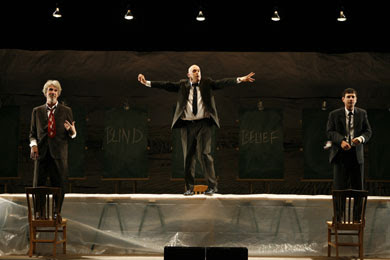 Photo/Carol Rosegg
Reviewed by Aaron Riccio
Playwrights who come right out and proclaim their play to be allegory are setting the bar rather high. Rinde Eckert's Horizon often hits the mark with panoramic observations on religion (based loosely on the philosophy of Reinhold Niebuhr). At the same time, the vista of parables is so large that the endless devices are as confusing to the ear as they are pleasing to the eye. David Schweizer's direction comes as a sort of deliverance from the decadent cadences of Eckert's performance and interwoven texts; the end result is well-spoken but emotionally tame.
On the surface, we have Reinhart Poole (Eckert), an ethics professor teaching his final class at seminary: he has just been fired for his provocative lessons, the likes of which encourage doubt: "Doubt is how we maintain our faith," he intones, his voice a melodic brimstone, his face flickering with the sinister joviality of Forest Whitaker. "Belief without doubt undermines faith." Beneath that is the metadramatic novelty of two Irish masons, Jim and Harrison (Samuel and Beckett sound better), who serve as eternal builders (allegories) in the play Poole is writing. Deeper still, theatrical demonstrations of Poole's lectures on topics ranging from Plato's ever-popular cave (the set itself is within an aluminum-like cave) to a windowless house and the truth-telling devil. These miniature playlets, largely performed by the grandiose Howard Swain and the perfectly restrained David Barlow, end up being the meat of the play, both for Schweizer's image-heavy work and Eckert's point-hammering prose.
The danger that Poole describes when first defining allegory is unfortunately realized: the allegory becomes the story, and Poole's struggles with his runaway brother, spectral parents, and distant wife (Swain and Barlow, whispering into downstage microphones) are subsumed by the animated combinations of gospel and comic a capella or the vaudeville choreography of a old-fashioned showtune. At one point, Poole writes himself into the allegory, only to die and resurrect like a phoenix from a shroud. Luckily, Schweizer's modish, modern direction is well-poised for metaphor: cinder blocks, wood, and plastic are all transmuted by clever lighting.
According to the devil of one parable, "The nature of truth is to be despised but indispensable." With entertaining performances and beautiful scenework, Horizon is far from being despised. But it's also far from a "dangerous pulpit"; the story is so controlled (right down to the Gothic techno music) that we may admire more than think. Comfort is derived not from the absence of horses from a picture (given faith that they are just beyond the frame), but in the painting of a beautifully empty field itself. The view's terrific, but it's lonely way out here in allegory.
------------------------------------------------------
New York Theatre Workshop (79 E 4th St.)
Tickets (212-947-8844): $50.00 (through July 1: $35 w/code HZ4TTRE)
Performances: Sun. & Tues. @ 7 | Wed. - Sat. @ 8 | Sat. @ 3 | Sun. @ 2
 Photo/Carol Rosegg
Playwrights who come right out and proclaim their play to be allegory are setting the bar rather high. Rinde Eckert's Horizon often hits the mark with panoramic observations on religion (based loosely on the philosophy of Reinhold Niebuhr). At the same time, the vista of parables is so large that the endless devices are as confusing to the ear as they are pleasing to the eye. David Schweizer's direction comes as a sort of deliverance from the decadent cadences of Eckert's performance and interwoven texts; the end result is well-spoken but emotionally tame.
On the surface, we have Reinhart Poole (Eckert), an ethics professor teaching his final class at seminary: he has just been fired for his provocative lessons, the likes of which encourage doubt: "Doubt is how we maintain our faith," he intones, his voice a melodic brimstone, his face flickering with the sinister joviality of Forest Whitaker. "Belief without doubt undermines faith." Beneath that is the metadramatic novelty of two Irish masons, Jim and Harrison (Samuel and Beckett sound better), who serve as eternal builders (allegories) in the play Poole is writing. Deeper still, theatrical demonstrations of Poole's lectures on topics ranging from Plato's ever-popular cave (the set itself is within an aluminum-like cave) to a windowless house and the truth-telling devil. These miniature playlets, largely performed by the grandiose Howard Swain and the perfectly restrained David Barlow, end up being the meat of the play, both for Schweizer's image-heavy work and Eckert's point-hammering prose.
The danger that Poole describes when first defining allegory is unfortunately realized: the allegory becomes the story, and Poole's struggles with his runaway brother, spectral parents, and distant wife (Swain and Barlow, whispering into downstage microphones) are subsumed by the animated combinations of gospel and comic a capella or the vaudeville choreography of a old-fashioned showtune. At one point, Poole writes himself into the allegory, only to die and resurrect like a phoenix from a shroud. Luckily, Schweizer's modish, modern direction is well-poised for metaphor: cinder blocks, wood, and plastic are all transmuted by clever lighting.
According to the devil of one parable, "The nature of truth is to be despised but indispensable." With entertaining performances and beautiful scenework, Horizon is far from being despised. But it's also far from a "dangerous pulpit"; the story is so controlled (right down to the Gothic techno music) that we may admire more than think. Comfort is derived not from the absence of horses from a picture (given faith that they are just beyond the frame), but in the painting of a beautifully empty field itself. The view's terrific, but it's lonely way out here in allegory.
------------------------------------------------------
New York Theatre Workshop (79 E 4th St.)
Tickets (212-947-8844): $50.00 (through July 1: $35 w/code HZ4TTRE)
Performances: Sun. & Tues. @ 7 | Wed. - Sat. @ 8 | Sat. @ 3 | Sun. @ 2
If Truth Be Known
Romance between a Caucasian Vietnam Veteran and a Japanese-American industrial psychologist struggles to flourish in the premiere of Judi L. Komaki's If Truth Be Known. Although the multiple themes of class, gender, and ethnic assimilation are potent, the restrained performances and substandard production at the ArcLight Theatre deflates them and renders the material ineffective.
Through June 24th. $20. Tickets: 212-868-4444. ArcLight Theatre 152 West 71st Street,New York, NY 10023

Photo by Jim Baldassare
.........................................................
Reviewed by Cindy Pierre
Scenic Designer Czerton Lim transforms the ArcLight Theatre's stage into Max's (Lydia Gaston) studious home in Judi L. Komaki's If Truth Be Known. The congested stage, displaying three settings simultaneously with nary a much needed partition, is much more distracting to the eye than the actors are engrossing. The entrance of Max and Philip (James Patrick Earley), timid in enunciation and presence, creates within the modest space the illusion of a cavern. David M. Lawson's intro music, overlapping with the opening lines, further stifles their impact.
If Truth Be Known demands a great deal from its audience. In order to be engrossed, one must suspend disbelief of relationships and intimacy. Earley and Gaston feign both as they struggle to command empathy, or at the very least, attention. There is simply no chemistry between this couple, and when Max says that Philip makes her "melt", there is a hint of a grimace.The patron is also asked to conjure settings that are superimposed unto the three rigid ones (bedroom, dining room and living room) that are already there. Blink once, and you're in a moving car. Blink twice, and you're on the shore, basking in the spray of sailboats. Unfortunately, rather than catapult myself into these ethereal settings as they were created, I was instead preoccupied with ways in which to make the transitions more fluid and credible. I came up with a scenario for each one. A simple reorganization or omitting of some of the props and purposeful direction by Christine Simpson would improve the show's plausibility.
The bedroom scenes, executed in the background, are tepid not only because the props obstruct the view, but because the performers are withdrawing further from volume.Constance Boardman, as Max's aunt Jane, is the only performer who comes close to being a spitfire. She is zany and fun, but unfortunately functions as the conduit for the "Asian Princess" awareness one too many times. As the voice of caution and a clinical psychology hopeful, her work with Vietnam Veterans bludgeons the audience with social consciousness and the challenges of Asian American acceptance.
A topic broached by If Truth Be Known that could have been more elaborate is the Japanese concentration camps during the time of World War II. A subject seldom explored on the stage, Max's mother Mrs. Ota (an overactive Bea Soong) provides an enticing glance, but I wanted to be fed with more history. She is also the portal to Max's heritage, and holds steadfast to her roots even in the midst of American assimilation. Had Komaki focused on this theme rather than juggle the various dense subjects that could not be properly handled in less than two hours, her play would have fared better.
A valiant though unsuccessful effort, If Truth Be Known aims to question your threshold for the truth. Do we, in fact, want all of the facts, even if it discomforts us? Or, like the play, do we prefer to just gloss over the details? If you prefer the former, then this piece will leave much to be desired.
Through June 24th. $20. Tickets: 212-868-4444. ArcLight Theatre 152 West 71st Street,New York, NY 10023
If Truth Be Known
If truth be told, If Truth Be Known leaves the audience perpetually wanting more, from the hasty start to the abrupt conclusion. There is, however, historical information and perspective to be gained from the many issues discussed - including race, class, and gender.
 (Left to right): Lydia Gaston and Constance Boardman
PHOTOS BY: JIM BALDASSARE
 (Left to right): Lydia Gaston and Constance Boardman
PHOTOS BY: JIM BALDASSARE
---------------------------------------------------------------------------------------------------------------- If Truth be Known concerns the struggles and tensions inherent in the relationship between Max, an Asian-American woman, and Philip, "the man of her dreams" (who also happens to be a Vietnam vet). This and many other details are outlined by a clunky exposition that is as preoccupied with giving us the historically accurate news report as the fictional story. Not having lived through this period myself, I find the aftermath of Vietnam quite interesting. It's a good thing that Judi Komaki wrote in so much history, because the romantic relationship that would otherwise be the crux of the play lacks chemistry: they don't even appear to be close friends.
Christine Simpson's direction doesn't exactly spice up the drama of this relationship. The intimate moments, particularly the ones in bed, are far from loving or romantic: they are laughable. Not only are they poorly staged, but they are poorly conceived. Actions don't flow naturally, and the actors take a methodical, almost robotic approach to their movements. Embrace for three seconds, kiss for five seconds, take off shirt, etc. The palpable awkwardness is unwarranted in a relationship that is supposedly ongoing for more than a year.
The other relationships (mother/daughter and aunt/niece) are similarly awkward. The situations of the story are not backed up by the interactions between the characters. For example, the aunt and niece are described as being like "sisters," but their interactions are like blind dates and have little familiarity. As a result, the emotions are superficial and the dialogue only advances the plot, not the characters. If this play were more Brechtian, the lack of motivation might be more effective, but here, they are just talking heads, tackling debates without a real point of view. Alternatively, if the focus was on one or two topics, instead of the four or five briefly brought up here, the point of view of the playwright would have been more clearly conveyed.
Despite these shortcomings and an ending that is both hasty and confusing, there are some notable successes. The performances from the cast of four are all quite competent. The female lead, played by Lydia Gaston, was especially captivating, although she benefits from playing the part most closely modeled after the playwright (and therefore the most three dimensional). The pacing also works: there's no intermission, so it zooms by without causing much weariness or impatience. (Not that there aren't moments that could use a dramatic pause or two.)
All in all, the play is well-researched but suffers from a great deal of incongruity and is at times plainly unnatural. If Truth Be Known succeeds in making you think, but there isn't enough focus to delve deep enough to sustain your thoughts after the house lights come up.
----------------------------------------------------------------------------------------------------------------
If Truth Be Known
The ArcLight
152 West 71st
(between Broadway an Columbus)
now through June 24
Wednesdays - Saturdays at 8PM
Sunday at 3PM
Tickets $20
Students and Seniors $15
212-868-4444 or smarttix.com
Monday, June 04, 2007
You Can't Take It With You
The T. Schreiber Studio's charming production of You Can't Take it With You brings us directly into the living room of a family who loves each other but can't seem to stop themselves from accidentally mortifying each other, getting one another arrested or nearly burning their house down. In other words, the kind of family one would hesitate to bring a significant other home to meet, rather than the other way around.

Reviewed by Ilena George
Before Meet the Parents’ Fockers and My Big Fat Greek Wedding’s Portokalos family, there were the Sycamores in Moss Hart and George S. Kaufman's You Can't Take it With You. The Sycamores are a deliriously eccentric family whose young daughter, Alice (Jacqueline van Biene), tries to keep a close rein on her family’s brand of free-ranging quirkiness when she brings her fiancé, Wall Street heir Anthony Kirby Junior (Jushua Sienkiewicz), and his parents home to meet her family for the first time. Only the stuffy Kirbys could resist the charms of the dozen people living under the Sycamores’ roof and the T. Schreiber Studio’s production of the classic play makes the Sycamore family innocent and endearing rather than frivolous and vapid.
From candy making to fireworks manufacturing, the Sycamores collect hobbies, most of which they do not excel in (to put it mildly). Mrs. Sycamore (Margot Bercy) starts but never finishes melodramatic plays while her husband Paul (Jerry Rago) builds fireworks in the basement and their adult daughter, Essie Carmichael (Jamie Neuman), has spent eight years trying to learn to pirouette from an overly enthusiastic Russian ex-pat who enjoys wrestling strangers to the ground. When not adding to their hobby collection, the family accumulates unplanned long-term residents, such as the milkman and the ice deliveryman, who show up one day and stay for years. The man behind the curtain of all this benign madness is the Sycamores’ patriarch and resident philosopher Martin Vanderhof (Peter Judd), whose personal philosophy is that everyone should pursue what makes them happy and not spend their life toiling away at work they despise.
Grandpa’s follow-your-heart message is not a subtle one, but what the character and the play as a whole lack in subtlety this production makes up for in kindheartedness. Judd’s performance lends sincerity and gravity to Grandpa, just as van Biene’s Alice is alive with the enthusiasm and innocence that lets her get away with overly naïve lines like, “Is there much rice in China?” Nearly all the adults display this childlike innocence, and the best moments come from their sweet quirks. Mrs. Sycamore, suffering from writers’ block, says, “I've sort of got myself in a monastery and I can't get out,” to which Essie replies, “It'll come to you, Mother, remember how you got out of that brothel.” There are moments when all the zaniness spills over into slapstick territory, particularly once the Kirbys show up, but they are mercifully few.
T. Schreiber Studio’s intimate theater makes the audience part of the family, bringing us right into the Sycamores’ tastefully, if erratically, furnished living room, designed by Ryan Scott. At times this up-close view may be a little too intimate: it is easy to see where the production cut some corners. But it also affords us a look of where they didn't scrimp: the simple but elegant costumes designed by Summer Lee Jack effectively capture both the time and the characters.
Elaborate and enthusiastically performed choreography set to period music covers the transition between some scenes; although the play’s characters are still fresh, more directorial additions such as this could have helped compensate for the many outdated jokes and references that do not have the same longevity. But while references to Childs or Schraft’s restaurants no longer resonate the way they once did, Grandpa would agree that a few hours in great company is something you can take with you.
........................................................................................
You Can't Take It With You by Moss Hart and George S. Kaufman
Directed by Peter Jensen
May 24th through June 24th, Thurs-Sat at 8 pm, Sun at 3 pm
T. Schreiber Studio, 151 W. 26th Street, 7th Floor

Reviewed by Ilena George
Before Meet the Parents’ Fockers and My Big Fat Greek Wedding’s Portokalos family, there were the Sycamores in Moss Hart and George S. Kaufman's You Can't Take it With You. The Sycamores are a deliriously eccentric family whose young daughter, Alice (Jacqueline van Biene), tries to keep a close rein on her family’s brand of free-ranging quirkiness when she brings her fiancé, Wall Street heir Anthony Kirby Junior (Jushua Sienkiewicz), and his parents home to meet her family for the first time. Only the stuffy Kirbys could resist the charms of the dozen people living under the Sycamores’ roof and the T. Schreiber Studio’s production of the classic play makes the Sycamore family innocent and endearing rather than frivolous and vapid.
From candy making to fireworks manufacturing, the Sycamores collect hobbies, most of which they do not excel in (to put it mildly). Mrs. Sycamore (Margot Bercy) starts but never finishes melodramatic plays while her husband Paul (Jerry Rago) builds fireworks in the basement and their adult daughter, Essie Carmichael (Jamie Neuman), has spent eight years trying to learn to pirouette from an overly enthusiastic Russian ex-pat who enjoys wrestling strangers to the ground. When not adding to their hobby collection, the family accumulates unplanned long-term residents, such as the milkman and the ice deliveryman, who show up one day and stay for years. The man behind the curtain of all this benign madness is the Sycamores’ patriarch and resident philosopher Martin Vanderhof (Peter Judd), whose personal philosophy is that everyone should pursue what makes them happy and not spend their life toiling away at work they despise.
Grandpa’s follow-your-heart message is not a subtle one, but what the character and the play as a whole lack in subtlety this production makes up for in kindheartedness. Judd’s performance lends sincerity and gravity to Grandpa, just as van Biene’s Alice is alive with the enthusiasm and innocence that lets her get away with overly naïve lines like, “Is there much rice in China?” Nearly all the adults display this childlike innocence, and the best moments come from their sweet quirks. Mrs. Sycamore, suffering from writers’ block, says, “I've sort of got myself in a monastery and I can't get out,” to which Essie replies, “It'll come to you, Mother, remember how you got out of that brothel.” There are moments when all the zaniness spills over into slapstick territory, particularly once the Kirbys show up, but they are mercifully few.
T. Schreiber Studio’s intimate theater makes the audience part of the family, bringing us right into the Sycamores’ tastefully, if erratically, furnished living room, designed by Ryan Scott. At times this up-close view may be a little too intimate: it is easy to see where the production cut some corners. But it also affords us a look of where they didn't scrimp: the simple but elegant costumes designed by Summer Lee Jack effectively capture both the time and the characters.
Elaborate and enthusiastically performed choreography set to period music covers the transition between some scenes; although the play’s characters are still fresh, more directorial additions such as this could have helped compensate for the many outdated jokes and references that do not have the same longevity. But while references to Childs or Schraft’s restaurants no longer resonate the way they once did, Grandpa would agree that a few hours in great company is something you can take with you.
........................................................................................
You Can't Take It With You by Moss Hart and George S. Kaufman
Directed by Peter Jensen
May 24th through June 24th, Thurs-Sat at 8 pm, Sun at 3 pm
T. Schreiber Studio, 151 W. 26th Street, 7th Floor
Don Juan in Chicago
The Clockwork Theater's production of Don Juan in Chicago manages to keep pace with David Ives' frenzied comic pace, and while it certainly gets our tongues wagging, the cast never stumbles over the twisting verse or the wordplay-heavy script.
 Photo/Monica Freisem
Reviewed by Aaron Riccio
David Ives meant Don Juan in Chicago as one of his patented verbal comedies, but by reversing the expected, he has created an even better love-struck origin story than the historic fables of the womanizing Don Juan. Simply making a bet just doesn't raise the stakes enough: no, here our Don Juan makes a deal with the devil: not for sex (he's too busy with reading to lose his virginity) but to live forever. It's the small print that turns our naive nerd into a seducer: if he doesn't "romance" a different woman every night, he'll forfeit his soul (and that of his servant, Leporello, who is unwillingly along for the ride). Worse than sex turning into a chore (think Wilt Chamberlain, multiplied by eight) is Mephistopheles's extra twist: the first woman he sleeps with, Doña Elvira, is the woman of his dreams, whom he is doomed never to sleep with again, lest he lose his immortality. And if that weren't bad enough, she becomes immortal too, a constant reminder of his inconstancy. Oh, and even worse (for them, not us): every time the devil comes around or the seduction gets heavy, they start speaking in verse.
Cut to 146,000 women later, Chicago, where Don Juan now goes by Don Johnson, and Leporello goes by Lefty, and the swank castle has eroded to a dank bachelor pad in the slums. His latest "conquest," Sandy, was one of his victims 23 years ago; Doña Elvira, disguised as a southerner, is still trying to sleep with "The Don," and his only recourse may be to steal the sweet, naive Zoey away from his neighbor, Mike. To quote the show, "It's either cum, or kingdom come."
Owen M. Smith's direction nails the enunciation on both, with a nice paralleling scene change between Spain and Illinois, and his cast manages to balance the sex with doom without going overboard with either. The actors are also great with Ives's wit, rhyming iniquitous with ubiquitous or cupidity with stupidity without batting an eyelash. Of particular note is Doug Nyman, who wins our hearts with his plaintive asides and grabs our attention with his energetic explicatives.
In the first act, the action runs a little slow, though it's spiced up by our asthmatic Queen of a devil, played to a delightful T by Stephen Balantzian. However, once the jokes have all been established and the stage set, Ives runs into a full-blown farce, with windows, doors, and beds all popping open, and character twists flying in and out through any and all openings. The energy builds into a nice comic crescendo, and the wordplay, steady throughout, keeps us engaged in the somewhat predictable story. From alliteration ("the pinnacle of pulchritude") to syllogism ("I have no reason to live, but that's no reason not to live"), Don Juan in Chicago is just a well-mannered delight.
-----------------------------------------------------------------------
The Kirk Theater @ Theater Row (410 West 42nd Street)
Tickets (212-279-4200): $25.00
Performances (through 6/9): Tues.-Sat. @ 8 | Sat. @ 2 | Sun. @ 3
 Photo/Monica Freisem
David Ives meant Don Juan in Chicago as one of his patented verbal comedies, but by reversing the expected, he has created an even better love-struck origin story than the historic fables of the womanizing Don Juan. Simply making a bet just doesn't raise the stakes enough: no, here our Don Juan makes a deal with the devil: not for sex (he's too busy with reading to lose his virginity) but to live forever. It's the small print that turns our naive nerd into a seducer: if he doesn't "romance" a different woman every night, he'll forfeit his soul (and that of his servant, Leporello, who is unwillingly along for the ride). Worse than sex turning into a chore (think Wilt Chamberlain, multiplied by eight) is Mephistopheles's extra twist: the first woman he sleeps with, Doña Elvira, is the woman of his dreams, whom he is doomed never to sleep with again, lest he lose his immortality. And if that weren't bad enough, she becomes immortal too, a constant reminder of his inconstancy. Oh, and even worse (for them, not us): every time the devil comes around or the seduction gets heavy, they start speaking in verse.
Cut to 146,000 women later, Chicago, where Don Juan now goes by Don Johnson, and Leporello goes by Lefty, and the swank castle has eroded to a dank bachelor pad in the slums. His latest "conquest," Sandy, was one of his victims 23 years ago; Doña Elvira, disguised as a southerner, is still trying to sleep with "The Don," and his only recourse may be to steal the sweet, naive Zoey away from his neighbor, Mike. To quote the show, "It's either cum, or kingdom come."
Owen M. Smith's direction nails the enunciation on both, with a nice paralleling scene change between Spain and Illinois, and his cast manages to balance the sex with doom without going overboard with either. The actors are also great with Ives's wit, rhyming iniquitous with ubiquitous or cupidity with stupidity without batting an eyelash. Of particular note is Doug Nyman, who wins our hearts with his plaintive asides and grabs our attention with his energetic explicatives.
In the first act, the action runs a little slow, though it's spiced up by our asthmatic Queen of a devil, played to a delightful T by Stephen Balantzian. However, once the jokes have all been established and the stage set, Ives runs into a full-blown farce, with windows, doors, and beds all popping open, and character twists flying in and out through any and all openings. The energy builds into a nice comic crescendo, and the wordplay, steady throughout, keeps us engaged in the somewhat predictable story. From alliteration ("the pinnacle of pulchritude") to syllogism ("I have no reason to live, but that's no reason not to live"), Don Juan in Chicago is just a well-mannered delight.
-----------------------------------------------------------------------
The Kirk Theater @ Theater Row (410 West 42nd Street)
Tickets (212-279-4200): $25.00
Performances (through 6/9): Tues.-Sat. @ 8 | Sat. @ 2 | Sun. @ 3
Saturday, June 02, 2007
Penetrator
Penetrator is an unsettling drama about the shattered psyches that follow in the wake of most modern wars. The light opening of the play is enjoyable and sweet, but the pitch-dark ending is what will have you talking as you leave the theater: it's a terrifyingly decent work.
 Photo/Julie Rossman
Reviewed by Aaron Riccio
One of the only good things about the Iraq War is that it is similar enough to the Gulf War (Bush War One) to give many playwrights the opportunity to update their material and give it a second go. Case in point with Anthony Nielson's Penetrator, in which a disturbed, AWOL soldier seeks solace in his memories of a happier past, only to find that his best friend, Max, has moved on from their patented duo of "you're the brains and I'm the brawn." The Max (Michael Mason) who opens the show is a self-obsessed asshole, playing Halo 2 with his eyes glued to a TV resting atop a black egg-crate, the sound blaring, the lights from the game exploding in static waves against his glazed skin. As he drinks beer, he switches from the game to a porno, only to get interrupted, mid-jerk, by his roommate, Alan (Jared Culverhouse).
Nielson's play does a terrific job of building the camaraderie between these two; they all but complete each other's lines. Alan is the shyer of the two, overweight and mustached, but together, the two quote old TV shows and re-enact the music video of Yoshimi Battles the Pink Robots. This, however, isn't the play that Nielson wants to give us, which is why there is the constant foreshadowing of a man hitchhiking in the rain as an ominously low voice-over rants sexual abuses, and why the program warns us of mature and violent content. The Flaming Lips are many things, but graphic isn't one of them. As a result of Jeremy Torres' direction (and of the small space), the enjoyable opening becomes layered with tension, a mood that only grows terser when this man, Woody (Cole Wimpee), actually arrives.
At first, Woody's presence is that of a thousand other plays: he is all at once crazy, retarded, and depressed, speaking in a sullen, choppy tone that somehow manages to combine all of those traits. After contradicting his own story about being discharged from the army (or being given money, being molested, escaping), he pulls out a nasty, foot-long knife, and accuses Alan of being a "Penetrator," i.e., one of the men in the Black Room who experimented on him. One of the advantages to the theater's set-up (the audience sits almost in the round) is that our reactions to the dangerous blocking become part of the show, and it would be an understatement to say that the show is not only a pitch-dark drama but terrifying, as well.
The show doesn't really answer any of the questions it presents, and it doesn't do much toward resolving the friendship between Max and Woody: there is the feeling that it is content with just scaring the audience with a lot of graphic monologues and in-your-face action. However, it is gripping, and if Jeremy Torres were to tighten up some of the long and artificially inserted pauses of the first half, it would be a far more effective scare tactic about the military. Woody keeps saying that "It was better before," and at times, I'm inclined to believe him -- the play has two distinct halves -- but the experience (far better than anything a movie can throw at you) is worth it for those who have forgotten what it's like to be unsettled by a play.
-------------------------------------------------------------
American Place Theatre (520 8th Avenue; Fl. 22)
Tickets (212-868-4444): $15.00
Performances (through 6/23): Thursday-Saturday @ 8
 Photo/Julie Rossman
One of the only good things about the Iraq War is that it is similar enough to the Gulf War (Bush War One) to give many playwrights the opportunity to update their material and give it a second go. Case in point with Anthony Nielson's Penetrator, in which a disturbed, AWOL soldier seeks solace in his memories of a happier past, only to find that his best friend, Max, has moved on from their patented duo of "you're the brains and I'm the brawn." The Max (Michael Mason) who opens the show is a self-obsessed asshole, playing Halo 2 with his eyes glued to a TV resting atop a black egg-crate, the sound blaring, the lights from the game exploding in static waves against his glazed skin. As he drinks beer, he switches from the game to a porno, only to get interrupted, mid-jerk, by his roommate, Alan (Jared Culverhouse).
Nielson's play does a terrific job of building the camaraderie between these two; they all but complete each other's lines. Alan is the shyer of the two, overweight and mustached, but together, the two quote old TV shows and re-enact the music video of Yoshimi Battles the Pink Robots. This, however, isn't the play that Nielson wants to give us, which is why there is the constant foreshadowing of a man hitchhiking in the rain as an ominously low voice-over rants sexual abuses, and why the program warns us of mature and violent content. The Flaming Lips are many things, but graphic isn't one of them. As a result of Jeremy Torres' direction (and of the small space), the enjoyable opening becomes layered with tension, a mood that only grows terser when this man, Woody (Cole Wimpee), actually arrives.
At first, Woody's presence is that of a thousand other plays: he is all at once crazy, retarded, and depressed, speaking in a sullen, choppy tone that somehow manages to combine all of those traits. After contradicting his own story about being discharged from the army (or being given money, being molested, escaping), he pulls out a nasty, foot-long knife, and accuses Alan of being a "Penetrator," i.e., one of the men in the Black Room who experimented on him. One of the advantages to the theater's set-up (the audience sits almost in the round) is that our reactions to the dangerous blocking become part of the show, and it would be an understatement to say that the show is not only a pitch-dark drama but terrifying, as well.
The show doesn't really answer any of the questions it presents, and it doesn't do much toward resolving the friendship between Max and Woody: there is the feeling that it is content with just scaring the audience with a lot of graphic monologues and in-your-face action. However, it is gripping, and if Jeremy Torres were to tighten up some of the long and artificially inserted pauses of the first half, it would be a far more effective scare tactic about the military. Woody keeps saying that "It was better before," and at times, I'm inclined to believe him -- the play has two distinct halves -- but the experience (far better than anything a movie can throw at you) is worth it for those who have forgotten what it's like to be unsettled by a play.
-------------------------------------------------------------
American Place Theatre (520 8th Avenue; Fl. 22)
Tickets (212-868-4444): $15.00
Performances (through 6/23): Thursday-Saturday @ 8
Friday, June 01, 2007
Don Juan in Chicago
Reviewed by: Matthew Barbot
In this new twist on the Don Juan legend, the titular Don (Mike Cinquino) is, much like Dr. Faustus, a cloistered alchemist seeking to make a pact with the devil, willing to trade his soul for immortality so that he has the time on Earth to discover the meaning of life. As is so often the case with Faustian deals, however, the snarky demon, Mephistopheles (Stephen Balantzian), has one condition before he grants the request: the heretofore virginal Don must seduce and sleep with a different woman every night for all eternity. Fast forward to the present day, where Don Juan and his similarly bound servant, Leperello (Doug Nyman), reside in a small Chicago apartment, seducing women and avoiding the also-immortal love of the Don’s life, Doña Elvira (Shayna Padovano), for if Don Juan ever sleeps with her again, his contract for immortality is nullified. All the while the two men reflect on and analyze four hundred years of life, sex, love, and the search for meaning, realizing in the end that those four things may all be intimately tied up in one another.
Slap Hugh Grant in the lead role, and it’s a cute idea for a picture.
And yet what makes this play more “Off-Broadway” and less “Hollywood” is the fact that the writer, David Ives, clearly has a deep affection for a much older kind of romantic comedy, and it comes across brilliantly in this play. If the lead characters are from 1599, Ives seems to say, then the play should be written like it’s from 1599 as well. Story-wise, it all plays out like a Shakespearian comedy: a troubled young man is pursued by the woman he’s destined to be with, who does everything in her power to follow him and be with him, even using disguises. The young man’s deadpan servant is also along for the ride, as is a puckish, supernatural being. There are a number of reversals, but everyone ends up with someone they love in the end, happily ever after. Perhaps even more impressive, however, is Ives’ decision to have, like in an Elizabethan play, lovers and supernatural creatures speak in verse, and every character takes joy in wordplay, resulting in the writer, the actors, and the audience seeming to have a sort of fun that comes purely from clever use of language, which is not something seen terribly often anymore. The words, though, are modern, and Ives delights in anachronistic swearing and self-conscious rhyming. (Doña Elvira responds to Don Juan's admission that he's been "carried away" with the simple word, "Continu-ay.")
The entire cast is strong. Cinquino’s nice-guy looks and attitude make it easy for the audience to sympathize with him and believe that he’s wearied of his charge and his reputation. Padovano is beautiful and very funny, seeming more at home, however, with the play’s comedy than it’s more emotional moments. Balantzian’s unorthodox portrayal of the devil – cheerful, bespectacled and heavyset with thick beard stubble – makes his performance even more believable and sincere, as he’s avoided stereotypes and made the role entirely his own; he's an audience favorite from the moment he enters. The supporting cast are great in their roles, with even the smallest parts getting their time to shine. The show is stolen, however, by Nyman’s Leperello. As was often the case with the Elizabethan comedies this play is based on, the servant character is the one the audience is meant to identify with, a window into the play’s action, and neither of the other immortals on stage fully portray the full range of experience that 400+ years of life would put a person through. Though Leperello is mostly a comic character – and Nyman is hilarious on stage - Nyman is also just as able to portray his loss, his frustration, and his despair.
My one complaint is a nitpicky one: the scene change in the first act, converting a sixteenth century castle into a twenty-first century bachelor pad, takes, at a conservative estimate, five minutes. Five whole minutes, without a curtain, of the stage crew running about in slightly dimmed light, accompanied by unlicensed covers of eighties songs. While the set is great to look at, if an audience has to sit there for that long while a scene change occurs, the set’s not designed as well as it could be.
One of the reasons that long pause was so unbearable, however, was simply because I was so eager to see more of this sweet, witty, well-written show. Don Juan in Chicago is a thoroughly entertaining play, big on laughs and big on heart.
Don Juan in Chicago by David Ives
Directed by Owen M. Smith
Kirk Theater at Theater Row, 410 West 42nd Street
May 26th-June 9th
Tuesday-Friday at 8pm, Saturdays at 2:00 and 8:00, Sundays at 3:00
Tickets: 212-279-4200
Subscribe to:
Posts (Atom)

